



What Do Short Horned Grasshoppers Eat and Where Do They Live?
The Short Horned Grasshopper is a fascinating insect found in fields, farms, and grasslands around the world. Known for its powerful jumping legs and short antennae, it plays an important role in nature. These insects are famous for their ability to leap long distances and sometimes travel in huge groups. Learning about Short Horned Grasshopper facts, habitat, diet, and life cycle helps us understand how insects support ecosystems.
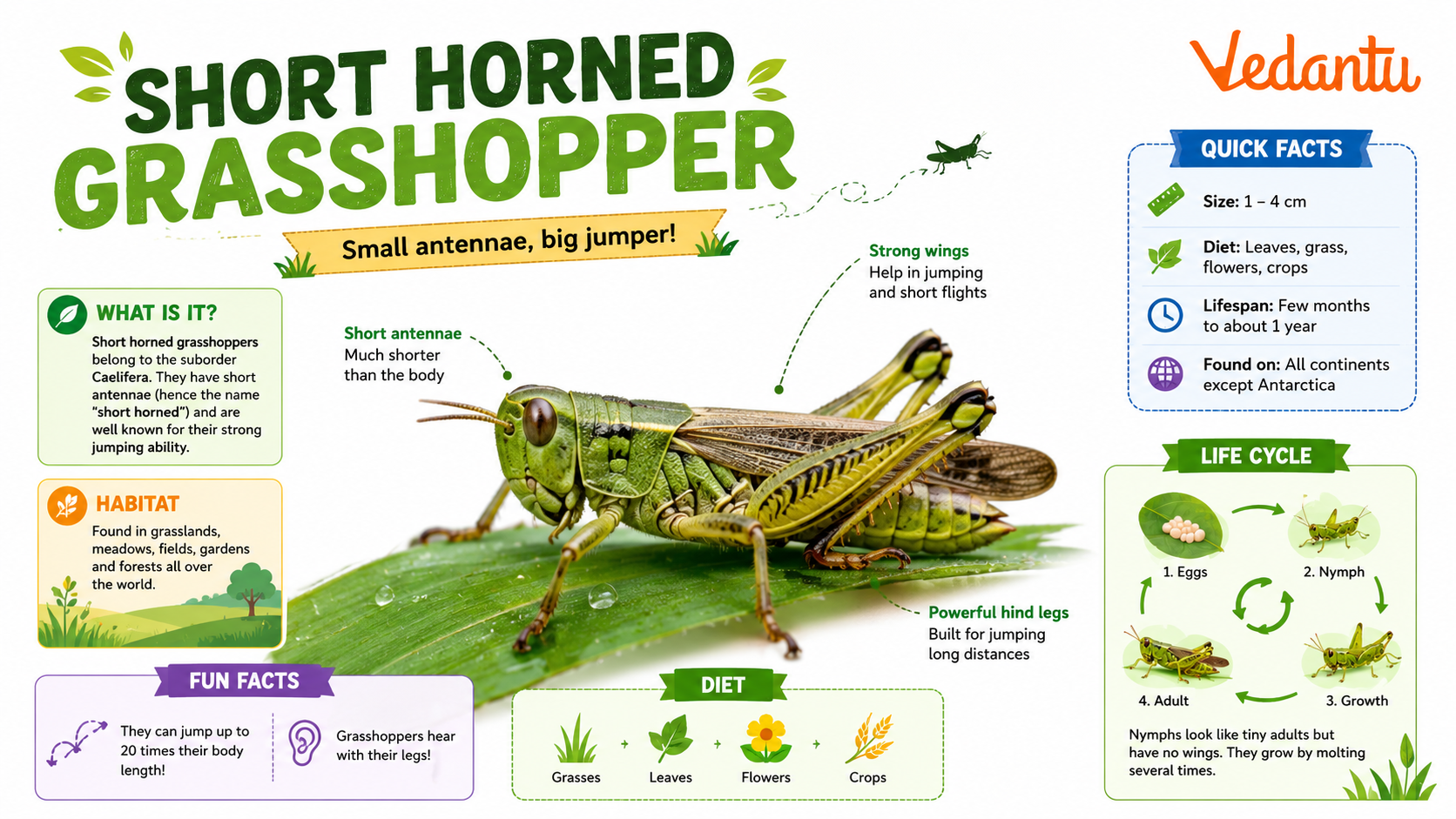
Quick Facts and Statistics
| Feature | Details |
|---|---|
| Common Name | Short Horned Grasshopper |
| Scientific Family | Acrididae |
| Animal Group | Insect |
| Size | 2 to 5 cm long (varies by species) |
| Habitat | Grasslands, farms, meadows, open fields |
| Diet | Leaves, grasses, crops |
| Movement | Jumping and flying |
| Life Cycle | Incomplete metamorphosis (egg → nymph → adult) |
Appearance and Physical Characteristics
- Body Shape: Long, narrow body divided into head, thorax, and abdomen.
- Antennae: Short and thick (this is why they are called “short horned”).
- Legs: Strong hind legs for powerful jumping.
- Wings: Two pairs of wings; front wings are narrow, back wings are broad.
- Colour: Green, brown, or grey to blend with grass and soil.
Habitat and Distribution
- Grasslands and meadows
- Crop fields and farms
- Open forests and dry areas
- Warm and sunny regions
These insects prefer warm climates and open spaces where grasses and plants grow in large amounts. Some species can survive in dry deserts, while others live in moist fields.
Diet and Feeding Habits
- They are herbivores.
- They eat grasses, leaves, and agricultural crops.
- Use strong chewing mouthparts to cut plant material.
- Can cause crop damage when present in large numbers.
Behaviour and Lifestyle
- Mostly active during the daytime.
- Excellent jumpers and short-distance fliers.
- Some species live alone, while others form huge swarms.
- Use camouflage to hide from predators like birds and frogs.
Life Cycle of Short Horned Grasshopper
- Egg: Laid in soil in groups called egg pods.
- Nymph: Looks like a small adult but has no wings.
- Adult: Develops wings and can reproduce.
Nymphs grow by shedding their outer skin several times before becoming adults.
What Makes Short Horned Grasshopper Special?
Special muscles allow them to leap long distances instantly.
Body colour helps them blend with grass and soil.
Some species (like locusts) travel in massive groups.
Perfect for eating tough plant material.
Sound or Call
Short Horned Grasshoppers produce sound by rubbing their hind legs against their wings. This sound is called stridulation.
- Used to attract mates.
- Helps in communication.
- Often heard in fields during warm afternoons.
Importance and Role in Nature
Eaten by birds, reptiles, frogs, and small mammals.
Help control plant growth in ecosystems.
Their droppings add nutrients to the soil.
Large swarms can damage crops.
Amazing Facts About Short Horned Grasshopper
- They belong to the same order as crickets and katydids.
- There are over 6,000 species in the Acrididae family.
- Some species can change behaviour and form locust swarms.
- Their hind legs act like springs.
- They taste food using receptors on their mouthparts.
- They can fly short distances to escape danger.
Fun Facts for Kids
FAQs on Short Horned Grasshopper: Identification, Habitat, and Life Cycle
1. What is a Short Horned Grasshopper?
A Short Horned Grasshopper is a jumping insect with short antennae that belongs to the family Acrididae.
- It is commonly called a grasshopper or locust (when in swarms).
- It has short antennae compared to long-horned grasshoppers.
- It is known for its powerful hind legs used for jumping.
- It is found in grasslands, farms, and meadows worldwide.
2. Why are they called Short Horned Grasshoppers?
They are called Short Horned Grasshoppers because they have short, thick antennae.
- Their antennae are shorter than their body length.
- This feature separates them from Long Horned Grasshoppers and katydids.
- The scientific group is suborder Caelifera.
3. What do Short Horned Grasshoppers eat?
Short Horned Grasshoppers are herbivores that mainly eat plants.
- They feed on grass, leaves, and crops.
- Some species can damage farms and agricultural fields.
- Locust swarms can eat large amounts of vegetation quickly.
4. Where do Short Horned Grasshoppers live?
Short Horned Grasshoppers live in warm and open habitats around the world.
- They prefer grasslands, meadows, and prairies.
- They are common in farmlands and crop fields.
- They are found on every continent except Antarctica.
5. How do Short Horned Grasshoppers move?
Short Horned Grasshoppers move by jumping and flying short distances.
- They use strong hind legs to leap far.
- They have wings for short flights.
- Jumping helps them escape from predators like birds and frogs.
6. What is the life cycle of a Short Horned Grasshopper?
The life cycle of a Short Horned Grasshopper has three main stages.
- Egg – laid in soil in pods.
- Nymph – looks like a small adult but without wings.
- Adult – fully grown with wings and reproductive ability.
7. What is the difference between a grasshopper and a locust?
A locust is a type of Short Horned Grasshopper that can form large swarms.
- Grasshoppers usually live alone.
- Locusts change behavior and gather in huge groups.
- Locust swarms can destroy crops and vegetation.
8. How do Short Horned Grasshoppers protect themselves?
Short Horned Grasshoppers use several defense methods to stay safe.
- Camouflage helps them blend with grass.
- They jump quickly to escape danger.
- Some produce warning colors to scare predators.
9. Are Short Horned Grasshoppers harmful to humans?
Short Horned Grasshoppers are not harmful to humans but can affect farming.
- They do not bite or sting people.
- Large numbers may damage crops and food plants.
- Farmers monitor them to prevent agricultural loss.
10. Why are Short Horned Grasshoppers important in the ecosystem?
Short Horned Grasshoppers play an important role in the ecosystem and food chain.
- They are food for birds, reptiles, and small mammals.
- They help control plant growth by feeding on vegetation.
- Their presence supports biodiversity in grassland habitats.
