



Where Do Snake Eels Live and How Do They Survive in the Wild?
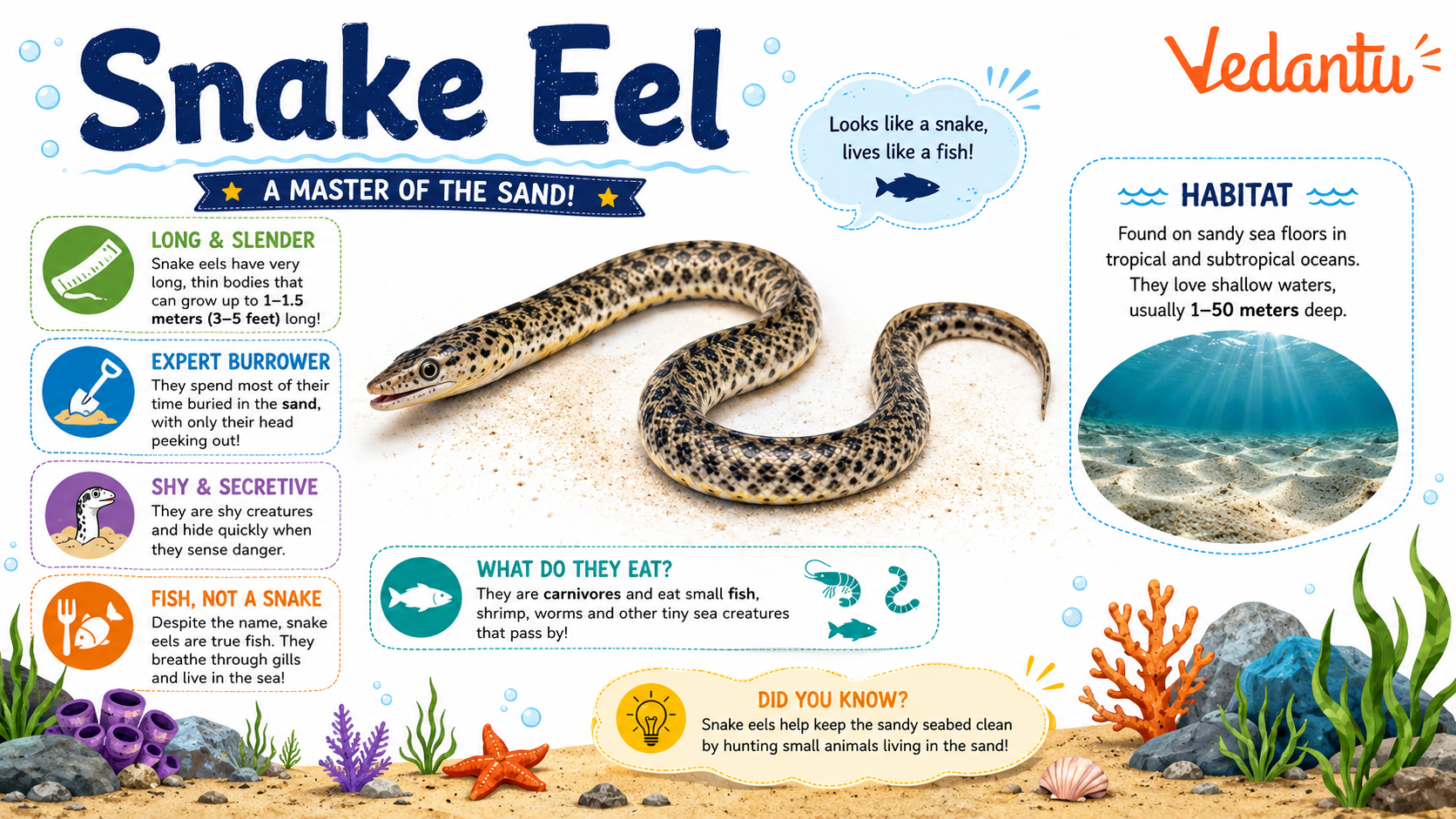
Quick Facts and Statistics
| Feature | Details |
|---|---|
| Common Name | Snake Eel |
| Scientific Family | Ophichthidae |
| Animal Group | Fish (Bony Fish) |
| Size | Up to 1.2 meters (varies by species) |
| Habitat | Coastal seas, sandy ocean floors, coral reefs |
| Diet | Small fish, crustaceans, worms |
| Movement | Slithering and burrowing |
| Conservation Status | Mostly Not Evaluated (varies by species) |
Appearance and Physical Characteristics
- Long, thin, snake-like body.
- Smooth, scaleless-looking skin.
- Pointed snout for digging into sand.
- Small fins and a narrow tail tip.
- Colours range from brown and grey to spotted or striped patterns.
These Snake Eel characteristics help them hide easily in sandy ocean floors. Their body shape allows them to slip into narrow spaces and escape quickly from predators.
Snake Eel Habitat and Distribution
- Found in tropical and warm temperate oceans.
- Common in the Indo-Pacific region.
- Live in shallow coastal waters and coral reef areas.
- Prefer sandy or muddy sea bottoms.
- Often stay partly buried with only their head visible.
The Snake Eel habitat mainly includes soft sea floors where they can burrow easily. They are rarely seen in open water because they spend most of their time hidden.
Snake Eel Diet and Feeding Habits
The Snake Eel diet shows that it is an important mid-level predator in marine ecosystems. It quickly grabs prey that passes near its hiding spot.
Behaviour and Lifestyle
- Mostly solitary animals.
- Active during night (nocturnal).
- Excellent burrowers.
- Shy and avoid humans.
- Use camouflage for protection.
Snake eels rarely attack unless disturbed. If threatened, they quickly disappear into the sand or swim away in a snake-like motion.
Snake Eel Life Cycle
- Egg Stage: Eggs are released in water.
- Larva Stage: Transparent, leaf-shaped larvae drift in the ocean.
- Juvenile Stage: Young eels settle on the sea floor.
- Adult Stage: Fully developed burrowing predator.
The Snake Eel life cycle includes a floating larval stage, which helps them spread to different regions before settling down.
What Makes Snake Eels Special?
Importance and Role in Nature
- Control population of small fish and crustaceans.
- Serve as prey for larger fish and marine predators.
- Help maintain balance in coral reef ecosystems.
- Indicate healthy sandy-bottom habitats.
Amazing Snake Eel Facts
Fun Facts for Kids
- Snake eels look like underwater snakes but are actually fish!
- They love playing hide-and-seek in the sand.
- They wiggle like a ribbon when swimming.
- Most people never see them because they hide so well.
- They are quiet and peaceful ocean creatures.
FAQs on Snake Eel: Fascinating Facts About This Burrowing Ocean Fish
1. What is a Snake Eel?
A Snake Eel is a long, snake-like fish that lives in the ocean and buries itself in the sand.
- It belongs to the Ophichthidae family.
- It looks like a sea snake but is actually a type of fish.
- It has a long, thin body and pointed tail for digging.
- Commonly found in tropical and warm oceans.
2. Are Snake Eels dangerous to humans?
No, Snake Eels are generally not dangerous to humans.
- They are shy sea creatures.
- They usually hide under sand to avoid predators.
- They rarely bite unless threatened.
- They are not poisonous like some sea snakes.
3. Where do Snake Eels live?
Snake Eels live in warm, shallow ocean waters around the world.
- Found in coral reefs and sandy sea floors.
- Common in the Pacific Ocean and Indian Ocean.
- Prefer tropical and subtropical regions.
- Often bury themselves in sand during the day.
4. What do Snake Eels eat?
Snake Eels are carnivores that eat small sea animals.
- Feed on small fish.
- Eat crabs and shrimp.
- Hunt tiny marine invertebrates.
- Use their sharp teeth to catch prey.
5. How are Snake Eels different from sea snakes?
Snake Eels are fish, while sea snakes are reptiles.
- Snake Eels breathe through gills.
- Sea snakes breathe air using lungs.
- Sea snakes are often venomous.
- Snake Eels have fins, even if they are small.
6. How big can a Snake Eel grow?
Snake Eels can grow quite long depending on the species.
- Most grow between 1 to 3 feet long.
- Some species can reach over 6 feet.
- They have slim, flexible bodies.
- Their length helps them burrow easily.
7. Why do Snake Eels bury themselves in the sand?
Snake Eels bury themselves to stay safe and hunt for food.
- It protects them from predators.
- Helps them surprise prey.
- Keeps them hidden during the day.
- Their pointed tails help them dig quickly.
8. Do Snake Eels have good eyesight?
Snake Eels rely more on smell than eyesight to find food.
- They have small eyes.
- Use a strong sense of smell to detect prey.
- Can sense vibrations in the water.
- This helps them hunt at night.
9. How do Snake Eels reproduce?
Snake Eels reproduce by laying eggs in the ocean.
- Females release eggs into the water.
- Males fertilize the eggs externally.
- Larvae float in the ocean before growing.
- Young eels later settle on the sea floor.
10. What are some interesting facts about Snake Eels?
Snake Eels are fascinating ocean animals with unique features.
- They belong to over 200 species worldwide.
- Some have bright colors and patterns.
- They are masters of camouflage.
- Despite looking like snakes, they are true marine fish.
