



Where Do Sun Bears Live, What Do They Eat, and Why Are They Endangered?
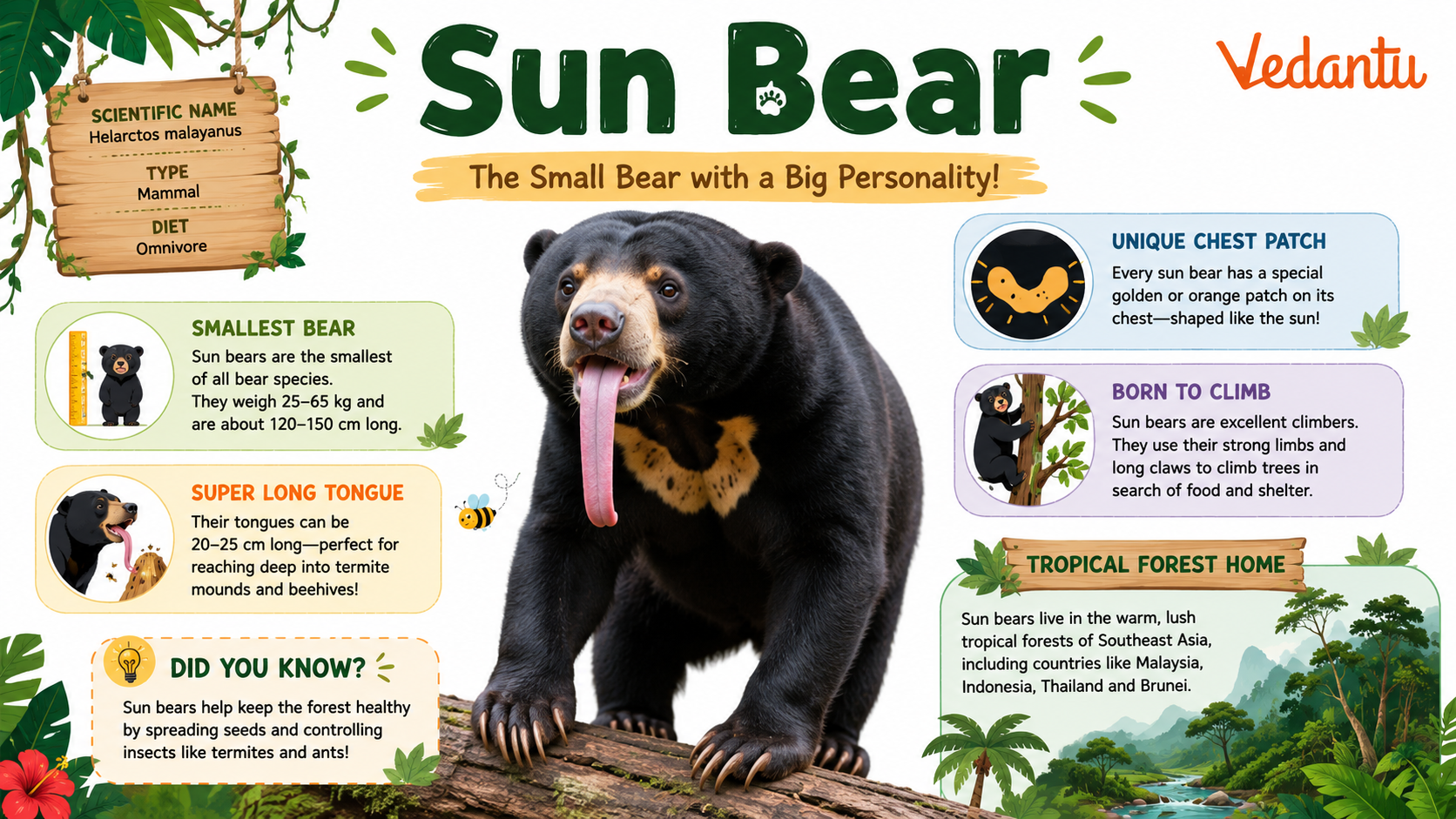
Quick Facts About Sun Bear
| Feature | Details |
|---|---|
| Common Name | Sun Bear |
| Scientific Name | Helarctos malayanus |
| Animal Group | Mammal |
| Size | About 1.2–1.5 metres long |
| Weight | 25–65 kg |
| Lifespan | Up to 25–30 years (in captivity) |
| Habitat | Tropical rainforests of Southeast Asia |
| Diet | Omnivore (fruits, insects, honey, small animals) |
| Conservation Status | Vulnerable |
Appearance and Physical Characteristics
- Fur: Short, smooth, and black.
- Chest Mark: Orange or yellow crescent-shaped patch that looks like a rising sun.
- Size: Smallest among all bear species.
- Claws: Long and curved for climbing trees.
- Tongue: Very long (up to 20–25 cm) to lick honey and insects.
Sun Bear Habitat and Distribution
- Found in Southeast Asia.
- Lives in countries like India (Northeast), Thailand, Malaysia, Indonesia, and Myanmar.
- Prefers tropical rainforests and lowland forests.
- Spends a lot of time in trees.
- Builds tree nests using branches and leaves.
The Sun Bear habitat is warm, humid, and full of tall trees. Dense forests provide food, shelter, and safety from predators.
Diet and Feeding Habits
What Does a Sun Bear Eat?
Behaviour and Lifestyle
- Mostly solitary animals.
- Usually active during the day (diurnal), but may be active at night too.
- Excellent tree climbers.
- Use claws and teeth for defence.
- Communicate through sounds, growls, and scent marking.
Sun Bear Life Cycle
- Mating: Can happen any time of the year.
- Pregnancy: Lasts about 95–100 days.
- Birth: Usually 1–2 cubs are born.
- Cubs: Born blind and helpless.
- Growth: Cubs stay with their mother for about 2 years.
- Adult Stage: Become independent and live alone.
What Makes Sun Bear Special?
Importance and Role in Nature
- Seed Disperser: Spreads seeds through droppings.
- Controls Insects: Eats termites and ants.
- Maintains Forest Health: Helps keep ecosystem balanced.
Amazing Sun Bear Facts
Interesting Facts About Sun Bear
- The chest patch may help scare enemies by making the bear look bigger.
- Sun Bears have loose skin, which helps them twist around if attacked.
- They have small, rounded ears compared to other bears.
- Deforestation is a major threat to their survival.
Fun Facts for Kids
- Sun Bears love honey just like Winnie the Pooh!
- They are the tiniest bears in the world.
- Their tongue is longer than a school ruler.
- They sleep in tree nests made of leaves.
- Each Sun Bear’s chest mark is special and different.
FAQs on Sun Bear: Fascinating Facts About the World’s Smallest Bear
1. What is a Sun Bear?
Sun Bear is the smallest bear species in the world and lives in tropical forests of Southeast Asia.
- Scientific name: Helarctos malayanus
- Also called the Honey Bear because it loves honey
- Known for the bright sun-shaped chest patch
- Belongs to the bear family (Ursidae)
- Found in countries like Malaysia, Thailand, and Indonesia
2. Where do Sun Bears live?
Sun Bears live in tropical rainforests of Southeast Asia where the climate is warm and humid.
- Found in Malaysia, Borneo, Sumatra, Thailand, and Myanmar
- Prefer dense forests with lots of trees
- Often stay in lowland rainforests
- Build nests in trees for resting
- Rarely seen in cold or mountain areas
3. Why is it called a Sun Bear?
Sun Bears are named after the golden or orange patch on their chest that looks like a rising sun.
- Each bear has a unique chest marking
- The patch may help with communication
- The bright mark stands out against their black fur
- This feature makes them easy to identify
4. What do Sun Bears eat?
Sun Bears are omnivores, which means they eat both plants and animals.
- Love honey and bee larvae
- Eat fruits, berries, and figs
- Feed on insects, termites, and ants
- Sometimes eat small animals and birds
- Use their long tongue to reach food inside trees
5. How big do Sun Bears grow?
Sun Bears are the smallest bear species, but they are strong and powerful.
- Length: about 4 to 5 feet (1.2–1.5 meters)
- Weight: 60 to 150 pounds (27–68 kg)
- Have a short black coat
- Possess strong claws for climbing
6. Are Sun Bears endangered?
Yes, Sun Bears are listed as Vulnerable due to habitat loss and illegal hunting.
- Forests are cut down for palm oil plantations
- Hunted for traditional medicine and pet trade
- Protected under wildlife conservation laws
- Efforts are being made to save them
7. How long do Sun Bears live?
Sun Bears can live up to 25 years in captivity and slightly less in the wild.
- Wild lifespan: around 20 years
- Captive lifespan: up to 25–30 years
- Life expectancy depends on food and safety
- Protected bears usually live longer
8. Are Sun Bears dangerous to humans?
Sun Bears are generally shy animals and avoid humans whenever possible.
- Prefer to stay hidden in forests
- May defend themselves if threatened
- Use strong claws and teeth for protection
- Human encounters are rare
9. What special features do Sun Bears have?
Sun Bears have unique physical adaptations that help them survive in rainforests.
- Very long tongue (8–10 inches) for honey
- Sharp, curved claws for climbing trees
- Strong jaws for breaking open logs
- Excellent sense of smell
- Short, sleek fur for hot climates
10. Why are Sun Bears important to the ecosystem?
Sun Bears play an important role in maintaining healthy forests by spreading seeds and controlling insects.
- Disperse fruit seeds through droppings
- Control termite and insect populations
- Create tree holes used by other animals
- Help balance the rainforest ecosystem
