




What is a Blood Group Test and How It Determines ABO and Rh Type
A blood group test is a basic yet crucial investigation that identifies the specific category of blood an individual possesses. There are different blood group test names for this, but most commonly it is referred to as ABO typing (to check whether you are Group A, B, AB, or O) and Rh typing (positive or negative). Knowing your blood type helps doctors make safe decisions in emergencies, especially when a blood transfusion is required. In this guide, we will discuss the blood group test procedure, the essential materials needed, how to interpret the blood group test chart, and what to keep in mind when reviewing a blood group test report.
What is a Blood Group Test?
A blood group test determines which antigens are present on the surface of your red blood cells. These antigens are generally classified under the ABO Blood Group System and the Rh factor. Testing your blood type accurately is necessary for safe blood transfusions, organ transplants, and even in certain medical conditions where blood grouping is mandatory.
The ABO Blood Group System
The ABO Blood Group System was discovered by Karl Landsteiner. It is based on the presence or absence of two primary antigens—A and B.
Group A: Has antigen A on the red blood cells and antibody B in the plasma.
Group B: Has antigen B on the red blood cells and antibody A in the plasma.
Group AB: Has both antigens A and B on the red blood cells and no A or B antibodies in the plasma.
Group O: Has no A or B antigens on the red blood cells but has both A and B antibodies in the plasma.
The Rh Factor
Apart from the A and B antigens, the Rh factor (mainly the D antigen) further classifies blood types into Rh-positive (D antigen present) or Rh-negative (D antigen absent). Consequently, each of the four ABO blood groups can either be Rh-positive or Rh-negative, giving rise to eight possible blood types:
A+
A-
B+
B-
AB+
AB-
O+
O-
Materials Required for a Blood Group Test
A blood group test kit typically contains everything you need to perform the test at home or in a lab setting:
A clean glass slide
Monoclonal antibodies (Anti-A, Anti-B, and Anti-D)
Lancet (for finger prick)
Alcohol swabs
Sterile cotton balls
Toothpicks (or similar stirrers)
Biohazard disposal container
Blood Group Test Procedure
Below is the simple blood group test procedure commonly followed in many labs and also doable at home with the right precautions:
Mark the Slide: Draw three separate circles on a clean glass slide.
Add Reagents: Place a drop of Anti-A in the first circle, Anti-B in the second, and Anti-D in the third.
Prepare the Finger: Clean your ring finger with an alcohol swab and allow it to dry.
Prick and Discard: Prick your fingertip gently with the lancet. Wipe off the first drop of blood using a cotton ball.
Collect Blood Drops: Carefully allow one drop of blood to fall on each circle by gently pressing your finger.
Mix Thoroughly: Use separate toothpicks to mix the blood with the antibodies in each circle.
Observe for Clumping: Look for agglutination (clumping). If clumping occurs in Anti-A, you have antigen A; if it occurs in Anti-B, you have antigen B; if it occurs in Anti-D, you are Rh-positive.
Dispose Safely: Discard all materials (including the slide and toothpicks) into a biohazard container.
Blood Group Test Chart
The blood group test chart helps to interpret the outcomes. If your blood reacts (clumps) with:
By checking combinations:
Clumps in Anti-A only → Group A
Clumps in Anti-B only → Group B
Clumps in both Anti-A and Anti-B → Group AB
No clumps in Anti-A or Anti-B → Group O
Clumps in Anti-D → Rh+; No clumps in Anti-D → Rh-
Blood Group Test Report: Understanding the Results
A blood group test report typically mentions the ABO group and the Rh type. For instance, if you are A+ (A positive), your red cells have the A antigen and the Rh factor. This knowledge is important during emergencies or surgeries when you may need blood from a matching donor.
Universal Donor and Recipient:
Group O-: Universal donor, as it lacks A, B, and Rh antigens.
Group AB+: Universal recipient, as it contains both A and B antigens and the Rh factor, making it compatible with all other groups in emergencies.
Additional Tips for Accuracy
Use a Fresh Lancet: Always use a new sterile lancet to prevent infection and cross-contamination.
Clean the Finger Properly: Ensure the site is disinfected with an alcohol swab.
Dispose of Materials Safely: Contaminated items must go into a biohazard disposal container.
Check Expiry: If you are using a blood group test kit, make sure the reagents (Anti-A, Anti-B, Anti-D) are not expired.
Quiz Time
Test your understanding of the topic with the short quiz below:
1. Which blood group is known as the universal recipient?
a. B+
b. O-
c. AB+
d. A-
Answer: c. AB+
2. What does the Anti-D reagent test for?
a. Antigen D, which indicates the Rh factor
b. Antibody A in plasma
c. Antibody B in plasma
d. Presence of haemoglobin
Answer: a. Antigen D, which indicates the Rh factor
3. What is the rarest blood type globally?
a. O+
b. AB-
c. A+
d. B-
Answer: b. AB-
4. Which blood group can donate to all groups?
a. B+
b. AB-
c. O-
d. O+
Answer: c. O-
Related Topics


FAQs on Blood Group Test in Biology and Clinical Practice
1. What is a blood group test?
A blood group test is a laboratory test used to determine a person’s ABO blood type and Rh factor. It identifies specific antigens present on the surface of red blood cells (RBCs).
- Detects A and/or B antigens for ABO grouping
- Checks for the presence of the Rh (D) antigen
- Essential before blood transfusion or organ transplant
2. How does a blood group test work?
A blood group test works by mixing a blood sample with specific antisera to observe agglutination (clumping). If clumping occurs, the corresponding antigen is present.
- Blood is mixed with anti-A serum → clumping means type A
- Blood is mixed with anti-B serum → clumping means type B
- Blood is mixed with anti-D serum → clumping means Rh positive
3. What are the different types of blood groups?
The main blood groups are classified under the ABO system and the Rh system. Together, they form eight common blood types.
- A+, A−
- B+, B−
- AB+, AB−
- O+, O−
4. Why is a blood group test important before blood transfusion?
A blood group test is important before transfusion to prevent immune reactions caused by incompatible blood types. If mismatched blood is transfused, the recipient’s antibodies attack donor RBCs.
- Causes agglutination and hemolysis
- May lead to shock or kidney failure
- Can be life-threatening
5. What is the difference between ABO and Rh blood group systems?
The ABO system classifies blood based on A and B antigens, while the Rh system is based on the presence or absence of the Rh (D) antigen. Both systems together determine complete blood type.
- ABO groups: A, B, AB, O
- Rh types: Positive (+) or Negative (−)
- ABO incompatibility causes immediate reactions
- Rh incompatibility is especially important in pregnancy
6. What are antigens and antibodies in a blood group test?
In a blood group test, antigens are molecules on RBC surfaces, and antibodies are proteins in plasma that react against foreign antigens. Their interaction determines compatibility.
- Type A blood → A antigen, anti-B antibody
- Type B blood → B antigen, anti-A antibody
- Type O blood → No A/B antigens, both antibodies
- Type AB blood → Both antigens, no anti-A or anti-B antibodies
7. Can blood group change over time?
A person’s blood group does not normally change over time because it is genetically inherited. The ABO and Rh types are determined by specific genes passed from parents.
- Inherited from both parents
- Remains constant throughout life
- Rare changes may occur after bone marrow transplant
8. How is blood group inherited?
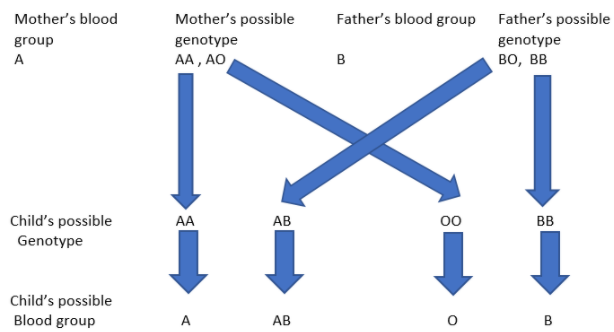
Blood group is inherited through alleles of the ABO gene and the Rh gene from both parents. The ABO system follows multiple allele inheritance.
- Alleles: IA, IB, and i
- IA and IB are codominant
- i is recessive
- Rh positive is dominant over Rh negative
9. What is the universal donor and universal recipient in blood groups?
The O negative (O−) blood group is considered the universal donor, and AB positive (AB+) is the universal recipient. This is based on antigen compatibility.
- O− has no A, B, or Rh antigens
- AB+ has no anti-A, anti-B, or anti-Rh antibodies
- Important in emergency transfusions
10. What is Rh incompatibility in pregnancy?
Rh incompatibility occurs when an Rh-negative mother carries an Rh-positive fetus, leading to an immune response against fetal RBCs. The mother produces anti-Rh antibodies.
- Usually affects subsequent pregnancies
- Can cause hemolytic disease of the newborn (HDN)
- Prevented by Rh immunoglobulin (RhoGAM) injection



