




Steps of the Calvin Cycle and Carbon Fixation Process
The Calvin cycle is a vital biochemical process in green plants that converts carbon dioxide (CO₂) into organic molecules such as sugars. Often referred to as the C3 cycle, this process is central to photosynthesis. In simple terms, the Calvin cycle is also known as the light-independent or dark reaction, because, unlike the light-dependent reactions, it does not directly require sunlight even though it benefits from the energy carriers produced during daylight.
Plants perform the Calvin cycle in the chloroplast stroma, where the energy from ATP and NADPH (produced during the light reactions) is used to build carbohydrates. When you look at a Calvin cycle diagram or a c3 cycle diagram, you’ll see three main stages: carbon fixation, reduction, and regeneration. In this guide, we will explore each of these Calvin cycle steps in detail.
The Three Stages of the Calvin Cycle
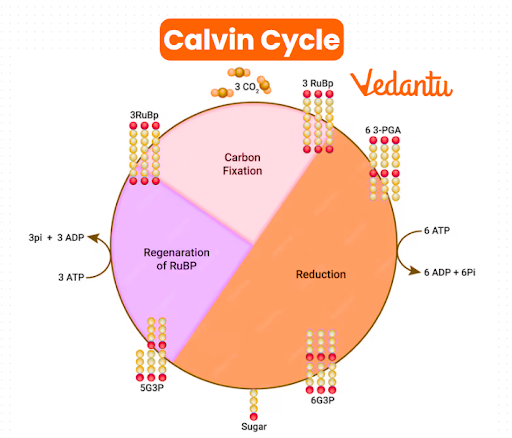
1. Carbon Fixation
The first Calvin cycle step involves the fixation of CO₂. Here, CO₂ binds to a five-carbon sugar called ribulose-1,5-bisphosphate (RuBP) through the action of the enzyme RuBisCO – one of the most abundant enzymes on Earth. In a typical leaf, this enzyme accounts for over 50% of all the protein, highlighting its significance.
Key Point: Calvin cycle occurs in the chloroplast stroma where CO₂ is fixed into an unstable six-carbon intermediate that quickly splits into two molecules of 3-phosphoglycerate (3-PGA).
When studying a Calvin cycle diagram, you will note that this step is crucial as it initiates the conversion of inorganic carbon into an organic form.
2. Reduction
In the second stage, the 3-PGA molecules formed during carbon fixation are converted into glyceraldehyde-3-phosphate (G3P), a process known as reduction.
How It Works: ATP and NADPH (from the light reactions) are utilised to transfer energy and electrons to 3-PGA, reducing it to G3P. This is why this part of the Calvin cycle is termed the reduction phase.
Fun Fact: The enzyme that catalyses these reactions works at a remarkably slow rate compared to other enzymes; however, its sheer abundance compensates for its slow pace!
3. Regeneration
The final Calvin cycle step is regeneration. Here, a portion of the G3P is used to synthesise glucose and other sugars, while the remainder is recycled to regenerate RuBP. This recycling is essential because it allows the cycle to continue and capture more CO₂.
Unique Insight: In every three turns of the cycle, one G3P molecule exits the cycle to contribute to sugar synthesis, while the rest help to maintain a continuous process by regenerating RuBP.
When you refer to a c3 cycle diagram, the regeneration phase is clearly demarcated as it ensures that the cycle can perpetually convert CO₂ into sugars.
Also, read Light Reaction and Dark Reaction
The Importance of RuBisCO and Efficiency
Despite its critical role, RuBisCO is not an especially efficient enzyme, processing only a few CO₂ molecules per second. However, plants have evolved to produce vast amounts of RuBisCO to overcome this limitation. This inefficiency has also led researchers to explore ways to enhance photosynthetic efficiency, which has potential applications in agriculture and bioengineering.
Environmental Impact
Understanding the Calvin cycle is crucial for environmental science. The way plants assimilate CO₂ through this cycle affects global carbon cycles and, by extension, climate change. Modern research is exploring how variations in the Calvin cycle occurs in different plant species, particularly between C3 and C4 plants, to better predict and mitigate climate impacts.
Real-World Applications
The principles of the Calvin cycle extend far beyond textbook biology:
Agricultural Improvement: By studying Calvin cycle steps, scientists are developing crops that can better utilise CO₂ and withstand climate change.
Biotechnology: Insights from the Calvin cycle diagram are applied in synthetic biology to engineer organisms capable of producing biofuels and other valuable chemicals.
Environmental Monitoring: Understanding how Calvin cycle occurs in various plants helps in designing better carbon capture strategies, crucial for reducing greenhouse gases.
These applications underscore the real-life significance of the Calvin cycle, making it not just a topic of academic interest but a cornerstone in sustainable development and environmental conservation.
Fun Facts about the Calvin Cycle
Abundance of RuBisCO: RuBisCO, the enzyme that initiates the Calvin cycle, is considered the most abundant protein on Earth – a true workhorse in the natural world.
Energy Conversion Efficiency: Despite the slow catalytic rate of RuBisCO, the vast number of these enzymes ensures that plants efficiently convert CO₂ into sugars, highlighting a remarkable balance between speed and quantity.
Evolutionary Significance: The Calvin cycle is also known as the C3 cycle because the first stable product contains three carbon atoms, distinguishing it from the C4 and CAM cycles found in other plants.
In summary, the Calvin cycle is an indispensable process in photosynthesis, transforming CO₂ into sugars through a series of well-orchestrated Calvin cycle steps: carbon fixation, reduction, and regeneration. Detailed Calvin cycle diagrams and c3 cycle diagrams visually represent these processes, making them easier to understand. Whether you are a student or a biology enthusiast, understanding how the Calvin cycle is also known as the C3 cycle provides a fundamental insight into plant life and its impact on our environment. Moreover, recognising how and where the Calvin cycle occurs in plant cells can lead to exciting applications in agriculture, biotechnology, and environmental science.


FAQs on Calvin Cycle Explained in Photosynthesis
1. What is the Calvin cycle in photosynthesis?
The Calvin cycle is the light-independent stage of photosynthesis that uses ATP and NADPH to convert carbon dioxide into glucose. It occurs in the stroma of the chloroplast and does not require light directly.
- Also called the Calvin–Benson cycle
- Fixes atmospheric CO₂ into organic molecules
- Produces glyceraldehyde-3-phosphate (G3P), a precursor to glucose
2. Where does the Calvin cycle occur in the cell?
The Calvin cycle occurs in the stroma of the chloroplast in plant and algal cells. The stroma is the fluid-filled space surrounding the thylakoid membranes.
- Light reactions occur in the thylakoid membranes
- The Calvin cycle uses ATP and NADPH produced by light reactions
- Common in plants, algae, and some bacteria (in cytoplasm of cyanobacteria)
3. What are the three stages of the Calvin cycle?
The Calvin cycle has three main stages: carbon fixation, reduction, and regeneration. Each stage helps convert CO₂ into a usable sugar molecule.
- 1. Carbon fixation: CO₂ combines with RuBP using the enzyme RuBisCO.
- 2. Reduction: ATP and NADPH convert 3-PGA into G3P.
- 3. Regeneration: RuBP is regenerated using ATP to continue the cycle.
4. What is the role of RuBisCO in the Calvin cycle?
The enzyme RuBisCO catalyzes the fixation of carbon dioxide to RuBP in the first step of the Calvin cycle. It is one of the most abundant enzymes on Earth.
- Full name: Ribulose-1,5-bisphosphate carboxylase/oxygenase
- Combines CO₂ with RuBP to form an unstable 6-carbon compound
- This splits into two molecules of 3-phosphoglycerate (3-PGA)
5. How many ATP and NADPH are used in the Calvin cycle?
The Calvin cycle uses 9 ATP and 6 NADPH to produce one net molecule of G3P from three molecules of CO₂. These energy molecules come from the light reactions of photosynthesis.
- 3 CO₂ enter the cycle
- 9 ATP molecules are consumed
- 6 NADPH molecules are oxidized
- 1 net G3P exits the cycle
6. How is glucose formed from the Calvin cycle?
Glucose is formed when two molecules of G3P produced in the Calvin cycle combine to form a six-carbon sugar. G3P is the direct product of the cycle.
- Each turn produces G3P (glyceraldehyde-3-phosphate)
- Two G3P molecules combine to form glucose (C₆H₁₂O₆)
- Glucose can be converted into starch, sucrose, or cellulose
7. Why is the Calvin cycle called the light-independent reaction?
The Calvin cycle is called the light-independent reaction because it does not directly require light to occur. Instead, it uses ATP and NADPH generated by the light-dependent reactions.
- Occurs in the stroma
- Depends on products of light reactions
- Can proceed in the absence of light if ATP and NADPH are available
8. What is the difference between the Calvin cycle and light reactions?
The main difference is that light reactions produce ATP and NADPH using sunlight, while the Calvin cycle uses them to fix CO₂ into sugars. They occur in different parts of the chloroplast.
- Light reactions: Occur in thylakoid membranes, require light, produce ATP, NADPH, and O₂
- Calvin cycle: Occurs in stroma, does not require light directly, produces G3P
9. How many turns of the Calvin cycle are needed to make one glucose molecule?
Six turns of the Calvin cycle are required to produce one molecule of glucose. Each turn fixes one molecule of CO₂.
- 1 turn fixes 1 CO₂
- 3 turns produce 1 net G3P
- 6 turns produce 2 G3P
- 2 G3P combine to form 1 glucose
10. What is the importance of the Calvin cycle in plants?
The Calvin cycle is important because it converts inorganic carbon dioxide into organic sugars that fuel plant growth and life on Earth. It is the primary pathway for carbon fixation in most ecosystems.
- Produces carbohydrates for energy storage
- Forms the basis of the food chain
- Reduces atmospheric CO₂
- Supports biosynthesis of starch, cellulose, and other biomolecules



