




What Is Coordination in Plants Types of Plant Hormones and Their Functions
Tropic movement in plants is a biological phenomenon that denotes growth or bending movements in plants due to environmental influences. Tropism is a three-step procedure that entails sensing the stimulus, signal transduction or response to the stimulus and the directional movement of plants. In plants, there are five tropism types: geotropism, chemotropism, phototropism, hydrotropism and thigmotropism. These will be discussed in detail later. Keep reading to learn more about tropic movement and coordination in plants and types of plant hormones.
Types of Tropism
Phototropism: Phototropism occurs in plants in response to sunlight, and the plants are reported to grow in the direction of light. The movement can be either towards or away from the sunlight.
What is Geotropism?
Positive geotropism is when a plant moves in the direction of gravity, causing its roots to grow downward. Similar to this, the process can be described as negative geotropism if its shoots continue to grow upward. The directional growth in plants occurs due to the uneven distribution of plant hormone auxin.
Chemotropism: In addition to environmental influences, there are also chemical elements that affect the tropic movements. Chemotropism example includes movement of pollen tube in the direction of the ovule. The transport of pollen grains to the female gamete releases certain chemicals which help in movement in seed plants.
Hydrotropism: Response of plant roots towards water is called hydrotropism. This phenomenon helps in the growth of roots in water.
Thigmotropism: The movement in plants that takes place in response to touch is called thigmotropism. An example includes the tropism that occurs in the touch me not plant.
Chemical Control and Coordination
All forms of life respond to environmental stimuli. Certain chemical reactions are reported to occur in plant cells in response to environmental stimuli. The capacity to use many plant components harmoniously and effectively is known as coordination. A plant chemical mechanism produces coordination, which is assisted by hormones and phytohormones.
Plant hormones, also known as phytohormones, are in charge of controlling and coordinating the chemical processes in plants. Cells are stimulated to produce these hormones that later diffuse throughout the plant. Plant hormones are involved in processes like fruit development, leaf drop, fruit ripening, plant ageing, cell division, cell enlargement, cell differentiation, and fruit ripening.
Plants display two types of movements: Growth-dependent movements/directional or Tropic Movements, and non-growth dependent/non-directional movements, also called the Nastic Movements.
Tropic movements are classified into 5 types. Phototropism (in response to light), Geotropism (in response to gravity), Hydrotropism (towards the water), Chemotropic movement (in response to chemicals), and Thigmotropism (in response to touch).
Nastic movements in plants are non-directional movements and are independent of stimulus. The example includes the leaves of Mimosa pudica, which immediately fold themselves when touched. These sorts of changes occur due to the alteration in the water content in the leaves. The leaves either swell up or shrink depending on the quantity of water. These changes are acquired in the opposite direction to the stimulus.
Types of Plant Hormones
The development and growth of the plant are affected by different hormones, namely, auxins, gibberellins, cytokinins, and abscisic acid.
Auxin is made at the stem's tip and aids in plant growth by lengthening cells. Auxins play a significant role in cell division, differentiation, development of embryos, roots, apical dominance, and flowering.
Gibberellin participates in flowering, seed germination, stem growth, and flowering. The environmental conditions must be favourable to initiate this process. The important environmental factors that need to be optimum for the processes to take place are the amount of water, oxygen, soil depth, and temperature. The fundamental process of seed germination is how various species of plants develop from a single seed into a young plant. The seed germination stages are water imbibition, root and shoot growth and formation of seedlings.
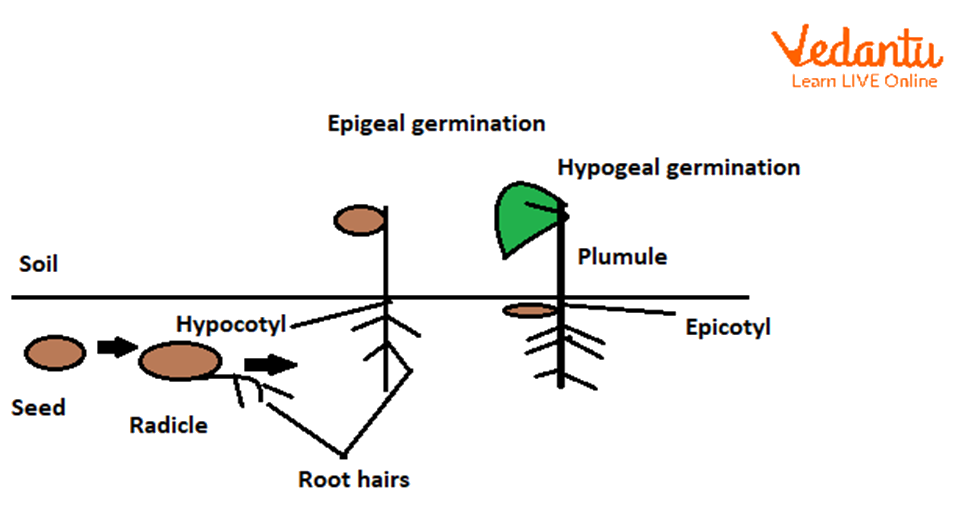
Seed Germination Diagram
In fruits and seeds, cytokinins are found where cells divide. It is primarily responsible for cytokinesis, but it also aids in the stomata opening, apical dominance, leaf senescence, and axillary bud growth.
Abscisic acid is in charge of stomata closing and limits the growth of several components, eventually inhibiting the plant's growth. Hence, the hormone is reported to encourage dormancy in seeds and buds. Plant hormones, also called phytohormones, are reported to regulate the directional or non-directional growth of plants.
Interesting Facts
Auxin was the first phytohormone to be identified, and it was found by biologist Charles Darwin.
Plant hormones are naturally occurring substances that impact a plant's growth and development.
Tropism in plants performs a protective role. They aid in creating an immediate reaction to a stimulus or change.
Key Features of Coordination in Plants
Plant hormones function as chemical messengers.
Plant hormones are reported to regulate all aspects of growth and development in plants. It also helps in the interaction that occurs between beneficial microbes and the plant.
Tropism promotes the development of pollen tubes that lead to ovules.


FAQs on Coordination in Plants and Role of Plant Hormones
1. What is coordination in plants?
Coordination in plants is the process by which different plant parts work together and respond to environmental stimuli using chemical signals (plant hormones). Unlike animals, plants do not have a nervous system, so coordination occurs through growth movements and hormonal regulation.
- Involves detection of stimuli such as light, gravity, and water
- Response is mainly through growth changes
- Controlled by plant hormones like auxins and gibberellins
2. How do plants coordinate without a nervous system?
Plants coordinate without a nervous system by using plant hormones that travel from one part of the plant to another to regulate growth and responses. These chemical messengers control various physiological activities.
- Hormones are produced in one region (e.g., shoot tip)
- They move through vascular tissues or by diffusion
- They trigger specific growth or movement responses
3. What are plant hormones and what is their role in coordination?
Plant hormones are chemical substances that regulate growth, development, and responses to stimuli in plants. They play a central role in coordination in plants.
- Auxins – control cell elongation and phototropism
- Gibberellins – promote stem growth and seed germination
- Cytokinins – stimulate cell division
- Ethylene – controls fruit ripening
- Abscisic acid (ABA) – induces dormancy and stress responses
4. What is phototropism in plants?
Phototropism is the growth response of a plant toward or away from light. It is mainly controlled by the hormone auxin.
- Shoots show positive phototropism (grow toward light)
- Auxin accumulates on the shaded side
- Cells on the shaded side elongate more, causing bending
5. What is geotropism (gravitropism) in plants?
Geotropism, also called gravitropism, is the growth response of plant parts to gravity. It helps roots and shoots grow in the correct direction.
- Roots show positive geotropism (grow downward)
- Shoots show negative geotropism (grow upward)
- Regulated by redistribution of auxin
6. What is the difference between tropic movements and nastic movements?
The main difference between tropic and nastic movements is that tropic movements depend on the direction of the stimulus, while nastic movements do not. Both are important in plant coordination.
- Tropic movements: Directional growth responses (e.g., phototropism)
- Nastic movements: Non-directional responses (e.g., folding of Mimosa leaves)
- Tropic movements are usually growth-based; nastic movements are often turgor-based
7. What is thigmotropism in plants?
Thigmotropism is the growth response of a plant to touch or physical contact. It is commonly seen in climbing plants.
- Tendrils coil around a support
- Caused by uneven growth due to auxin distribution
- Helps plants obtain structural support
8. How does the Mimosa plant show coordination?
The Mimosa plant shows coordination by folding its leaves in response to touch through a nastic movement called thigmonasty. This movement is not growth-based but caused by changes in cell turgor pressure.
- Touch stimulus is detected
- Water moves out of pulvinus cells
- Leaves droop temporarily and reopen later
9. What is the role of auxin in plant coordination?
Auxin is a plant hormone that regulates cell elongation and controls major growth responses like phototropism and geotropism. It is primarily produced in the shoot apex.
- Promotes cell elongation in stems
- Helps in root initiation
- Controls directional growth responses
10. Why is coordination important in plants?
Coordination is important in plants because it ensures proper growth, development, and survival in changing environmental conditions. It allows plants to respond effectively to stimuli.
- Helps plants grow toward light and water
- Regulates flowering, fruiting, and dormancy
- Protects against stress through hormones like abscisic acid



