




What Is the Difference Between Active and Passive Transport in Cells
Understanding the difference between active and passive transport is essential for anyone studying cellular biology. These two fundamental processes explain how substances move across cell membranes, directly influencing the health and functioning of all living organisms. This page explores their definitions, mechanisms, real-life examples, and distinct characteristics for students and enthusiasts alike.
What Is the Difference Between Active and Passive Transport?
The difference between active and passive transport lies in energy usage and the direction of movement along the concentration gradient. Both processes help maintain cellular balance, supporting vital functions throughout the body. Let's define each and examine their key differences.
Active Transport Definition
Active transport is the process by which cells move molecules or ions from an area of lower concentration to an area of higher concentration—against the concentration gradient. This process requires cellular energy, typically in the form of ATP (adenosine triphosphate), and often involves specific protein pumps or carriers.
Passive Transport Definition
Passive transport describes the movement of substances from a region of higher concentration to one of lower concentration. This natural flow occurs without the cell using energy. It relies on the inherent kinetic energy of molecules moving down the concentration gradient. Examples include diffusion and osmosis.
Active and Passive Transport Diagram
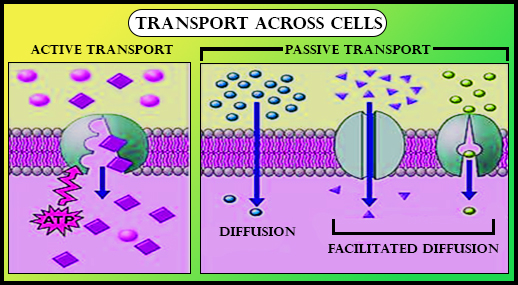
The diagram above visually represents how active transport (uphill movement, energy needed) contrasts with passive transport (downhill, no energy used). Notice that passive transport follows the natural flow, while active transport works against it, using specialized proteins within the membrane.
Difference Between Active and Passive Transport: Comparison Table
| Parameter | Active Transport | Passive Transport |
|---|---|---|
| Energy Requirement | Requires energy (ATP) | Does not require energy |
| Concentration Gradient | Moves from low to high (against gradient) | Moves from high to low (down gradient) |
| Carrier Proteins | Involves specific pumps or carriers | Channel/carrier proteins may help, or move freely |
| Examples | Sodium-potassium pump, endocytosis, mineral ion uptake | Diffusion, osmosis, facilitated diffusion |
| Directionality | Mostly unidirectional | Bidirectional (depends on gradient) |
| Speed | Faster with energy input | Relies on molecule motion; can be slower |
| Effect of Inhibitors | Affected by metabolic inhibitors | Little or no effect |
| Temperature Influence | Strongly dependent (enzymes/proteins function best at optimal temperatures) | Less dependent; affected mostly in protein-based transport |
This table makes it easy to distinguish the difference between active and passive transport by summarizing key traits and processes. Students preparing for class 12 biology or competitive exams often refer to such tables for revision.
Difference Between Active and Passive Transport: Explanation & Examples
Let's break down the difference between active and passive transport definition with practical examples relevant to human health and plant science. These mechanisms play vital roles in areas such as nerve signaling, kidney filtration, and nutrient uptake.
- Active Transport Examples:
- Sodium-potassium pump in nerve cells (important for electrical impulse transmission)
- Uptake of mineral ions by plant roots, especially in agriculture
- Endocytosis of nutrients or pathogens by immune cells
- Exocytosis of hormones, such as insulin from the pancreas (endocrinology topics)
- Passive Transport Examples:
- Osmosis—water absorption in plant roots and animal kidneys
- Simple diffusion—exchange of oxygen and carbon dioxide in lung alveoli
- Facilitated diffusion—glucose entering muscle and fat cells using transport proteins
Both types of transport are vital for maintaining cell homeostasis and support processes from environmental adaptation to human medicine. For real-life agricultural and nutrition contexts, see food science and nutritional biology topics at Vedantu.
Details of Active and Passive Transport Mechanisms
Active transport is often split into primary (direct ATP use) and secondary (uses gradients created by primary) forms. In contrast, passive transport primarily covers diffusion, osmosis, and facilitated diffusion. Both are influenced by temperature, but only active transport is directly tied to metabolism and ATP generation.
- Primary Active Transport: Direct energy usage (e.g., sodium-potassium pump).
- Secondary Active Transport: Moves other molecules using potential created by primary transport (e.g., glucose symport).
- Simple Diffusion: Molecules move freely across the phospholipid bilayer (e.g., oxygen, CO₂).
- Facilitated Diffusion: Larger/polar molecules use channel or carrier proteins (e.g., glucose).
- Osmosis: Water moves through a selectively permeable membrane—essential in photosynthesis and kidney filtration.
Key Points to Distinguish Active and Passive Transport
- Active transport requires energy input; passive transport does not.
- Active moves substances up the concentration gradient; passive moves down.
- Active transport is essential for maintaining unique intracellular environments—enabling nerve impulses and muscle contractions (muscular tissue details).
- Passive transport is important in processes such as gas exchange and water balance.
Mnemonic for Remembering the Difference
Remember this simple line: "Low to High? Must Supply!" In other words, if a molecule moves from low to high concentration, active transport supplies the energy.
Practice Questions: Difference Between Active and Passive Transport MCQs
- Which process requires ATP?
- a) Osmosis
- b) Diffusion
- c) Endocytosis
- d) Facilitated diffusion
- What is the key difference regarding concentration gradients?
- a) Both move high to low
- b) Active: low to high; Passive: high to low
- c) Both require ATP
- d) None of the above
- Which is passive transport?
- a) Exocytosis
- b) Endocytosis
- c) Osmosis
- d) Sodium-potassium pump
Applications and Relevance in Biology
The difference between active and passive transport is relevant to many fields. In agriculture, active transport helps roots absorb minerals. In medicine, understanding these processes assists in treating dehydration, metabolic diseases, and managing kidney health. These principles are foundational in studying cell structure, transportation in plants, and more advanced biological science concepts.
Quick Recap: Active vs. Passive Transport
- Both help maintain homeostasis in cells.
- Active transport is energy-dependent and works against natural gradients.
- Passive transport relies on kinetic energy and always follows the concentration gradient.
- Processes like osmosis, diffusion, and the sodium-potassium pump are classic textbook examples.
By studying the difference between active and passive transport, students can master biology fundamentals and apply these concepts to more complex topics, from cell theory to real-world health challenges. For more in-depth exploration, browse related Vedantu resources on inherited and acquired traits, climate impacts, or biomolecules.
In summary, distinguishing active from passive transport is crucial to grasp how substances enter, leave, and circulate within living organisms. Mastery of these processes enables students to excel at biology, understand health and environmental sciences, and succeed in further research or clinical roles. Keep exploring Vedantu's interactive content for deeper learning and exam success!


FAQs on Difference Between Active and Passive Transport Explained
1. What is the difference between active and passive transport?
The main difference between active transport and passive transport is that active transport requires energy to move substances against their concentration gradient, while passive transport does not require energy and moves substances down their concentration gradient.
- Active transport: Uses cellular energy (ATP); moves substances from low to high concentration.
- Passive transport: Does not use energy; moves substances from high to low concentration.
- Active transport involves membrane pumps; passive transport includes diffusion and osmosis.
2. What is active transport in biology?
Active transport is the movement of molecules across a cell membrane against their concentration gradient using energy in the form of ATP.
- Moves substances from low concentration to high concentration.
- Requires specific carrier proteins or membrane pumps.
- Example: Sodium-potassium pump in animal cells.
3. What is passive transport in biology?
Passive transport is the movement of substances across a cell membrane from high concentration to low concentration without using cellular energy.
- Occurs along the concentration gradient.
- Does not require ATP.
- Includes diffusion, osmosis, and facilitated diffusion.
4. What are the types of passive transport?
The main types of passive transport are diffusion, osmosis, and facilitated diffusion.
- Simple diffusion: Movement of small nonpolar molecules like oxygen across the membrane.
- Osmosis: Movement of water across a selectively permeable membrane.
- Facilitated diffusion: Movement of substances through protein channels or carrier proteins.
5. What are the types of active transport?
The main types of active transport are primary active transport, secondary active transport, and bulk transport.
- Primary active transport: Directly uses ATP (e.g., sodium-potassium pump).
- Secondary active transport: Uses energy from an ion gradient.
- Bulk transport: Includes endocytosis and exocytosis.
6. Why does active transport require energy?
Active transport requires energy because it moves substances against their concentration gradient, which is energetically unfavorable.
- Substances move from low to high concentration.
- Energy is supplied by ATP hydrolysis.
- Membrane proteins change shape to transport molecules.
7. Can you give examples of active and passive transport?
Examples of active transport include the sodium-potassium pump, while examples of passive transport include diffusion and osmosis.
- Active transport example: Sodium-potassium pump moving Na⁺ and K⁺ ions.
- Passive transport example: Oxygen diffusing into cells.
- Osmosis example: Water entering plant cells.
8. How does facilitated diffusion differ from active transport?
Facilitated diffusion differs from active transport because it does not require energy and moves substances down their concentration gradient.
- Facilitated diffusion: Uses protein channels; no ATP required.
- Active transport: Requires ATP; moves substances against gradient.
- Both use membrane proteins but differ in energy use.
9. What role does the cell membrane play in active and passive transport?
The cell membrane controls active and passive transport by regulating what enters and leaves the cell.
- It is selectively permeable.
- Contains protein channels and carrier proteins.
- Maintains internal balance through transport processes.
10. Why is transport across the cell membrane important?
Transport across the cell membrane is important because it maintains cellular homeostasis and allows cells to obtain nutrients and remove waste.
- Supplies oxygen and glucose for respiration.
- Removes carbon dioxide and metabolic waste.
- Maintains proper ion concentration and pH balance.



