




Gene knockout vs gene knockdown definition mechanism and applications
Gene knockdown is a technique that enables interim inactivation of genes. In this method, the mRNA is deactivated using interfering RNA (RNAi). These snRNA and SiRNA form the duplex with target mRNA, resulting in its degradation by the DICER and RISC complex. A recent knockout gene study was performed to find the effect of the Xirp 2 gene in Brugada and SUNDS syndrome.
Xirp2 knockout mice were created, and the study revealed the role of Xirp2 in cardiac function. Gene Knockout permanently deletes the gene from the genome by introducing frameshift or nonsense mutation. This alters the genetic code resulting in alteration in the expression of the genome. Recently knockout mice have been used to study the effect of genes on human health.
Gene Knockout Definition
Gene knockout is an irreversible biotechnological method to make genes nonfunctional in an organism. The organisms in which one or more genes are removed are called knockout organisms. These organisms are vital genetic models to screen for the effect of certain genes on human health. They play important roles in the drug development process; study the effect of lethal genes and important biological concepts. Gene knock-out methods are a reverse process to annotate genes whose function is unknown.
Gene Knockout Technology
The best method to create a knockout organism is the homologous recombination method. This technique erases a single gene without altering the functioning of another gene present in an organism.
Homologous Recombination Method
The exchange of genetic material between sister chromatids is called homologous recombination.
It is the most widely traditional method used for knocking out genes.
A novel DNA segment with a selectable marker gene is constructed in vitro. The new DNA construct must have a 2 Kb homology with the target gene that has to be eliminated.
The DNA construct is incorporated into embryonic stem cells isolated from the blastocyst of the model organism by using the microinjection or electroporation method.
Homologous recombination event is a default mechanism occurring in all the cells. The crossing-over event will occur between the new DNA construct and the target gene.
The target genes get exchanged by marker genes flanked by homologous sequence bringing about loss of function.
The transformed stem cells are screened from untransformed ones and can be delivered to early embryos.
The efficiency of homologous recombination is less (10-2 to 10-3) several new methods are devised to bring about gene knockout.
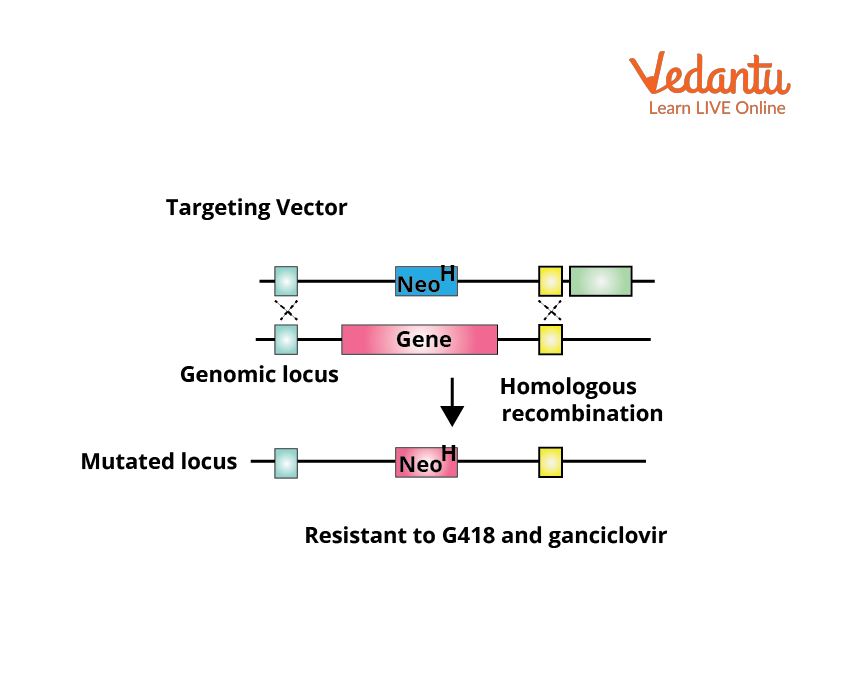
Gene Knockout by Homologous Recombination
Non-Homologous End Joining (NHEJ): It is a repair mechanism that can seal double-strand breaks in DNA without the need for a homologous template. During this ligation process, NHEJ integrates small insertions or deletions at the breakpoints. This leads to frameshift disrupting gene function.
Zinc-Fingers: These are restriction endonucleases integrated with specific binding domains. These recognise the desired codon or segment of DNA and bind to the target site. Binding is coupled with endonucleases activity which breaks the double strands of DNA. The repair mechanism mutates the target DNA sequence creating a loss of function.
CRISPR: It means clustered regularly interspaced short palindromic repeats. In this technique, the Cas enzyme cuts the target DNA at a specific site. Cas is integrated with RNA – guided endonuclease activity.
The guide RNA is constructed in accordance with the target gene for specific recognition. Once the target gene is identified, the Cas 9 enzyme cleaves the double-stranded DNA. The repair mechanism creates insertion and deletion, altering the gene function. This destructs the target gene and makes it non-functional.
Gene Knock Down
It is a molecular biological technique to suppress gene expression. This is done at the transcriptional level by modifying the mRNA sequences. Gene knockdown is a temporary method to decrease the activity of genes. As mRNA is alerted, the genomes of the organism do not get affected.
Gene Knock Down Technologies
RNA Interference: It is a technique to suppress or silence a gene by degrading its transcriptional mRNA. Small double-stranded siRNA (small interfering RNA) are inserted exogenously into the target cell. The sequence siRNA is designed complementary to the target mRNA. This results in the formation of double-stranded mRNA, which is then degraded by RISC (RNA-induced silencing complex) and has ribonuclease activity. Thus, resulting in the suppression of genes.
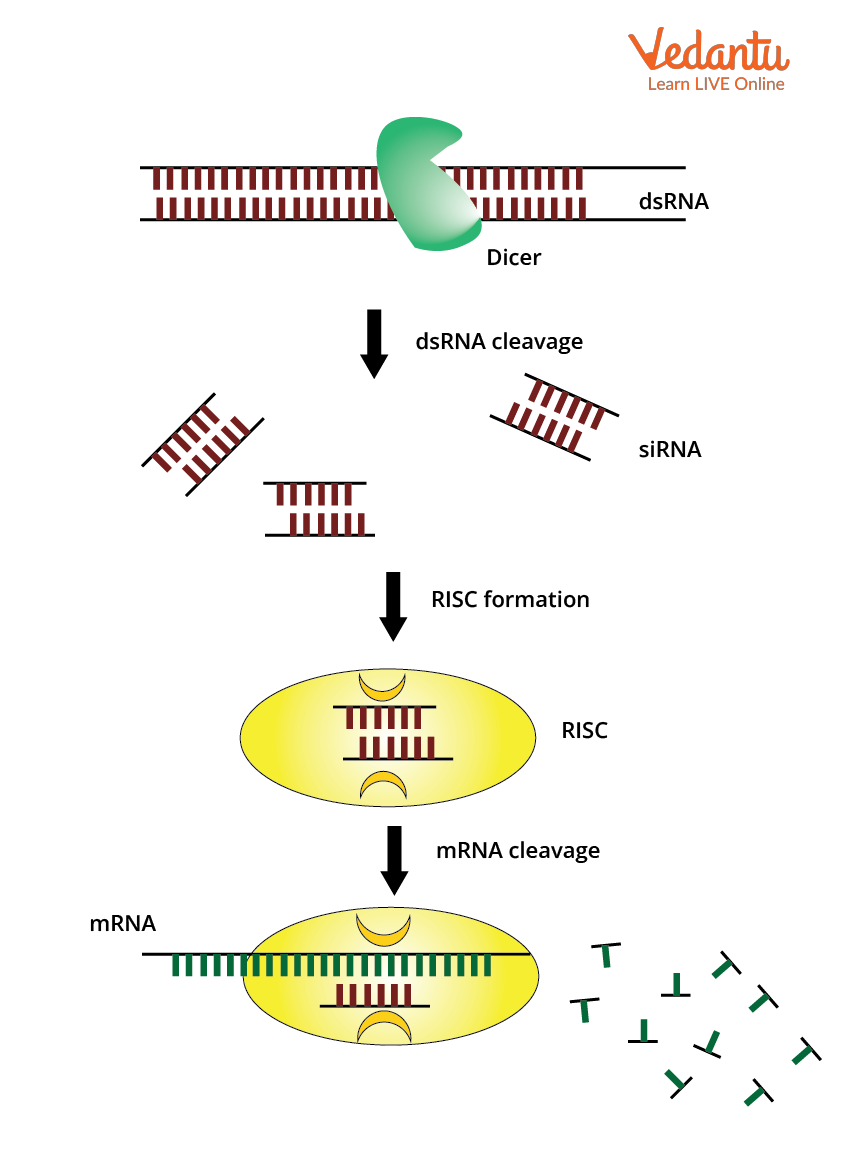
Knockdown by RNA Pathway
DNA-Based RNA Interference: In this technique, antisense oligonucleotides are constructed. These are 15 to 20 base long DNA sequences designed in antisense orientation to the target mRNA.
CRISPR Cas 13 Enzymes: This is generally used as gene knockout technology. In this method, rather than using Cas 9 enzyme, which targets DNA, Cas 13 enzymes are used. This enzyme directly targets RNA and degrades them. Using Cas 13 enzymes in cellular machinery will degrade mRNA, but the host DNA remains intact.
Differences Between Gene Knockout and Gene Knockdown
Interesting Facts
The year 2013 is considered after the CRISPR era and is the most recent endonuclease-based genetic engineering tool.
With the use of CAS enzymes, gene editing pigs are considered as best models for research in human disease and are potent models for xenotransplantation.
With help of new gene editing methods, it is easy to induce point mutations in the porcine genome of pigs that encodes for xenoantigen and are a recent model to understand human disease mutation.
Important Questions
1. Explain Genetically Modified Organisms (GMO).
Ans: Genetically modified organisms are engineered organisms created in the laboratory. expressing desired characteristics. GMOs are created using recombinant DNA technology. Example - Dolly, Bt cotton, etc.
2. Explain RNA interference Mechanism.
Ans: It is a post-transcriptional regulatory mechanism to control gene activity. The siRNA shows homology with mRNA and thus forms a DICER complex which cleaves the mRNA, thereby stopping translation.
Key Features
Gene knockout erases the gene permanently in an organism. This technique is used for drug discovery, understanding the gene effect, etc.
Gene knockdown suppresses the activity of genes at the transcriptional level.


FAQs on Difference Between Gene Knockout and Gene Knockdown Explained
1. What is the difference between gene knockout and gene knockdown?
The main difference between gene knockout and gene knockdown is that knockout completely removes or inactivates a gene, while knockdown only reduces its expression.
- Gene knockout results in a permanent loss of gene function by deleting or disrupting the DNA sequence.
- Gene knockdown decreases the level of gene expression, usually at the RNA level, without altering the DNA permanently.
- Knockout is often used to study gene function long term, whereas knockdown is useful for temporary or partial suppression studies.
2. What is gene knockout?
A gene knockout is a genetic technique in which a specific gene is completely inactivated or deleted from an organism’s genome.
- It disrupts the gene’s DNA sequence so no functional protein is produced.
- Commonly performed using CRISPR-Cas9, homologous recombination, or other genome editing tools.
- Widely used in model organisms like mice to study gene function and disease mechanisms.
3. What is gene knockdown?
A gene knockdown is a method used to reduce the expression of a specific gene without completely deleting it from the genome.
- It usually targets mRNA to prevent translation into protein.
- Common techniques include RNA interference (RNAi), siRNA, and shRNA.
- The effect may be temporary or partial, making it useful for studying essential genes.
4. How does gene knockout work?
Gene knockout works by disrupting the DNA sequence of a target gene so that it can no longer produce a functional protein.
- A genome editing tool like CRISPR-Cas9 creates a double-strand break in the target gene.
- The cell repairs the break through non-homologous end joining (NHEJ) or homologous recombination.
- This repair process introduces mutations or deletions that inactivate the gene.
5. How does gene knockdown work?
Gene knockdown works by targeting and degrading or blocking the translation of a gene’s mRNA to reduce protein production.
- Small interfering RNA (siRNA) binds to complementary mRNA.
- The RNA-induced silencing complex (RISC) degrades the target mRNA.
- As a result, less protein is synthesized from that gene.
6. Is gene knockout permanent?
Yes, a gene knockout is typically permanent because it alters the DNA sequence of the gene.
- The gene is deleted or disrupted at the genomic level.
- The change is stable and passed to daughter cells during cell division.
- In organisms, the mutation can be inherited by offspring if present in germ cells.
7. Is gene knockdown temporary or permanent?
Gene knockdown is usually temporary, although it can be made stable in some experimental systems.
- Transient knockdown occurs when siRNA is introduced and degrades over time.
- Stable knockdown can be achieved using vectors expressing shRNA.
- Unlike knockout, the original DNA sequence remains unchanged.
8. What are the advantages of gene knockdown over gene knockout?
Gene knockdown has the advantage of allowing partial and reversible suppression of gene expression.
- Useful for studying essential genes that would cause death if completely knocked out.
- Faster and often easier to perform than permanent genome editing.
- Allows researchers to study dose-dependent effects of reduced gene expression.
9. What are knockout and knockdown models used for?
Knockout and knockdown models are used to study gene function, disease mechanisms, and biological pathways.
- Knockout models help identify the role of a gene by observing effects when it is completely absent.
- Knockdown models help analyze the effects of reduced gene expression.
- Both are widely used in cancer research, developmental biology, and drug discovery.
10. Can you give an example of gene knockout and gene knockdown?
An example of gene knockout is deleting the p53 tumor suppressor gene in mice to study cancer development, while gene knockdown can involve using siRNA to reduce p53 expression in cultured cells.
- p53 knockout mice completely lack functional p53 protein and show increased tumor formation.
- p53 knockdown cells produce reduced levels of p53 protein but still retain the gene in their DNA.
- This comparison highlights the difference between complete loss and partial suppression of gene function.



