




What is the difference between open and closed circulatory system in structure and function
A circulatory system is essential in most multicellular organisms for transporting nutrients, oxygen, and other substances throughout the body. There are two main types of circulatory systems: open and closed. Understanding the difference between open and closed circulatory system helps us see how organisms adapt to their environments and maintain life processes.
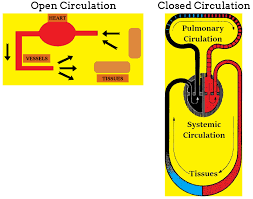
In an open circulatory system, the circulating fluid (often referred to as haemolymph) moves freely within body cavities, bathing organs directly. In a closed circulatory system, blood circulates strictly within a network of vessels, ensuring more efficient transport of substances.
What is an Open Circulatory System?
An open circulatory system is found in many invertebrates such as arthropods (cockroaches, spiders, crabs) and some molluscs (snails, clams). Here, the heart pumps haemolymph into open-ended vessels. This fluid leaves the vessels, enters body cavities or sinuses, and comes into direct contact with tissues.
Key Points:
Blood (haemolymph) directly bathes organs.
Blood and interstitial fluid are not distinct.
Common open circulatory system examples: Cockroaches, snails, spiders, crabs.
Generally lower blood pressure and slower flow.
No capillaries or a well-defined network of vessels.
What is a Closed Circulatory System?
A closed circulatory system is typically seen in vertebrates (fish, amphibians, reptiles, birds, mammals) and certain invertebrates like annelids (earthworms). In this system, blood remains confined within vessels—arteries, veins, and capillaries—throughout circulation.
Key Points:
Blood does not come into direct contact with tissues; exchange occurs through capillaries.
Blood and interstitial fluid are distinct.
Common closed circulatory system examples: Humans, cats, earthworms.
Higher blood pressure and faster flow.
Presence of well-developed vessels (arteries, veins, and capillaries).
Major Differences between Open and Closed Circulatory Systems
Additional Points and Unique Facts
Evolutionary Aspect: The closed circulatory system allows for higher metabolic rates and greater activity, which is why most large and highly active organisms possess it.
Energy Efficiency: Open systems require less energy to maintain but may not support very high metabolic demands. Closed systems, while more energy-intensive, provide precise delivery of nutrients and gases.
Quick Quiz (with Answers)
Which type of circulatory system involves haemolymph directly bathing the internal organs?
A) Closed circulatory system
B) Open circulatory system
Answer: B) Open circulatory system
Which one of these is a closed circulatory system example?
A) Cockroach
B) Human
Answer: B) Human
Where does gas exchange mainly occur in a closed circulatory system?
A) Sinuses
B) Capillaries
Answer: B) Capillaries
Which system typically has more control over blood volume and flow?
A) Open circulatory system
B) Closed circulatory system
Answer: B) Closed circulatory system
Simple Mnemonic for Key Differences
Try this mnemonic “OPEN: Organ Pool, ENcloses nothing” to remember that open circulatory systems let fluid pool around organs rather than enclosing blood in vessels.
And “CLOSE: Circulation Locked, Organised, Systemic & Efficient” for closed circulatory systems that are organised, locked in vessels, and more efficient.
Both open and closed circulatory systems play a vital role in transporting essential materials to support life processes. Open circulatory systems are found in smaller or less active organisms like cockroaches and snails, while closed circulatory systems typically occur in more complex or larger organisms such as humans and earthworms. The primary difference between open and closed circulatory system lies in how blood is circulated and how nutrients, gases, and wastes are exchanged with tissues.
Related Topics


FAQs on Open and Closed Circulatory System Differences Explained
1. What is the difference between open and closed circulatory system?
The main difference between an open circulatory system and a closed circulatory system is that blood flows freely in body cavities in the open system, while it remains enclosed within blood vessels in the closed system.
- In an open circulatory system, blood (hemolymph) directly bathes the organs in a body cavity called the hemocoel.
- In a closed circulatory system, blood circulates through a continuous network of arteries, veins, and capillaries.
- Closed systems allow faster and more efficient transport of oxygen and nutrients.
2. What is an open circulatory system?
An open circulatory system is a type of circulatory system in which blood is not confined to vessels and directly bathes body tissues.
- The circulating fluid is called hemolymph.
- Blood is pumped by the heart into open spaces known as the hemocoel.
- It operates at low blood pressure and slower circulation.
3. What is a closed circulatory system?
A closed circulatory system is a circulatory system where blood flows entirely within a network of blood vessels.
- Blood circulates through arteries, capillaries, and veins.
- Exchange of gases and nutrients occurs through thin-walled capillaries.
- It maintains higher blood pressure for efficient transport.
4. How does an open circulatory system work?
An open circulatory system works by pumping hemolymph from the heart into open body cavities where it directly surrounds organs.
- The heart pumps hemolymph into the hemocoel.
- Organs are bathed directly in hemolymph for nutrient and gas exchange.
- Hemolymph returns to the heart through openings called ostia.
5. How does a closed circulatory system work?
A closed circulatory system works by circulating blood through a continuous system of vessels powered by the heart.
- The heart pumps blood into arteries.
- Arteries branch into capillaries where exchange of oxygen, nutrients, and wastes occurs.
- Blood returns to the heart through veins.
6. What are examples of animals with open and closed circulatory systems?
Animals such as insects have an open circulatory system, while humans have a closed circulatory system.
- Open circulatory system: insects, spiders, crabs, most mollusks.
- Closed circulatory system: earthworms, fish, amphibians, reptiles, birds, mammals.
7. Why is a closed circulatory system more efficient than an open circulatory system?
A closed circulatory system is more efficient because blood flows at higher pressure within vessels, enabling faster and targeted transport.
- Maintains high blood pressure for rapid circulation.
- Allows controlled distribution of blood to specific organs.
- Supports higher metabolic rates in active animals.
8. What is hemolymph in an open circulatory system?
Hemolymph is the circulatory fluid in an open circulatory system that performs functions similar to blood and interstitial fluid.
- It transports nutrients, hormones, and wastes.
- It directly bathes tissues in the hemocoel.
- In many insects, it does not primarily carry oxygen (oxygen is delivered by the tracheal system).
9. What are the advantages and disadvantages of an open circulatory system?
An open circulatory system is simple and energy-efficient but less effective for rapid transport.
- Advantages:
- Requires less energy to operate.
- Simple structure with fewer vessels.
- Disadvantages:
- Low blood pressure and slower circulation.
- Limited control over blood distribution.
- Less efficient oxygen delivery.
10. Do humans have an open or closed circulatory system?
Humans have a closed circulatory system in which blood is always confined within blood vessels.
- The heart pumps blood through arteries, veins, and capillaries.
- It ensures efficient delivery of oxygen via red blood cells.
- It supports high energy demands and complex body functions.



