




What Is the Structural and Functional Difference Between Ribose and Deoxyribose
Ribose and deoxyribose are both monosaccharides (simple sugars) with five carbon atoms, known as aldopentoses. These sugars play a vital role in the structure of nucleic acids, which are key to storing and transmitting genetic information. DNA Structure relies on deoxyribose, whereas RNA incorporates ribose.
Here, we will discuss the difference between ribose and deoxyribose, their structures, functions, discovery, and other intriguing facts. We will also explore how these sugars connect to genetics, covering topics like deoxyribose sugar in DNA, the deoxyribose formula, and more.
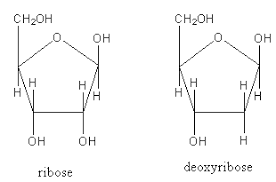
What is Deoxyribose?
Deoxyribose is a pentose sugar that has one less oxygen atom than ribose. Its chemical formula is C₅H₁₀O₄, and it is also referred to as 2-deoxy-D-ribose. In deoxyribose, the second carbon atom is attached to a hydrogen (H) instead of a hydroxyl (OH) group.
Molecular Structure: 2-deoxy-D-ribose has a hydrogen at the second carbon instead of a hydroxyl group.
deoxyribose sugar in DNA: Deoxyribose is the sugar present in deoxyribonucleic acid (DNA). Its presence gives DNA its name and helps form the DNA backbone along with phosphate groups.
Role in Genetics: Deoxyribose forms part of the nucleotides that link together to create the double-stranded DNA helix. The bases (adenine, thymine, guanine, and cytosine) attach to the sugar, enabling the storage of genetic information.
Discovery: It was discovered by Phoebus Levene in 1929.
Additional Notes on Deoxyribose
deoxyribose sugar hair growth: Some studies explore the role of sugars and sugar analogues in biological processes, but there is no definitive evidence that deoxyribose alone promotes hair growth directly in humans.
deoxyribose sugar gel: In certain biochemical or laboratory techniques, sugar-based gels can be used. Deoxyribose itself is not typically used as a standalone gel, but sugar derivatives might be part of experimental media.
What is Ribose?
Ribose is a pentose sugar with the chemical formula C₅H₁₀O₅. It has a hydroxyl (OH) group at the second carbon. Ribose is primarily found in ribonucleic acid (RNA).
Molecular Structure: Ribose has an OH group at the second carbon, making it slightly heavier (higher molar mass) than deoxyribose.
Role in RNA: Ribose is crucial for forming ribonucleotides, which are the building blocks of RNA. RNA is responsible for coding, decoding, and regulating gene expression.
Discovery: Emil Fischer and Oskar Piloty first identified ribose in 1891.
Key Differences Between Ribose and Deoxyribose
Below is a concise comparison table highlighting the major distinctions:
This difference between ribose and deoxyribose is crucial in defining the difference between DNA and RNA molecules. The absence of an oxygen atom in deoxyribose makes DNA more chemically stable, which is beneficial for long-term genetic information storage. RNA, containing ribose, is more reactive and suitable for tasks like protein synthesis and gene regulation.
Biological Significance
Both sugars have an aldehyde group in their open-chain form and serve as essential components of nucleic acids:
Deoxyribose (DNA):
Stores genetic instructions.
Passes hereditary information to the next generation.
Ribose (RNA):
Translates DNA’s genetic code into proteins.
Acts in various regulatory and catalytic roles (e.g., messenger RNA, transfer RNA, ribosomal RNA).
2-deoxy-D-ribose and Its Importance
2-deoxy-D-ribose is another name for deoxyribose.
It is crucial for making deoxyribonucleotides, which in turn form the structural units of DNA.
Its slight structural difference from ribose (missing an oxygen) significantly affects the function and stability of the nucleic acid.
Quick Quiz
Which sugar is found in DNA?
A. Ribose
B. Deoxyribose
Answer: B. Deoxyribose
Which sugar has the chemical formula C₅H₁₀O₅?
A. Ribose
B. Deoxyribose
Answer: A. Ribose
Who discovered ribose?
A. Phoebus Levene
B. Emil Fischer and Oskar Piloty
Answer: B. Emil Fischer and Oskar Piloty
Additional Fact
Just like we talk about the difference between DNA and RNA based on their sugar molecules, the subtle difference in sugar structures—hydroxyl (OH) in ribose versus hydrogen (H) in deoxyribose—makes a huge difference in their biological roles.
Related Topics to Explore


FAQs on Difference Between Ribose and Deoxyribose in DNA and RNA
1. What is the main difference between ribose and deoxyribose?
The main difference between ribose and deoxyribose is that ribose has one more oxygen atom than deoxyribose.
- Ribose contains a hydroxyl group (–OH) at the 2′ carbon.
- Deoxyribose has a hydrogen (–H) instead of –OH at the 2′ carbon.
- This small structural difference makes RNA less stable and DNA more stable.
2. What is ribose?
Ribose is a five-carbon sugar that forms the backbone of RNA (ribonucleic acid).
- It is a pentose monosaccharide.
- It contains hydroxyl (–OH) groups on the 2′ and 3′ carbons.
- It combines with nitrogenous bases and phosphate groups to form RNA nucleotides.
3. What is deoxyribose?
Deoxyribose is a five-carbon sugar that forms the backbone of DNA (deoxyribonucleic acid).
- It is a modified pentose sugar lacking one oxygen atom at the 2′ carbon.
- It has a hydrogen (–H) instead of a hydroxyl (–OH) group at the 2′ position.
- It forms DNA nucleotides along with nitrogenous bases and phosphate groups.
4. Why does deoxyribose have one less oxygen than ribose?
Deoxyribose has one less oxygen because the hydroxyl group at the 2′ carbon is replaced by hydrogen.
- In ribose, the 2′ carbon has an –OH group.
- In deoxyribose, the 2′ carbon has only –H.
- This absence of oxygen makes DNA less reactive and more chemically stable.
5. How does the structure of ribose and deoxyribose affect DNA and RNA stability?
The extra hydroxyl group in ribose makes RNA less stable, while the absence of this group in deoxyribose makes DNA more stable.
- The 2′ –OH group in RNA can participate in chemical reactions, leading to strand breakage.
- DNA lacks this 2′ –OH, reducing reactivity and increasing durability.
- This stability allows DNA to store genetic information long-term.
6. Where are ribose and deoxyribose found in the cell?
Ribose is found in RNA, while deoxyribose is found in DNA within cells.
- Ribose is present in mRNA, tRNA, and rRNA in the nucleus and cytoplasm.
- Deoxyribose is found in DNA mainly in the nucleus and also in mitochondria.
- Both sugars are part of the nucleotide backbone of nucleic acids.
7. What type of sugar are ribose and deoxyribose?
Ribose and deoxyribose are both pentose sugars, meaning they contain five carbon atoms.
- They are classified as monosaccharides.
- They exist mainly in a five-membered ring form called a furanose ring.
- They are components of nucleotides in nucleic acids.
8. How are ribose and deoxyribose similar?
Ribose and deoxyribose are similar because both are five-carbon sugars that form the backbone of nucleic acids.
- Both are pentose monosaccharides.
- Both attach to a phosphate group and a nitrogenous base to form a nucleotide.
- Both form phosphodiester bonds in nucleic acid chains.
9. What role do ribose and deoxyribose play in nucleotides?
Ribose and deoxyribose act as the sugar component of nucleotides, forming the structural backbone of DNA and RNA.
- Each nucleotide contains a pentose sugar, a phosphate group, and a nitrogenous base.
- The sugar links to the base at the 1′ carbon.
- The sugar connects to phosphate groups at the 3′ and 5′ carbons, forming phosphodiester bonds.
10. Why is deoxyribose important for DNA function?
Deoxyribose is important for DNA function because its structure provides chemical stability for long-term genetic storage.
- The absence of the 2′ –OH group reduces hydrolysis and strand breakage.
- This stability supports accurate DNA replication and inheritance.
- It allows DNA to maintain genetic information across generations.



