




Structure and Functions of the Fish Skeletal System with Diagram and Types
The structure of bones and cartilage that supports the body is known as the fish skeletal system. A fish is an aquatic and vertebrate animal. It has a well-developed skeleton system that helps in the formation of body structure. Even more basic is the skeleton of the Hagfish. Although the skeletons of sharks and rays are more complicated, they are still mostly made of cartilage rather than bones.
What is Skeleton?
A particular organism's skeleton is a typically stiff supporting or protecting structure or framework. The internal organs of a vertebrate are supported by and protected by a bony or mostly cartilaginous framework.
Fish Skeleton
Fish have vertebrae. The vertebrae, which make up the spine, have bone or cartilage that surrounds the dorsal nerve cord. A fish skeleton is formed of bones and cartilage. Some fish which are formed of only bones are called bony fishes, while those formed of cartilage are called cartilaginous fishes.
The predatory fishes in the class Chondrichthyes include sharks, rays, skates, and ratfishes. They have jaws and paired fins. Many of them have their skin covered by a special form of scale, and their skeleton is composed of cartilage rather than bone. These are cartilaginous fish.
Structure of Fish Skeleton
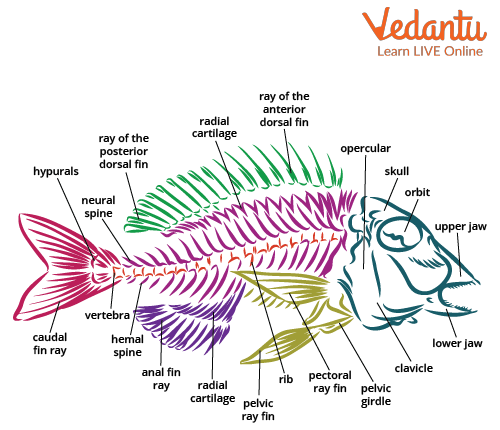
Skeleton of Fish
Fish Bones
Bones may recover on their own and become stronger than the original bone since they are made of tissues that include blood vessels and nerves. The skeleton system of a fish has many small bones. Approximately 150 bones are present in the skeletal system. The bones are dense, less flexible connective tissue.
Vomer: On the roof of the mouth is the vomer midline bone, which typically supports teeth.
Maxillary: Paired bones are located behind or above these bones (toothed primitively).
Articular: A moveable joint is formed dorsally by a pair of paired, angular-shaped bones that are articulated and take up a portion of the lower jaw's posterior end.
Retro Articular: Paired bones are located at each articular's lower posterior corner.
Dentary: Large paired dental bones that are united medially and create the lower jaw's front (toothed).
Opercle: Flat, paired, and connected to hyomandibula bones form the majority of the gill cover.
Centrum: The centrum, the central, cylindrical component of each vertebra, obstructs the embryonic notochord during ossification.
Scapula: They are a pair of flat bones that articulate with the cleithra posteriorly and the coracoids anteriorly. The cleithra and scapula articulate with the coracoid paired bones. Small bones, called radials, connect the fin rays; they articulate anteriorly with the scapula and coracoid bones.
Fish Skull
The skull is also known as the cranium. The fish's skull is really a double construction made up of two bone "boxes" that are encased in one another.
Dermal bone forms the outer shell of the skull. Endochondral bone makes up the inside of the skull. On the surface of the gills, there is an operculum. First, on top of the gills, is the preoperculum. The premaxilla is very close to the mouth. Second, in the mouth, after the palatine are the maxillae. The jaw's bottom is called the dental, and between the palatine and the dentary lies the angular. Between the palatine and hyomandibular is the quadrate, while the hyomandibular and cranium are joined. The mouth roof refers to the palatine.
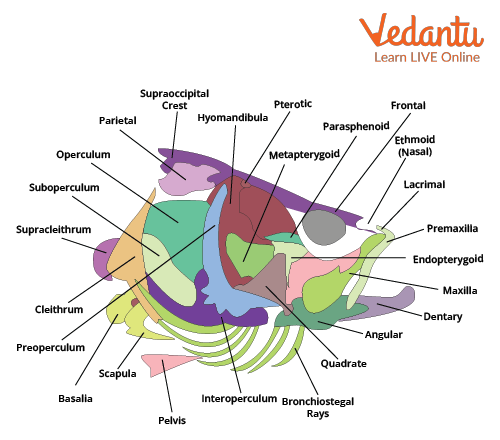
Skull Anatomy of Fish
Function of Skull
Fishes have a cranium (skull), which protects the brain. The skull covers the brain and protects it from any injury and shock.
Vertebral Column
The vertebral column is made up of a number of endochondral bones known as vertebrae. The centrum of one is the enormous spool-shaped core region. The trunk and the tail are the two sections of the fish’s vertebral column. Fish ribs are attached to the spinal column in the trunk region.
Pectoral and Pelvic Girdle
The pectoral fin is connected to the fish skeleton by the pectoral gridle. The pelvic girdle joins the fish skeleton to the pelvic fin. The pelvic girdle is free-floating and not connected to the spinal column or the pectoral girdle.
Types of Skeleton
There are two basic kinds of skeletons:
The exoskeleton, which serves as an organism's sturdy exterior shell, and
The endoskeleton, which provides the body's internal support system. The exoskeleton has scales of fishes.
An animal's internal support system, or endoskeleton, is made of tissue that has undergone mineralisation. The skin or deeper bodily tissues are where the endoskeleton develops. Essentially, a vertebrate has an endoskeleton consisting of two different types of tissues (bone and cartilage). Exoskeletons are skeletons that are external to the animal and are created to protect certain bodily parts.
Parts of the Skeleton
A fish is a vertebrate, and vertebrate skeletons may be generally classified into two axial and appendicular skeletons. The skull, vertebrae, and ribs make up the axial skeleton.
The pectoral and pelvic girdles, as well as the bones of the appendages, make up the appendicular skeleton.
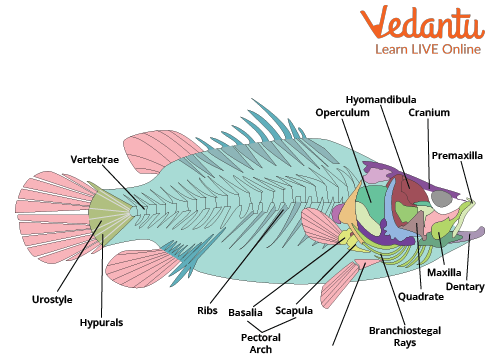
Fish Skeleton System
Function of Skeleton
It provides a framework and support that surrounds and supports the body's soft organs. The heart, lungs, and brain are among the fragile organs that the skeleton protects. It aids in bodily movement, and muscles use bones as levers. The bone is a component of the skeleton and aids in the storage of minerals like calcium and phosphate. Bone marrow in the bones aids in the production of blood cells.
Conclusion
Fishes are vertebrates and have bones and cartilage in their skeletal system. This skeletal system helps to make the framework of fishes. The fishes can be bony fishes in which only bones are present or can be cartilage fishes in which only cartilages are functional to form a skeleton.


FAQs on Fish Skeletal System Anatomy and Organization
1. What is the fish skeletal system?
The fish skeletal system is the internal framework made of bone or cartilage that supports the body, protects organs, and enables movement in fish.
It consists of:
- The axial skeleton (skull, vertebral column, ribs)
- The appendicular skeleton (fins and girdles)
2. What are the main parts of the fish skeleton?
The main parts of a fish skeleton are the axial skeleton and the appendicular skeleton.
- Axial skeleton: Includes the skull (cranium), vertebral column, and ribs.
- Appendicular skeleton: Includes pectoral fins, pelvic fins, and their supporting girdles.
3. What is the difference between bony fish and cartilaginous fish skeletons?
The main difference is that bony fish have skeletons made of bone, while cartilaginous fish have skeletons made of cartilage.
- Bony fish (Osteichthyes): Skeleton is hard and calcified; example – salmon, rohu.
- Cartilaginous fish (Chondrichthyes): Skeleton is flexible and made of cartilage; example – sharks, rays.
4. What is the function of the vertebral column in fish?
The vertebral column in fish provides support, protects the spinal cord, and allows flexible movement during swimming.
- It is made up of repeating units called vertebrae.
- It protects the spinal cord.
- It enables lateral bending for side-to-side swimming motion.
5. How does the fish skeleton help in swimming?
The fish skeleton helps in swimming by providing attachment points for muscles and allowing flexible body movements.
- The vertebral column bends sideways to create thrust.
- Fins supported by fin rays help in steering and balance.
- Strong muscle attachments to bones generate propulsion.
6. Do fish have ribs?
Yes, most fish have ribs that are attached to the vertebral column.
- Ribs help protect internal organs such as the liver and kidneys.
- They provide additional support to the body wall.
7. What is the role of the skull in the fish skeletal system?
The skull of a fish protects the brain and supports the jaws and gill structures.
- It encloses the brain and sensory organs.
- It forms the upper and lower jaws for feeding.
- It supports the gill arches for respiration.
8. What are fin rays in fish?
Fin rays are thin, bony or cartilaginous structures that support the fins of fish.
- They are called lepidotrichia in bony fish.
- They provide shape and stiffness to fins.
- They help in steering, stability, and propulsion.
9. What is the axial skeleton in fish?
The axial skeleton in fish is the central part of the skeleton that includes the skull, vertebral column, and ribs.
- Skull (cranium): Protects the brain.
- Vertebral column: Supports the body and protects the spinal cord.
- Ribs: Protect internal organs.
10. Why is the fish skeleton important for survival?
The fish skeleton is important for survival because it provides support, protection, and efficient movement in water.
- Protects vital organs like the brain and spinal cord.
- Enables fast and controlled swimming to escape predators.
- Supports feeding through strong jaw structures.



