




What Are Gymnosperms Definition Types Life Cycle and Examples
Gymnosperms are a group of seed-producing plants that do not form flowers or fruits. Instead, their seeds remain exposed on the surface of specialised structures such as scales or leaves. In many cases, these structures are organised into cones. Most gymnosperms plants are found in cooler regions, but some varieties also grow in warmer or drier climates. Let us explore their defining features, classifications, life cycle and gymnosperm plants examples in detail.
What are Gymnosperms?
The term “Gymnosperm” is derived from the Greek words “gymnos” meaning “naked” and “sperma” meaning “seed.” Thus, they are referred to as “naked seeds.” Their seeds are not enclosed by the walls of an ovary or fruit, which distinguishes them from angiosperms. The fossil record suggests gymnosperms date back to the Palaeozoic Era, approximately 390 million years ago.
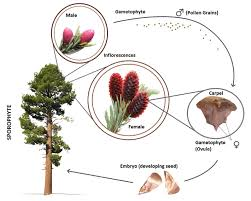
Key points about gymnosperms:
They produce seeds without forming flowers or fruits.
They often have tough, needle-like leaves with sunken stomata and a thick cuticle to minimise water loss.
Their reproductive structures are typically organised into cones (male and female).
Main Characteristics of Gymnosperms
Non-flowering plants: They do not produce flowers and fruits.
Naked seeds: Seeds develop on cone scales or leaf-like structures without any protective covering like a fruit.
Adaptations: Many gymnosperms characteristics include needle-like leaves, thick cuticles and sunken stomata, particularly suited for colder or drought-prone regions.
Vascular system: They have well-developed vascular tissues (xylem and phloem). However, xylem generally lacks vessels (except in gnetophytes), and their phloem lacks companion cells.
Cones or strobili: The reproductive structures (male and female cones) typically bear sporangia where the spores and subsequently gametophytes are produced.
Pollination: Occurs mainly by wind as there is no stigma to receive pollen. Pollen grains directly reach the ovule through pollination.
Male gametes: The male gametophytes often produce two gametes, but only one is functional in most species.
Dioecious or monoecious: Some gymnosperms (such as cycads and Ginkgo) have separate male and female plants (dioecious), whereas others have both types of cones on the same plant (monoecious).
Classification of Gymnosperms
Gymnosperms are commonly classified into four groups:
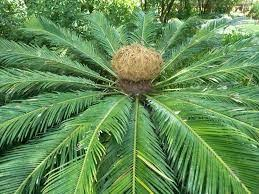
Cycadophyta (Cycads)
These are mostly dioecious plants (separate male and female plants).
They have thick trunks, large compound leaves and small leaflets.
Mostly found in tropical and subtropical regions, though some adapt to arid or swampy environments.
Ginkgophyta (Ginkgo)
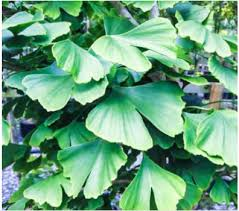
This division has only one extant species: Ginkgo biloba.
Characterised by unique fan-shaped leaves.
Ginkgo biloba is resistant to pollution and has been known to survive extreme conditions.
Commonly used in traditional remedies for various memory-related conditions.
Gnetophyta (Gnetophytes)
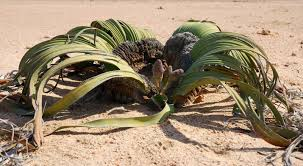
Comprises a few remaining genera such as Gnetum, Ephedra and Welwitschia.
Their leaves may appear somewhat “flowery,” hinting at an evolutionary link to angiosperms.
Possess vessels in the xylem (a trait shared with angiosperms).
Coniferophyta (Conifers)
The largest group of gymnosperms, including pines, cedars, spruces and firs.
Generally evergreen, retaining leaves all year round.
Commonly found in temperate regions with moderate to cold climates.
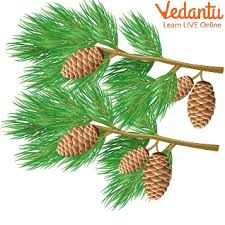
Gymnosperms Examples with Names
Here are some gymnosperm plants examples that you might come across:
Cycas
Pinus (pine)
Araucaria (monkey puzzle tree)
Thuja (arborvitae)
Cedrus (cedar)
Picea (spruce)
Abies (fir)
Juniperus (juniper)
Larix (larch)
Each of these gymnosperms examples with names highlights the diversity within this group. For instance, Pinus species are typically found in colder climates and often form extensive forests, while Cycas grows in tropical or subtropical environments.
Life Cycle of Gymnosperms
Gymnosperms exhibit alternation of generations, with a dominant sporophyte stage (diploid) and a shorter gametophyte stage (haploid). Their life cycle can be broadly outlined as follows:
Sporophyte generation: The main plant body is diploid (2n). Cones (strobili) appear, each bearing sporangia.
Male cone (microstrobilus): Contains microsporophylls with microsporangia, which produce haploid microspores. Some microspores develop into pollen grains (male gametophytes).
Female cone (megastrobilus): Bears megasporophylls with ovules containing megasporangia. These produce haploid megaspores; typically, one megaspore survives to form the female gametophyte.
Pollination: The wind carries pollen grains to the female cone.
Fertilisation: The male gamete (from pollen) fuses with the female gamete (egg) inside the ovule, forming a diploid zygote.
Seed formation: The fertilised ovule develops into a seed. These seeds rest openly on cone scales or leaf-like structures (hence “naked seeds”).
To learn more about another group of seed-producing plants that bear flowers, check our detailed article on Angiosperms. Also, read more about the Alternation of Generations in plants.
Unique Facts
Many conifers are economically important for timber, resin, paper production and ornamental use.
Ginkgo biloba is extremely resilient; after the Hiroshima nuclear bomb, a few Ginkgo trees near the blast site survived.
Cycads have motile sperm cells – a rather ancient feature, rarely found in modern seed plants.
Gymnosperm resin can protect against insects and fungal infections.
Mnemonics to Remember Gymnosperms
Here is a simple mnemonic to recall the four main divisions of gymnosperms:
“C G G C” – Cycadophyta, Ginkgophyta, Gnetophyta, Coniferophyta.
You might also modify it to something memorable like:
“Cool Green Giants Conquer” (representing Cycadophyta, Ginkgophyta, Gnetophyta, Coniferophyta).
Quiz on Gymnosperms (With Answers)
Try this short quiz to check your understanding:
1. Which group of gymnosperms includes Gnetum and Welwitschia?
A. Cycadophyta
B. Ginkgophyta
C. Gnetophyta
D. Coniferophyta
Answer: C. Gnetophyta
2. Why are gymnosperm seeds called “naked seeds”?
A. Because they lack a seed coat
B. Because they are not enclosed in an ovary or fruit
C. Because they grow in water
D. Because they lose their outer covering after fertilisation
Answer: B. Because they are not enclosed in an ovary or fruit
3. Which gymnosperm is known for fan-shaped leaves and resilience against pollution?
A. Pinus
B. Cycas
C. Ginkgo biloba
D. Cedrus
Answer: C. Ginkgo biloba
4. Which stage is dominant in the life cycle of gymnosperms?
A. Gametophyte (haploid)
B. Sporophyte (diploid)
C. Zygotic (diploid)
D. Prothallus (haploid)
Answer: B. Sporophyte (diploid)
Related Topics


FAQs on Gymnosperms Structure Classification and Reproduction
1. What are gymnosperms?
Gymnosperms are seed-producing vascular plants that bear naked seeds not enclosed within a fruit. Unlike flowering plants, their seeds are exposed on the surface of cones or similar structures. Key features include:
- Presence of vascular tissues (xylem and phloem)
- Production of seeds without forming fruits
- Dominant sporophyte generation
- Mostly woody plants such as trees and shrubs
2. Why are gymnosperms called naked seed plants?
Gymnosperms are called naked seed plants because their seeds are not enclosed within an ovary or fruit. In these plants:
- The ovules are exposed on the surface of cone scales
- After fertilization, seeds develop openly without forming a fruit
- There is no ovary as seen in angiosperms
3. What are the main characteristics of gymnosperms?
The main characteristics of gymnosperms include naked seeds, cones, and well-developed vascular tissues. Important features are:
- Seeds borne on cones
- Absence of flowers and fruits
- Presence of xylem (mainly tracheids) and phloem
- Dominant sporophyte plant body
- Mostly evergreen trees with needle-like or scale-like leaves
4. What are some examples of gymnosperms?
Common examples of gymnosperms include conifers, cycads, ginkgo, and gnetophytes. Examples are:
- Pinus (pine)
- Cycas (cycad)
- Ginkgo biloba
- Ephedra
5. How do gymnosperms reproduce?
Gymnosperms reproduce by forming seeds through a process involving cones and pollination. The steps include:
- Production of male cones that release pollen grains
- Formation of female cones containing ovules
- Wind pollination transfers pollen to ovules
- Fertilization forms a zygote, which develops into a seed
6. What is the difference between gymnosperms and angiosperms?
The main difference between gymnosperms and angiosperms is that gymnosperms have naked seeds, while angiosperms have seeds enclosed in fruits. Key differences include:
- Gymnosperms: Seeds exposed on cones, no flowers, no fruits
- Angiosperms: Seeds enclosed within an ovary that develops into fruit
- Double fertilization occurs only in angiosperms
- Gymnosperms mostly have needle-like leaves, while angiosperms usually have broad leaves
7. What are the different types of gymnosperms?
Gymnosperms are classified into four main groups based on structure and evolutionary traits. These groups are:
- Coniferophyta (conifers like pine and fir)
- Cycadophyta (cycads like Cycas)
- Ginkgophyta (Ginkgo biloba)
- Gnetophyta (Ephedra, Gnetum, Welwitschia)
8. What is the structure of a gymnosperm cone?
A gymnosperm cone is a reproductive structure made up of a central axis bearing modified leaves called scales. Its structure includes:
- Male cone: Contains microsporophylls with pollen sacs
- Female cone: Contains megasporophylls with exposed ovules
- A central woody axis supporting the scales
9. Why are gymnosperms important?
Gymnosperms are important because they provide ecological stability, timber, and economic products. Their significance includes:
- Major source of softwood timber and paper pulp
- Production of resins, turpentine, and medicinal compounds
- Act as dominant trees in many forest ecosystems
- Help in carbon sequestration and oxygen production
10. Do gymnosperms produce flowers or fruits?
Gymnosperms do not produce flowers or fruits; instead, they reproduce using cones. Unlike angiosperms:
- There are no true flowers with petals or sepals
- No ovary develops into a fruit
- Seeds remain exposed on cone scales



