




What is Homeostasis Definition Mechanism and Examples
Homeostasis is the process through which an organism maintains a stable internal environment despite fluctuations in its external surroundings. In simpler words, homeostasis simple definition can be stated as a self-regulating system that ensures internal conditions remain constant for optimal functioning. This stability is crucial for survival, growth, and reproduction across all forms of life, from single-celled organisms to complex vertebrates.
If you have ever wondered what homeostasis is in biology, think about how your body adjusts its temperature on a hot day by sweating or when your heartbeat rate changes during exercise. These automatic responses are classic illustrations of homeostasis definition and examples in action.
Homeostasis Meaning & Etymology
The homeostasis medical definition stems from the Greek words “ὅμοιος” (hómoios), meaning “similar,” and “ἵστημι” (hístēmi), meaning “standing still.” This term was first coined in 1926 by Walter Bradford Cannon, though the concept was originally introduced in 1865 by Claude Bernard, a French physiologist. Together, they laid the foundation for understanding homeostasis physiology, demonstrating how living organisms strive to keep their internal environments stable.
Mechanisms of Homeostasis
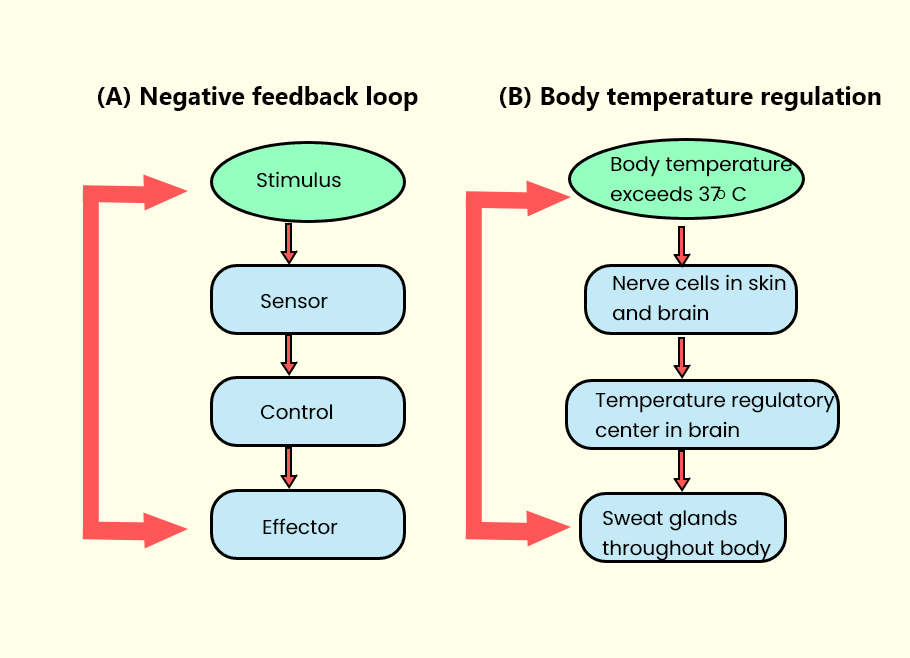
To understand homeostasis definition and examples in depth, it’s important to know how these mechanisms work. There are three key components involved in this process:
Receptor (Sensor): A receptor detects changes (or stimuli) in the external and internal environment. For instance, skin receptors pick up temperature changes.
Control Centre (Integration Centre): The control centre, often located in the brain or spinal cord, processes the information received from the receptor and determines the appropriate response.
Effector: The effector carries out the necessary action decided by the control centre. An effector can be a muscle, a gland, or any structure capable of producing the required response.
Negative and Positive Feedback Loops
Negative Feedback: The most common mechanism in homeostasis physiology. It counteracts any deviation from the set point. For example, if your blood sugar is high, insulin is released to lower it.
Positive Feedback: Less common but still essential. It amplifies the initial stimulus, such as during childbirth, where contractions intensify to facilitate delivery.
Body Systems & Homeostasis
Multiple organ systems work collaboratively to achieve homeostasis. Understanding what is homeostasis in biology also requires recognising the roles of these body systems:
Nervous System
Central Nervous System (CNS): Comprises the brain and spinal cord, acting as the primary control centre for receiving and processing stimuli.
Peripheral Nervous System (PNS): Includes nerves branching out to the rest of the body, transmitting signals to and from the CNS.
Autonomic System: Regulates involuntary functions like heart rate, digestion, and respiratory rate, crucial for homeostasis physiology.
Endocrine System
Composed of glands such as the pituitary, thyroid, and adrenal glands, which secrete hormones.
Hormones like insulin, cortisol, and adrenaline regulate various functions including metabolism, stress response, and blood glucose levels to ensure homeostasis.
Circulatory System
Transports nutrients, gases, and waste products through blood, helping to maintain pH balance, temperature, and oxygen supply.
Respiratory System
Maintains blood oxygen and carbon dioxide levels through gas exchange in the lungs, another homeostasis example of balancing internal conditions.
Excretory System
Removes metabolic wastes and regulates water-salt balance, aiding in homeostasis medical definition by keeping internal fluid levels stable.
Digestive System
Breaks down food and absorbs nutrients, vital for producing the energy required for all bodily processes related to homeostasis simple definition.
To learn more about related concepts, explore our detailed article on Thermoregulation, where you can understand how the body maintains a stable temperature. You might also want to see Osmoregulation to discover how organisms balance water and solute levels.
Homeostasis Example in Action
A classic homeostasis example is body temperature regulation:
Stimulus: A rise or drop in the external temperature.
Receptor: Skin receptors detect the change.
Control Centre: The hypothalamus in the brain processes this information.
Effector: Sweat glands (to cool down) or muscle activity (shivering to generate heat).
Similarly, Blood Glucose Homeostasis is controlled by hormones such as insulin and glucagon. When blood glucose rises after a meal, insulin helps cells absorb more glucose; if glucose levels are too low, glucagon stimulates the liver to release stored glucose.
Failure of Homeostasis
When the body’s regulatory mechanisms fail, it leads to imbalances that can result in diseases, disorders, or even life-threatening conditions. Here are some common factors that disrupt homeostasis medical definition:
Genetic mutations
Poor diet or malnutrition
Toxin or venom exposure
Chronic stress or psychological conditions
Side effects of medications
Organ failure and age-related degeneration
Severe disruptions can make it extremely challenging for the body to revert to its stable internal environment.
Additional Examples of Homeostasis
Apart from temperature and blood glucose regulation, other vital examples include:
Blood pH Balance: Maintaining a slightly alkaline pH (around 7.4)
Blood Pressure Regulation: Ensuring stable arterial pressure through vasoconstriction or vasodilation
Electrolyte Balance: Sustaining appropriate levels of sodium, potassium, and calcium
Fluid Balance: Ensuring adequate hydration and solute concentration
These processes collectively highlight the versatility of homeostasis definition and example across different body systems.
Unique Insights & Interesting Facts
Origins of the Concept: Claude Bernard focused on the “milieu intérieur,” emphasising an internal stable environment. Walter Cannon built upon this idea, coining the term homeostasis.
Dynamic Equilibrium: Although “standing still” is part of the etymology, homeostasis is a dynamic process with continuous adjustments.
Wide Applicability: What is homeostasis in biology is not limited to humans; even plants regulate water through stomata, and single-celled organisms maintain ionic balance via active transport.
Behavioural Homeostasis: Besides physiological changes, organisms exhibit behavioural strategies, such as seeking shade or migrating, to maintain equilibrium.
Mnemonics to Master Homeostasis
A quick mnemonic to remember some essential variables controlled by homeostasis is “TOBCOW”:
Temperature
Oxygen
Blood pressure
Carbon dioxide
Osmotic balance
Water balance
This mnemonic reminds you of key factors that an organism regulates for homeostasis physiology.
Interactive Quiz
Test your understanding of homeostasis with a short quiz:
What part of the body acts as the main control centre for temperature regulation?
a) Heart
b) Hypothalamus
c) Lungs
d) Kidneys
Which of the following is an example of positive feedback?
a) Regulation of blood sugar levels
b) Maintenance of normal blood pressure
c) Blood clotting or labour contractions
d) Thermoregulation through sweating
Which system plays a key role in hormone production for homeostasis?
a) Nervous system
b) Excretory system
c) Respiratory system
d) Endocrine system
What is the primary benefit of negative feedback loops in homeostasis?
a) They amplify changes in the body
b) They detect changes but do not respond
c) They reverse deviations from normal levels
d) They speed up metabolic waste removal
Answers to Quiz
b) Hypothalamus
c) Blood clotting or labour contractions
d) Endocrine system
c) They reverse deviations from normal levels
Check out our related articles on


FAQs on Homeostasis in Living Organisms and Body Regulation
1. What is homeostasis in biology?
Homeostasis is the ability of a living organism to maintain a stable internal environment despite changes in the external environment. It keeps conditions such as body temperature, pH, blood glucose level, and water balance within narrow limits. This stability is essential for proper enzyme function and overall survival. In humans and other animals, homeostasis is regulated mainly by the nervous system and endocrine system.
2. Why is homeostasis important for living organisms?
Homeostasis is important because it ensures optimal conditions for cellular processes and enzyme activity. Most enzymes work efficiently only within specific ranges of temperature and pH. If internal conditions fluctuate too much, it can lead to cell damage or death. By maintaining internal balance, homeostasis supports metabolism, growth, reproduction, and survival in changing environments.
3. How does homeostasis work in the human body?
Homeostasis in the human body works through coordinated control systems that detect changes and trigger responses to restore balance. The basic steps include:
- Receptor – detects a change in the internal environment.
- Control center (often the brain or endocrine gland) – processes information and sends signals.
- Effector – muscles or glands that carry out the corrective action.
For example, if body temperature rises, the hypothalamus activates sweating to cool the body.
4. What is negative feedback in homeostasis?
Negative feedback is a regulatory mechanism in which a change in a variable triggers a response that reverses the initial change. It is the most common mechanism of homeostatic regulation. For example, when blood glucose levels rise, the pancreas releases insulin, which lowers glucose levels back to normal. Once balance is restored, insulin secretion decreases.
5. What is positive feedback in homeostasis?
Positive feedback is a mechanism in which a change in a variable triggers responses that amplify the original change. Unlike negative feedback, it increases the effect until a specific outcome is reached. A classic example is childbirth, where the hormone oxytocin intensifies uterine contractions until delivery occurs. Positive feedback is less common and usually associated with specific events.
6. What are some examples of homeostasis in the body?
Common examples of homeostasis include regulation of temperature, blood sugar, and water balance. Key examples are:
- Thermoregulation – sweating when hot and shivering when cold.
- Blood glucose regulation – insulin and glucagon control sugar levels.
- Osmoregulation – kidneys adjust water and salt balance.
- pH regulation – buffers and respiration maintain blood pH around 7.4.
7. How does the body regulate temperature through homeostasis?
The body regulates temperature through thermoregulation controlled by the hypothalamus. When body temperature rises:
- Sweat glands produce sweat for evaporative cooling.
- Blood vessels dilate (vasodilation) to release heat.
When temperature drops:
- Shivering generates heat through muscle activity.
- Vasoconstriction reduces heat loss.
These responses maintain a core temperature near 37°C in humans.
8. What is the role of the kidneys in homeostasis?
The kidneys maintain homeostasis by regulating water balance, electrolyte levels, and waste removal. They perform key functions such as:
- Filtering blood to remove urea and metabolic wastes.
- Adjusting water reabsorption to control blood volume.
- Balancing electrolytes like sodium and potassium.
- Helping regulate blood pH by excreting hydrogen ions.
These processes are vital for stable internal conditions.
9. What is the difference between homeostasis and equilibrium?
Homeostasis is a dynamic process that maintains stable internal conditions, while equilibrium is a state of complete balance with no net change. In homeostasis, the body continuously adjusts variables within a narrow range using feedback mechanisms. In contrast, equilibrium implies no energy input or active regulation, which is not typical of living systems.
10. Can plants maintain homeostasis?
Yes, plants maintain homeostasis by regulating internal water balance, gas exchange, and nutrient levels. For example:
- Stomata open and close to control water loss and carbon dioxide intake.
- Transpiration helps regulate temperature.
- Hormones like abscisic acid respond to drought stress.
Although plants lack a nervous system, they use hormonal and cellular mechanisms to maintain internal stability.



