




Structure and functions of pivot joints with examples
Pivot joints are a type of synovial joint that allows bones to rotate around a single axis. Unlike a hinge joint, which typically permits back-and-forth motion (like a door hinge), or a gliding joint, which allows bones to slide past each other, a pivot joint specialises in rotational mobility. Below, we’ll explore pivot joint movement, look at some pivot joint examples, learn about potential disorders, and see why these joints are crucial for our everyday activities. We’ll also include a pivot joint diagram for a clearer visual understanding, plus a fun quiz to test your knowledge.
What is a Pivot Joint?
A pivot joint is formed when the rounded or cylindrical surface of one bone rotates within a ring-shaped structure (often comprising bone and ligament) of another. This design lets the rotating bone move in a circular path around a single axis, making it possible for us to turn our head side to side or twist our forearm.
Key Structural Features of Pivot Joints
Bone Cylinder or Ring: One bone typically has a rounded or cylindrical head that fits into a ring formed by another bone and its ligament.
Synovial Membrane: Like other synovial joints, pivot joints contain a synovial membrane that secretes synovial fluid, reducing friction and aiding smooth pivot joint movement.
Joint Capsule: A fibrous capsule encloses the joint, providing stability.
Articular Cartilage: The ends of the bones in a pivot joint are lined with cartilage to minimise wear and tear.
Examples of Pivot Joints in the Body
1. Neck (Atlas-Axis Joint)
The first cervical vertebra (atlas) and the second cervical vertebra (axis) form a pivot joint right beneath the skull.
This joint facilitates the side-to-side rotation of the head—like shaking your head to say “no.”
Without this pivot joint movement, tasks such as looking over your shoulder or turning your head quickly would be difficult.
2. Forearm (Radius and Ulna)
One of the most commonly cited examples of pivot joints in the body is the joint between the radius and ulna near the elbow.
This joint allows the rotation of the forearm, enabling motions like pronation (turning the palm down) and supination (turning the palm up).
A similar pivot joint exists near the wrist where the radius and ulna connect again, allowing you to twist and pivot the forearm with ease.
3. Additional Wrist Movement
While the wrist is primarily a gliding joint in some areas, pivot elements also play a role, especially when you flip your hand up and down.
The seamless rotation and adjustment of the wrist angle rely significantly on the interplay of various joints, but pivot characteristics are critical for full rotational freedom.
Pivot Joint Diagram
Below is a simplified description of what a pivot joint diagram typically includes (we recommend viewing an actual labelled image for better clarity):
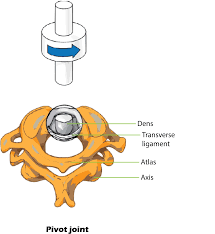
Labelled Bones: The atlas and axis, or the radius and ulna, highlighting the circular head.
Ring Structure: An illustration showing how a bony ring or ligament encloses the rotating bone.
Synovial Capsule: A depiction of the capsule holding the fluid for lubrication.
How Pivot Joints Improve Coordination
While hinge joint and gliding joint structures support bending and sliding movements, pivot joints contribute significantly to our coordination. Imagine trying to pass a ball around your waist or twist open a jar lid without rotating your forearm. Pivot action is essential for such activities, making daily tasks simpler and more efficient.
Additional Point: Pivot joints develop robustly during early growth as part of the body’s skeletal system. Proper nutrition, including calcium and vitamin D, supports healthy bone and joint formation.
What Happens If Pivot Joints Malfunction? (Common Disorders)
Ankylosis
Fusion of bones across a joint, leading to the absence of normal movement.
Often a complication of arthritis.
Ankylosing Spondylitis
An inflammatory disease causes some of the spine’s vertebrae to fuse.
Reduces the flexibility of the neck and may impact the pivot joint between the atlas and the axis.
Capsulitis
Inflammation of the joint capsule, often due to improper mechanics or excess pressure.
Commonly affects the ball of the foot but can impact other joints as well.
Dislocation
Occurs when a bone is forced out of its normal position.
In a pivot joint, such as the neck or forearm, this can severely restrict pivot joint movement and cause immense pain.
Neoplasms
Abnormal growth of tissue; can be benign or malignant (cancerous).
Tumours around a pivot joint may disrupt normal function.
Rheumatoid Arthritis
An autoimmune condition where the immune system attacks healthy tissue.
Can lead to swollen, painful joints, restricting motion in areas like the forearm or neck.
Why Pivot Joints are Invaluable
Versatility in Movement: They allow rotational movement crucial for turning the head, twisting the wrist, and rotating the forearm.
Efficiency: Reduce strain on muscles by providing mechanical advantage in circular motions.
Stability & Support: Despite their rotational freedom, they maintain stability via ligaments and the joint capsule.
Coordination: Work seamlessly with hinge joint and gliding joint counterparts for complex tasks like throwing a ball or looking in multiple directions.
Without healthy pivot joints, the body would become rigid, making everyday tasks like driving, cooking, or simply looking around significantly more difficult.
Also, read Types of Joints in the Human Body
Fun Task: Pivot Joint Hunt
Pick a typical day’s activities—such as brushing your teeth, writing, or turning your head to converse. Identify moments when you rotate your forearm or move your neck from side to side. Note down at least 5 instances of such rotational movements. You’ll be amazed at how often you rely on pivot joint movement!
Interactive Quiz: Test Your Pivot Joint Knowledge
Which two bones in the forearm form a pivot joint?
a) Radius and humerus
b) Radius and ulna
c) Ulna and humerus
What type of motion does a pivot joint primarily allow?
a) Bending and straightening
b) Gliding or sliding
c) Rotation around a single axis
Which vertebrae are involved in the pivot joint under the skull?
a) Atlas and axis
b) Axis and occipital bone
c) Atlas and thoracic vertebra
How does a pivot joint differ from a hinge joint?
a) Pivot joints allow rotation; hinge joints allow angular motion
b) Both allow only back-and-forth movement
c) Both allow only rotational movement
Which disorder involves the fusion of the spine’s vertebrae, potentially affecting pivot joint function?
a) Dislocation
b) Ankylosing Spondylitis
c) Capsulitis
Check Your Answers
b) Radius and ulna
c) Rotation around a single axis
a) Atlas and axis
a) Pivot joints allow rotation; hinge joints allow angular motion
b) Ankylosing Spondylitis


FAQs on Pivot Joints in the Human Body
1. What is a pivot joint?
A pivot joint is a type of synovial joint in which one bone rotates around another bone along a single axis. It allows rotational movement only, meaning one bone turns around a central axis formed by another bone. Pivot joints are classified under synovial joints because they have a joint cavity filled with synovial fluid, a joint capsule, and articular cartilage.
2. Where is a pivot joint found in the human body?
A pivot joint is found in the neck and forearm, specifically at the atlantoaxial joint and the proximal radioulnar joint. Important examples include:
- Atlantoaxial joint – between the atlas (C1) and axis (C2) vertebrae.
- Proximal radioulnar joint – between the radius and ulna near the elbow.
These joints allow rotation of the head and forearm.
3. What movement does a pivot joint allow?
A pivot joint allows rotational movement around a single longitudinal axis. This type of movement is called rotation, where one bone spins around another. Examples include:
- Turning the head side to side ("no" movement).
- Rotating the forearm to turn the palm up or down.
It does not allow bending, straightening, or side-to-side movement.
4. How does the atlantoaxial pivot joint work?
The atlantoaxial joint works by allowing the atlas vertebra to rotate around the dens of the axis vertebra. The mechanism includes:
- The dens (odontoid process) of the axis acting as a pivot.
- The atlas forming a ring that rotates around the dens.
- Ligaments stabilizing the joint to prevent excessive movement.
This joint enables the head to turn left and right.
5. What is the function of a pivot joint?
The main function of a pivot joint is to permit controlled rotational movement in the body. Its key roles include:
- Allowing head rotation at the neck.
- Enabling forearm rotation during pronation and supination.
- Providing stability while allowing limited, precise motion.
This makes pivot joints essential for coordinated body movements.
6. What is the difference between a pivot joint and a hinge joint?
The key difference is that a pivot joint allows rotation, while a hinge joint allows bending and straightening. Comparison:
- Pivot joint: Uniaxial rotation (e.g., atlantoaxial joint).
- Hinge joint: Flexion and extension only (e.g., elbow, knee).
Both are synovial joints, but they permit different types of movement.
7. Is a pivot joint a synovial joint?
Yes, a pivot joint is a type of synovial joint characterized by a fluid-filled joint cavity and a surrounding capsule. Like other synovial joints, it contains:
- Articular cartilage covering bone ends.
- A synovial membrane producing synovial fluid.
- A joint capsule for stability.
These features allow smooth and frictionless rotation.
8. How does the pivot joint in the forearm help in movement?
The pivot joint in the forearm allows the radius to rotate around the ulna during pronation and supination. Specifically:
- Pronation – turning the palm downward.
- Supination – turning the palm upward.
This movement occurs at the proximal radioulnar joint and is essential for daily tasks like turning a doorknob.
9. Why is the pivot joint considered uniaxial?
A pivot joint is considered uniaxial because it permits movement around only one axis. The rotation occurs along a single longitudinal axis formed by one bone acting as a pivot. Unlike ball-and-socket joints, it does not allow movement in multiple planes.
10. What are the structural features of a pivot joint?
A pivot joint has a ring-like structure where one bone rotates around another fixed bone. Its main structural features include:
- A rounded or pointed bone surface acting as a pivot.
- A ring formed by bone and ligaments that encircle the pivot.
- A synovial cavity filled with synovial fluid.
- Articular cartilage reducing friction.
These components ensure stable and smooth rotational movement.



