




What are polysaccharides definition types and functions with examples
Polysaccharides are some of the most important biomolecules on Earth, serving critical roles in both plants and animals. Whether you are curious about polysaccharide definition and examples, want to find out is cellulose a polysaccharide, or simply wish to explore examples of polysaccharides, this article will guide you through everything you need to know. Let us analyse their structure, types, and polysaccharide function in organisms, and learn how they impact our everyday lives.
What are Polysaccharides?
A polysaccharide is a large carbohydrate molecule formed by the linkage of many smaller sugar units called monosaccharides. These linked monosaccharides can create straight chains (linear) or branching structures. Since they contain multiple repeating sugar units, polysaccharides are sometimes called complex carbohydrates.
Key Features of Polysaccharides
Non-sweet and generally insoluble: Unlike simple sugars, most polysaccharides do not taste sweet and do not dissolve readily in water.
High molecular weight: They consist of many monosaccharides joined by glycosidic bonds, resulting in a large molecular mass.
Hydrophobic nature: Water usually cannot penetrate these large, often tightly bound molecules, making them hydrophobic.
Osmotically inactive: Because they are large, they do not create significant osmotic pressure within cells, which makes them ideal for storage polysaccharides.
Composed of carbon, hydrogen, and oxygen: The hydrogen-to-oxygen ratio typically remains at 2:1, a hallmark of carbohydrates.
Types of Polysaccharides
Polysaccharides are broadly classified as homopolysaccharides and heteropolysaccharides, based on the nature of their monosaccharide units.
1. Homopolysaccharides
Homopolysaccharides are composed of identical monosaccharide units repeated throughout the chain.
Starch
Found largely in seeds, fruits, and plant storage organs.
Formed by the condensation of two components: amylose (linear) and amylopectin (branched).
A prime example of storage polysaccharides in plants.
Cellulose
When people ask, “Is cellulose a polysaccharide?” the answer is an emphatic yes.
Forms the main component of plant cell walls, providing structural support.
Composed of β-glycosidic linkages that form long, rigid chains.
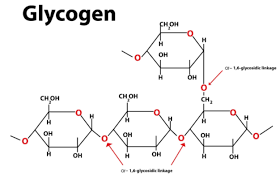
Glycogen
If you have ever wondered, “Is glycogen a polysaccharide?” – it certainly is!
Known as the major storage polysaccharides in animals and fungi.
Highly branched structure, stored primarily in liver and muscle tissues in animals.
Inulin
Made up of multiple fructofuranose units.
Commonly found in plants like dahlia and artichoke tubers.
2. Heteropolysaccharides
Heteropolysaccharides contain different types of monosaccharides in their chains.
Hyaluronic Acid
Composed of D-glucuronic acid and N-acetyl-glucosamine.
Found in connective tissues, skin, and involved in tissue hydration and lubrication.
Heparin
Made of D-glucuronic acid, L-iduronic acid, and N-sulfo-D-glucosamine.
Acts as an anticoagulant in blood and is abundant in mast cells.
Chondroitin-4-Sulfate
Contains D-glucuronic acid and N-acetyl-D-galactosamine-4-O-sulfate.
Present in cartilage, aiding in flexibility and shock absorption.
Gamma Globulin
Includes N-acetyl-hexosamine, D-mannose, D-galactose.
Found in blood and plays a role in immune functions.
Polysaccharide Function
Wondering how these large biomolecules impact living systems? Let’s explore their main roles:
Energy Storage
Storage polysaccharides like starch and glycogen act as energy reservoirs. In plants, starch accumulates in seeds and tubers, while animals synthesise glycogen in muscle and liver.
Structural Support
The question “Is cellulose a polysaccharide?” comes with the crucial role it plays in plant cell walls, giving rigidity and shape.
In insects and fungi, chitin (another polysaccharide) provides structural integrity to their exoskeletons or cell walls.
Cellular Communication
Polysaccharides often bond with lipids (forming glycolipids) and proteins (glycoproteins), enabling cell-to-cell signalling and recognition.
Protection & Lubrication
Hyaluronic acid contributes to cushioning and lubrication in joints.
Heparin helps prevent clotting, ensuring smooth blood flow.
Maintaining Concentration Gradients
Large polysaccharides are osmotically inactive, which aids cells in regulating water and solute levels.
Polysaccharides in Daily Life and Beyond
In addition to their well-known roles, polysaccharides have diverse applications:
Food Industry: Pectin (found in fruit cell walls) is used as a gelling agent in jams, while cellulose derivatives thicken sauces.
Pharmaceuticals: Exopolysaccharides produced by certain bacteria help stabilise formulations in drugs and vaccines.
Eco-Friendly Materials: Research is ongoing into converting cellulose and chitin into biodegradable plastics and fibres.
Quick Quiz: Test Your Polysaccharide Knowledge
True/False: Glycogen is a polysaccharide stored in the liver of animals.
Multiple Choice: Which of the following is a heteropolysaccharide?
a) Starch
b) Cellulose
c) Heparin
d) Glycogen
Fill in the Blank: __________ is found in plant cell walls and provides structural support.
True/False: Hyaluronic acid is composed solely of glucose molecules.
Multiple Choice: Which of these is known as a storage polysaccharide in plants?
a) Inulin
b) Starch
c) Gamma globulin
d) Chondroitin-4-sulfate
Check your answers below
True – Glycogen is indeed a polysaccharide stored in animal liver and muscles.
(c) Heparin – This is a classic example of a heteropolysaccharide.
Cellulose – It is a structural polysaccharide found in plant cell walls.
False – Hyaluronic acid contains D-glucuronic acid and N-acetyl-glucosamine, not just glucose.
(b) Starch – Starch is the main storage polysaccharide in plants.


FAQs on Polysaccharides Structure Classification and Biological Functions
1. What are polysaccharides in biology?
Polysaccharides are complex carbohydrates made of many monosaccharide units linked together by glycosidic bonds. They are large biological macromolecules formed through condensation reactions. In living organisms, polysaccharides function mainly as:
- Energy storage molecules (e.g., starch in plants, glycogen in animals)
- Structural components (e.g., cellulose in plant cell walls, chitin in fungi and arthropods)
2. What is the function of polysaccharides?
The main function of polysaccharides is to store energy and provide structural support in organisms. Depending on their structure, they perform different biological roles:
- Energy storage: Starch stores glucose in plants; glycogen stores glucose in animals.
- Structural support: Cellulose strengthens plant cell walls; chitin forms fungal cell walls and arthropod exoskeletons.
3. What are the main types of polysaccharides?
The main types of polysaccharides are storage polysaccharides and structural polysaccharides. They can be classified as:
- Storage polysaccharides: Starch (plants) and glycogen (animals).
- Structural polysaccharides: Cellulose (plant cell walls) and chitin (fungi and arthropods).
4. What is the difference between starch and glycogen?
The main difference between starch and glycogen is that starch stores glucose in plants, while glycogen stores glucose in animals and is more highly branched. Key differences include:
- Organism: Starch in plants; glycogen in animals.
- Structure: Glycogen has more frequent α-1,6 glycosidic branches than starch.
- Storage site: Starch in chloroplasts; glycogen in liver and muscle cells.
5. What is cellulose and why is it important?
Cellulose is a structural polysaccharide made of β-glucose units that forms the main component of plant cell walls. It consists of long chains of β-1,4 glycosidic bonds that form strong microfibrils. Its importance includes:
- Providing mechanical strength to plant cells
- Maintaining cell shape
- Contributing to dietary fiber in humans
6. How are polysaccharides formed?
Polysaccharides are formed by linking monosaccharides through condensation reactions that create glycosidic bonds. The process involves:
- Two monosaccharides reacting
- Removal of a water molecule (dehydration synthesis)
- Formation of a glycosidic bond
7. What are glycosidic bonds in polysaccharides?
Glycosidic bonds are covalent bonds that link monosaccharide units together in a polysaccharide. They form between the hydroxyl groups of two sugars during a condensation reaction. Common types include:
- α-1,4 glycosidic bonds in starch and glycogen
- α-1,6 glycosidic bonds at branch points in glycogen
- β-1,4 glycosidic bonds in cellulose
8. Why can humans digest starch but not cellulose?
Humans can digest starch but not cellulose because we have enzymes that break α-glycosidic bonds but not β-glycosidic bonds. Specifically:
- Amylase breaks α-1,4 bonds in starch.
- Humans lack cellulase, which is needed to break β-1,4 bonds in cellulose.
9. What is chitin and where is it found?
Chitin is a structural polysaccharide made of N-acetylglucosamine units and is found in fungal cell walls and arthropod exoskeletons. It contains β-1,4 glycosidic bonds similar to cellulose. Chitin provides:
- Protection and rigidity in insects and crustaceans
- Structural support in fungi
10. What are examples of polysaccharides in living organisms?
Common examples of polysaccharides in living organisms include starch, glycogen, cellulose, and chitin. These examples can be grouped as:
- Starch: Energy storage in plants
- Glycogen: Energy storage in animals
- Cellulose: Structural component of plant cell walls
- Chitin: Structural component of fungal cell walls and arthropod exoskeletons



