




Types of Feather and Detailed Structure with Diagram Explanation
Feathers are remarkable biological structures unique to birds, crucial for flight, insulation, and display. Understanding the feather, its types, anatomy, and importance is essential for exploring avian biology and adaptation. Let’s delve into the features, structure, functions, and various examples that showcase the diversity and relevance of feathers in nature and science.
What is a Feather? - Feather Definition
Feather definition: A feather is a complex, lightweight epidermal outgrowth forming the main external covering of birds. Each feather is made of specialized proteins and serves multiple roles: enabling flight, regulating body temperature, camouflaging, and aiding in courtship. Feathers are one of the key features distinguishing the class Aves from other vertebrates.
Structure and Parts of a Feather
A typical feather has several key parts. Below is a well-labelled diagram and explanation to make feather anatomy clear for Class 12 and competitive exams. Understanding this structure helps students appreciate adaptations seen in different bird species.
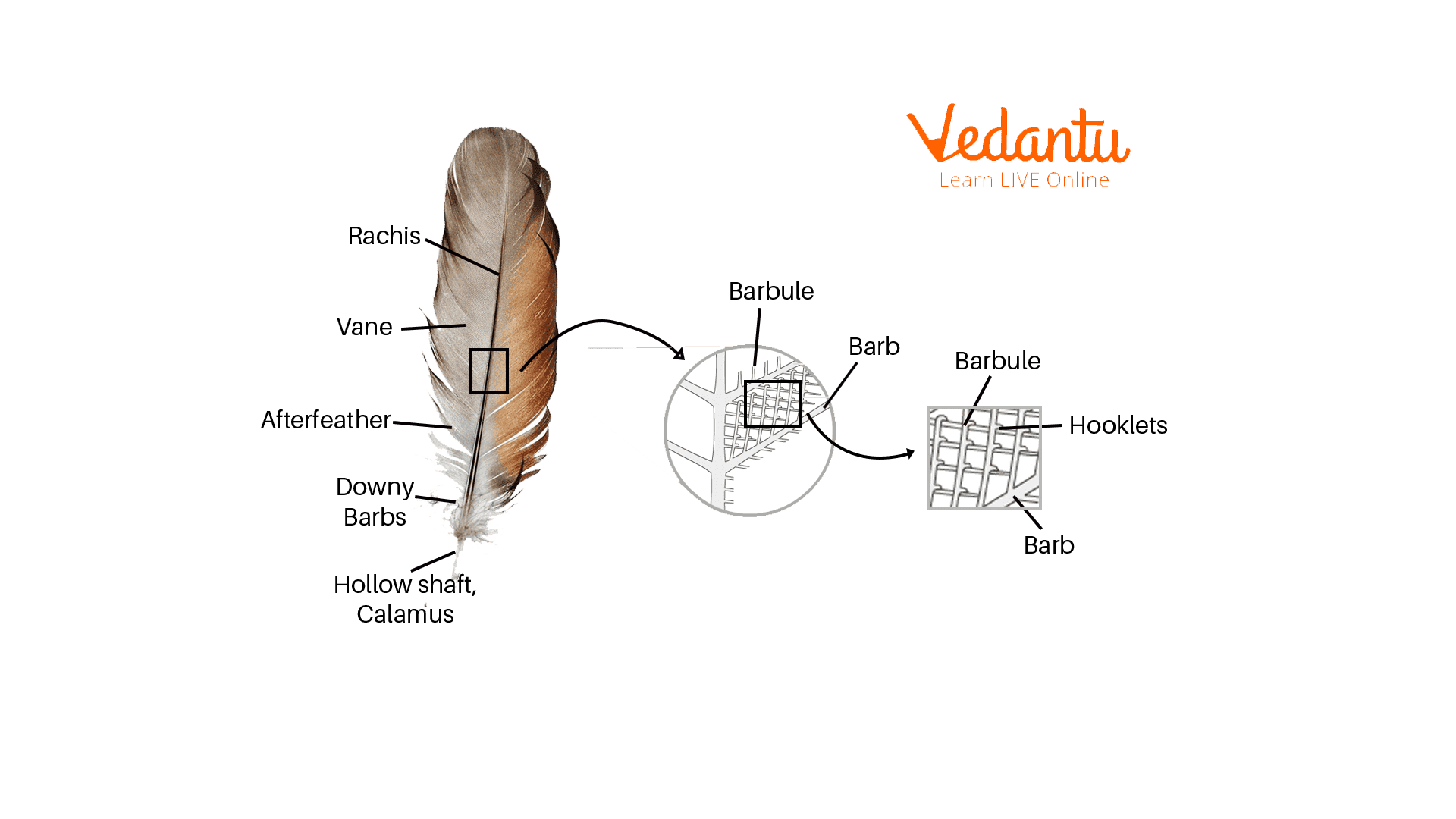
- Shaft (Rachis): The central stiff stem supporting the feather.
- Quill (Calamus): Hollow base inserted into the bird’s skin.
- Vane: The flat, extended part on each side of the shaft, made up of barbs.
- Barbs: Parallel filaments branching from the rachis.
- Barbules: Tiny branches from each barb, with hooks called barbicels to interlock adjoining barbs.
These interlocking structures give the feather strength and flexibility, key for functions like flight and insulation.
Types and Examples of Feathers in Birds
Feathers can be classified into different types based on location and function. Each type supports important activities in birds’ lives and adaptations to different environments. Some major types include:
- Contour Feathers: Give birds their shape and color, covering outer body and wings.
- Flight Feathers: Large, strong feathers on wings (remiges) and tail (rectrices) enabling flight.
- Down Feathers: Soft and fluffy, found under contour feathers providing insulation, especially in young birds.
- Semi-plume Feathers: Intermediate in structure, assist with both shape and insulation.
- Filoplume Feathers: Hair-like, help in sensory feedback for controlling other feathers.
- Bristle Feathers: Stiff, hairlike feathers usually around mouth, nostrils, or eyes, serving a protective function.
Functions and Importance of Feathers
Feathers perform many vital functions not only for survival but also for the ecological balance. Their varied roles include:
- Flight: Flight feathers on wings and tail provide surface area and shape for lift and maneuvering.
- Insulation: Down and semi-plume feathers trap air for thermal regulation, helping birds survive temperature extremes.
- Communication and Mating: Brightly colored and patterned feathers are used for attracting mates and signaling.
- Camouflage: Some feathers blend birds into their environment, protecting them from predators.
- Protection: Feathers shield the skin from sun, wind, and rain.
Feathers also help in waterproofing due to special oils. They are crucial adaptations explaining the evolutionary success of birds. You can learn more about animal adaptations in our article on animal adaptations.
Feather Diagram (Labeled)
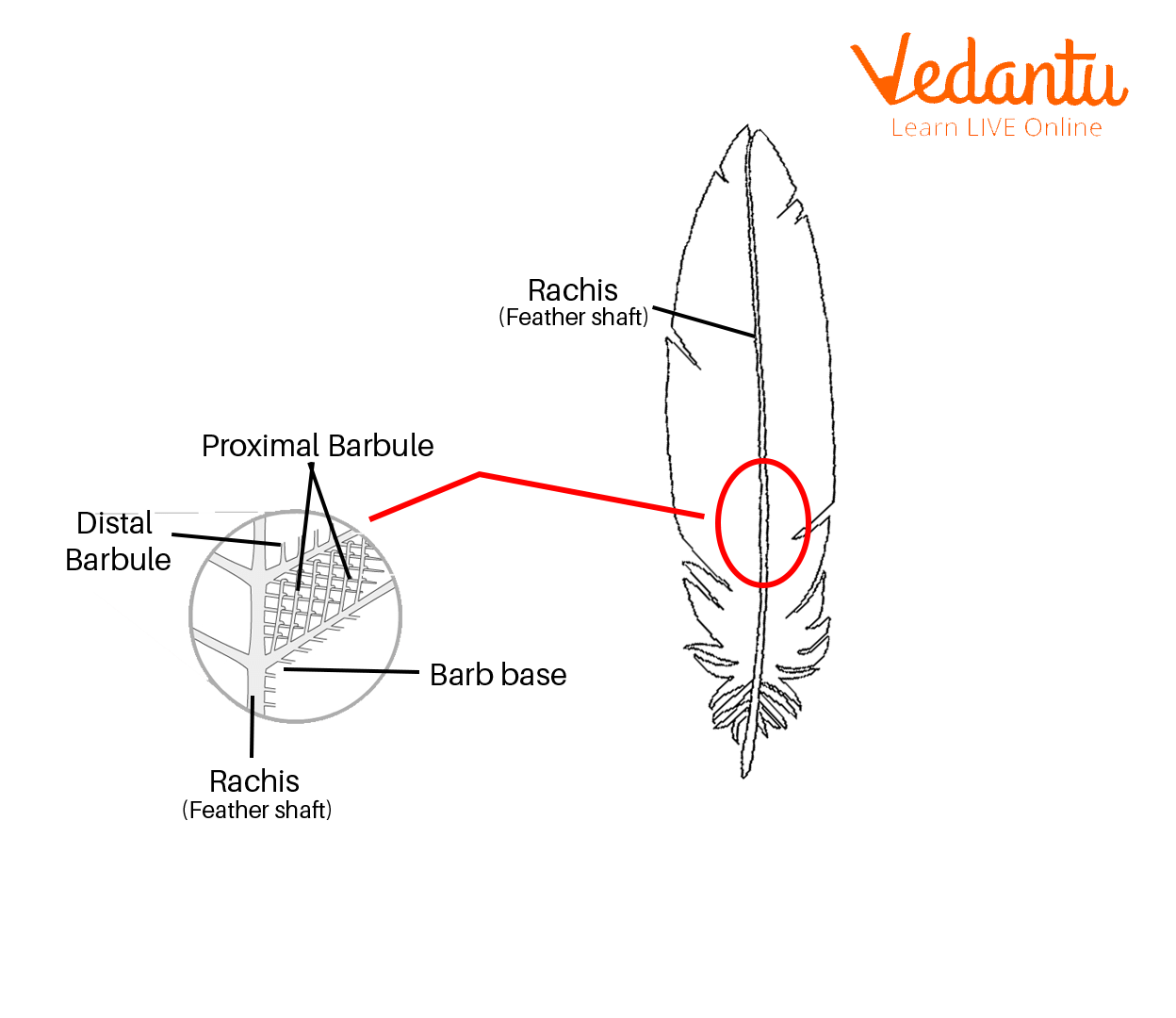
A well-labelled feather diagram is essential for biology exams, project work, and presentations. The diagram below highlights main parts important for Class 12, NEET, and Board exams:
- Quill (Calamus): Lower hollow tube anchoring the feather.
- Rachis: Main continuation of the shaft.
- Barbs and Barbules: Interlocking branches for strength and flexibility.
- Vane: Creates the surface essential for flight and coverage.
Studying the structure of a feather helps explain how birds can fly and adapt to different environments. For similar labelled diagrams, see our class 7 important diagrams resource.
How Do Feathers Develop and Grow?
Feathers grow from follicles in the bird’s skin, much like human hair. The development process is as follows:
- Initiation: A small bump (papilla) forms in the skin.
- Growth: Cells multiply, pushing outward and forming a tubular structure.
- Specialization: As the feather develops, cells differentiate to become barbs, barbules, and shaft.
- Maturation: The dead cells harden through keratinization, a process similar to human nails and hair formation.
- Eruption: The sheath enclosing the new feather breaks open, allowing the feather to unfurl.
Feathers are periodically replaced through a process called molting. This keeps birds’ plumage healthy, functional, and suited for seasonal changes. Feather growth and molting can be influenced by environmental factors—read more in effects of climate changes.
Feather Examples in Nature
There are several fascinating feather examples across different bird groups, each adapted for their specific needs:
- Peacock: Ornamental tail feathers used for courtship displays.
- Penguin: Specialized waterproof contour and down feathers for insulation in cold waters.
- Owl: Fringe-edged flight feathers for silent hunting.
- Duck: Waterproof feathers coated with oil.
- Woodpecker: Tail feathers support vertical climbing on trees.
From air travel to heat insulation, each feather example demonstrates fantastic evolutionary solutions tailored to bird lifestyles.
Feathers in Human Life and Research
Feathers have long been valuable to humans. They are used in bedding (down), writing (quills), clothing, cultural symbols, and even in scientific research. Analysis of fossil feathers informs scientists about dinosaur evolution, connecting birds to ancient reptiles. Feathers are also studied in environmental science to monitor pollution (since chemicals accumulate in feathers).
Understanding feathers also helps inform climate adaptation strategies. To explore animal and plant responses to climate, check out our section on effects of climate changes.
Feather Class 12 Key Points
- Feather is unique to birds (Aves).
- Structure: Quill, rachis, barbs, barbules, vane.
- Types: Contour, flight, down, semi-plume, filoplume, bristle.
- Functions: Flight, insulation, waterproofing, camouflage, courtship and communication.
- Importance in research, agriculture, and traditional uses.
- Relevant for MCQs and diagram-based questions in CBSE and NEET.
For more about traits and inherited characteristics, explore acquired and inherited traits. To learn about organs associated with movement, read muscular tissue.
Feather Questions and MCQs
Common feather MCQs and questions for exams often test on definition, structure, types, and function. Practice regularly for scoring high in biology.
- Q1. What are the main functions of feathers?
- Q2. Name and describe two types of feathers.
- Q3. How does the feather structure help in flight?
- Q4. Draw and label a feather diagram.
- Q5. Give examples of birds with specialized feathers.
For more objective questions, refer to our comprehensive biology MCQ sets.
Feather - Summary Table
| Feather Part | Description | Function |
|---|---|---|
| Quill (Calamus) | Hollow base, anchors in skin | Attachment and support |
| Rachis | Central shaft | Strength, main support |
| Barb | Branches from rachis | Forms vanes; flexibility |
| Barbule | Mini branches from barbs | Interlocks barbs; stability |
| Vane | Flat surface from interlocked barbs | Flight, coverage |
This table summarises feather structure and the biological significance of each main part.
Related Topics at Vedantu
To expand your knowledge, explore related topics on:
Feathers represent one of evolution’s most innovative adaptations, vital for bird survival and human research. Understanding feather structure, types, and functions helps explain avian success and reveals broader patterns of adaptation and ecological balance in nature. This overview offers a strong foundation for biology students and enthusiasts alike.


FAQs on Feather in Birds Definition Structure and Functions
1. What is a feather in biology?
A feather is a specialized epidermal structure made of keratin that covers the body of birds. Feathers are unique to the class Aves and are considered a defining characteristic of birds.
- They develop from feather follicles in the skin.
- They are lightweight yet strong due to their branched structure.
- They perform functions such as flight, insulation, and display.
2. What are the main parts of a feather?
The main parts of a feather are the calamus, rachis, and vane. These structures work together to provide strength and flexibility.
- Calamus (quill): Hollow base inserted into the skin.
- Rachis: Central shaft extending from the calamus.
- Vane: Flat surface formed by barbs branching from the rachis.
- Barbules with hooklets: Interlock to keep the vane intact.
3. What is the function of feathers?
The primary function of feathers is flight, insulation, and protection in birds. Different types of feathers perform specific roles.
- Flight feathers: Enable flying and gliding.
- Down feathers: Provide thermal insulation.
- Contour feathers: Protect the body and streamline shape.
- Display feathers: Used in courtship and camouflage.
4. How do feathers help birds fly?
Feathers help birds fly by creating a lightweight, aerodynamic surface that generates lift and enables controlled movement in air. The large remiges (wing feathers) and rectrices (tail feathers) are especially important.
- Wing feathers form an airfoil shape for lift.
- Strong yet flexible rachis resists air pressure.
- Tail feathers help in steering and balance.
5. What are the different types of feathers?
There are several types of feathers, each specialized for a specific function in birds. The main types include:
- Contour feathers: Cover the body and give shape.
- Flight feathers (remiges and rectrices): Used for flying.
- Down feathers: Soft feathers for insulation.
- Filoplumes: Sensory feathers that detect movement.
- Bristles: Protect eyes and nostrils.
6. What are feathers made of?
Feathers are made of beta-keratin, a tough and lightweight structural protein. This protein is also found in reptile scales and claws.
- Keratin provides strength and flexibility.
- It is produced by specialized epidermal cells.
- Feathers are non-living once fully formed.
7. How do feathers grow and develop?
Feathers grow from feather follicles in the skin through a process of controlled cell division and keratinization. Development occurs in stages:
- A feather germ forms in the follicle.
- Cells proliferate and produce keratin.
- The feather emerges enclosed in a sheath.
- The sheath breaks open as the feather matures.
8. What is molting in birds?
Molting is the periodic shedding and replacement of old feathers in birds. This process maintains feather quality and function.
- Old or damaged feathers fall out.
- New feathers grow from the same follicles.
- Molting may occur seasonally or annually.
9. What is the difference between feathers and hair?
Feathers and hair are both keratin structures, but feathers are branched and found in birds, while hair is unbranched and found in mammals. Key differences include:
- Feathers: Made of beta-keratin, branched structure, adapted for flight and insulation.
- Hair: Made of alpha-keratin, simple filament structure, mainly for insulation and sensory function.
10. Why are feathers important for bird survival?
Feathers are essential for bird survival because they enable flight, regulate body temperature, and provide protection. Their importance includes:
- Thermoregulation: Down feathers trap air to retain heat.
- Camouflage: Color patterns help avoid predators.
- Communication: Bright feathers aid in mating displays.
- Waterproofing: Feathers repel water when coated with oil from the preen gland.



