




What Are Prokaryotic Cells Structure Function Types and Examples
Prokaryotic cells are the earliest and simplest type of cells found on Earth. These tiny structures lack a true nucleus and most membrane-bound organelles, making them unique among living organisms. Understanding the structure, functions, and significance of prokaryotic cells is crucial for students in biology, especially in areas like microbiology, medicine, agriculture, and environmental science.
Prokaryotic Cells Definition
Prokaryotic cells are cells that do not have a well-defined, membrane-bound nucleus. Instead, their genetic material lies freely in the cytoplasm, usually in a single circular DNA molecule. Prokaryotic cells are found in unicellular organisms, primarily the bacteria and archaea kingdoms. They are known for their simple structure and remarkable adaptability to various environments.
Key Characteristics of Prokaryotic Cells
The main features of prokaryotic cells help distinguish them from more complex eukaryotic cells. These distinguishing characteristics also form the basis for many biology class 12 topics.
- No membrane-bound nucleus; DNA resides in a nucleoid region.
- Absence of membrane-bound organelles such as mitochondria or endoplasmic reticulum.
- Cell wall usually present, providing shape and protection.
- Small cell size, generally between 0.1 to 5 micrometers.
- Simple internal structure with few compartments.
- Reproduce mainly by binary fission (asexual division).
Structure of Prokaryotic Cells
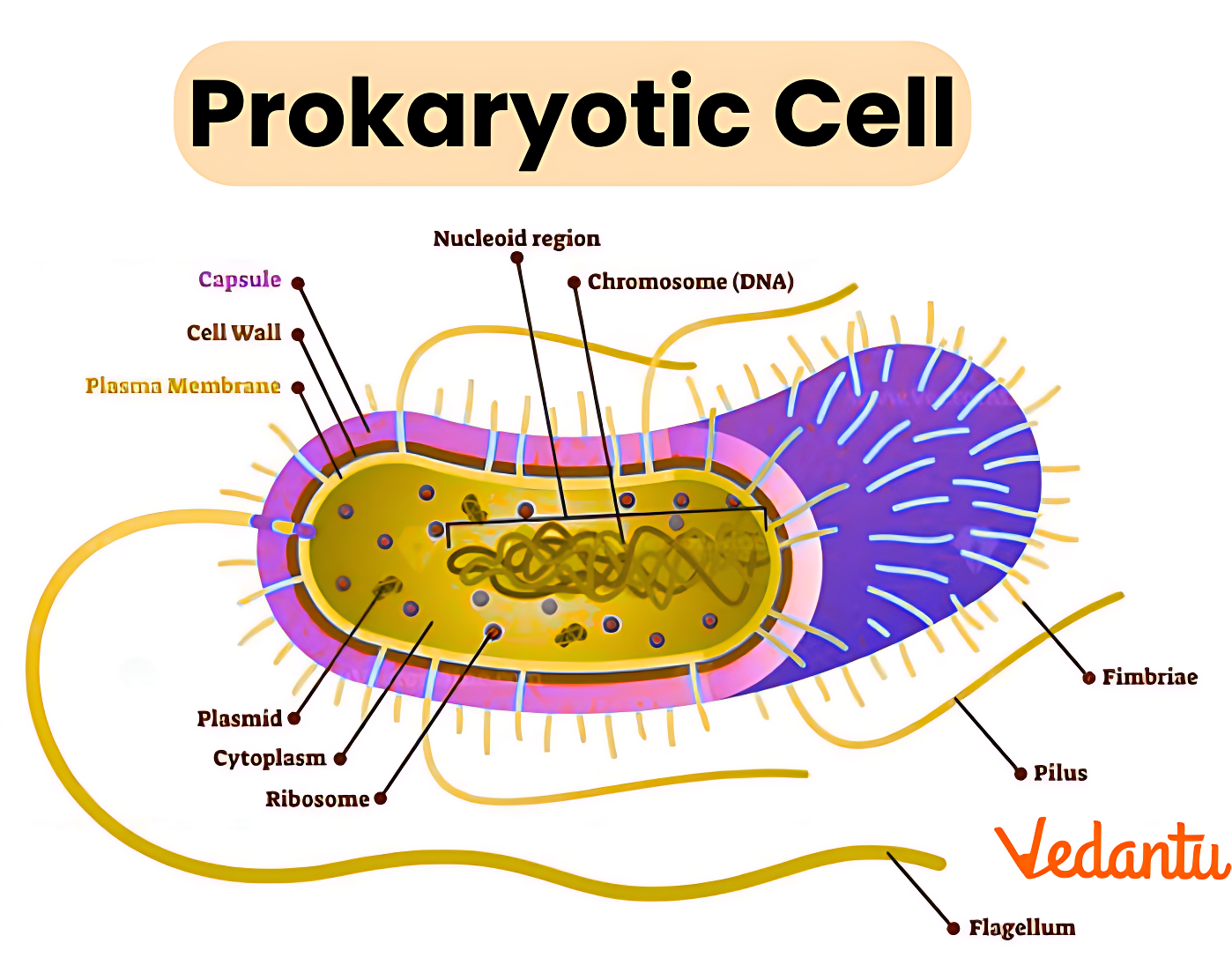
Prokaryotic cells have essential structures that carry out basic life functions. Here are the typical components found in a prokaryotic cell:
- Plasma membrane – Controls the entry and exit of substances.
- Cell wall – Gives rigidity and protects against external stress.
- Nucleoid – Irregular region containing the circular DNA.
- Cytoplasm – Gel-like fluid where chemical reactions occur.
- Ribosomes – Small structures responsible for protein synthesis.
- Plasmids – Small, extra circles of DNA found in some bacteria.
- Flagella or pili (occasionally) – Help in movement or attachment to surfaces.
Prokaryotic Cells Examples
Most prokaryotic cells belong to the domains Bacteria and Archaea. Here are some common examples you’ll encounter in biology:
- Escherichia coli (E. coli): Found in the human gut, often studied in microbiology.
- Streptococcus: Causes sore throat and other infections.
- Lactobacillus: Used in the production of curd and yogurt.
- Archaea: Such as Halobacterium, thrive in extreme environments like salt lakes.
These examples show the diversity and ecological roles of prokaryotes, from aiding in human digestion to causing diseases. To know more about the differences between microbes and their classification, visit Vedantu’s Kingdom Monera page.
Types of Prokaryotic Cells
Prokaryotic cells are mainly classified into two groups based on their molecular and structural features:
- Bacteria: Found in soil, water, air, and living organisms. Includes both beneficial and harmful bacteria.
- Archaea: Often live in extreme environments and differ in cell wall composition compared to bacteria.
This classification is vital for understanding microbial diversity and for biotechnology applications.
Functions and Importance of Prokaryotic Cells
Prokaryotic cells play essential roles in ecosystems, medicine, and industry:
- They recycle nutrients in soil and water through decomposition.
- Used in making dairy products, antibiotics, and enzymes.
- Some cause diseases, while others support human health.
- Involved in nitrogen fixation, making them crucial for agriculture (see nitrogen-fixing bacteria).
Recognizing the functions of prokaryotic cells makes it easier to connect food science and environmental issues to biology topics you learn in school.
Prokaryotic Cells vs Eukaryotic Cells
| Feature | Prokaryotic Cells | Eukaryotic Cells |
|---|---|---|
| Nucleus | No true nucleus; DNA in nucleoid | True membrane-bound nucleus |
| Cell size | Small (0.1-5 µm) | Larger (10-100 µm) |
| Organelles | Few, no membrane-bound organelles | Many, membrane-bound organelles present |
| Examples | Bacteria, Archaea | Plants, animals, fungi, protists |
Knowing the difference between prokaryotic and eukaryotic cells forms the basis for understanding advanced concepts like cell theory and modern genetics.
Reproduction in Prokaryotic Cells
Prokaryotic cells reproduce asexually, primarily through a process known as binary fission. Here’s a simplified sequence:
- The DNA is copied.
- The cell grows larger.
- The cell membrane pinches inward.
- The cell splits into two identical cells.
This rapid means of reproduction allows bacterial populations to multiply quickly, which matters for both healthcare and environmental management.
Prokaryotic Cells in Human Life and the Environment
Understanding prokaryotic cells proves helpful in several real-world areas:
- Treating diseases by targeting bacterial infections with antibiotics.
- Useful in food processing and pharmaceuticals.
- Key in environmental conservation and bioremediation.
- Basis of advanced research like biotechnology and genetic engineering.
By studying prokaryotic cells, students can connect classroom lessons to broader scientific and practical issues.
Practice Questions: Prokaryotic Cells
Test your understanding of prokaryotic cells with these sample questions:
- Define prokaryotic cells and list two examples.
- Describe the structure of a prokaryotic cell.
- How do prokaryotic and eukaryotic cells differ?
- Explain why prokaryotic cells are important in the environment.
For more MCQs and questions, visit our biology MCQs page.
Prokaryotic Cells PPT and Diagrams
Teachers and students often use diagrams and presentations to understand the anatomy and function of prokaryotic cells. A clear prokaryotic cells diagram typically highlights the nucleoid, cell wall, plasma membrane, ribosomes, and sometimes flagella. If you’re preparing for a class presentation, include labelled diagrams and summaries. Explore more visual guides at CBSE Class 7 important diagrams.
Page Summary
Prokaryotic cells, lacking a true nucleus, represent the oldest and simplest type of living cells. They are fundamental in medicine, ecology, biotechnology, and daily human life. Understanding their definition, structure, examples, and roles provides an essential foundation for advanced biology topics and helps learners appreciate the vast diversity and impact of microbial life.


FAQs on Prokaryotic Cells Definition Structure and Key Features
1. What are prokaryotic cells?
Prokaryotic cells are simple, unicellular cells that lack a true nucleus and membrane-bound organelles. Their genetic material is found in a region called the nucleoid instead of inside a nucleus. Key features of prokaryotic cells include:
- Presence of a cell membrane and usually a cell wall
- DNA in a single circular chromosome
- Small ribosomes (70S)
- Reproduction by binary fission
Examples include organisms from the domains Bacteria and Archaea.
2. What is the difference between prokaryotic and eukaryotic cells?
The main difference between prokaryotic and eukaryotic cells is that prokaryotes lack a true nucleus and membrane-bound organelles, while eukaryotes have them. Key differences include:
- Nucleus: Absent in prokaryotes; present in eukaryotes
- DNA structure: Circular in prokaryotes; linear chromosomes in eukaryotes
- Organelles: No membrane-bound organelles in prokaryotes; present in eukaryotes (e.g., mitochondria)
- Cell size: Prokaryotes are generally smaller (1–5 µm)
Examples of prokaryotes include bacteria, while plants and animals are made of eukaryotic cells.
3. What are the main parts of a prokaryotic cell?
The main parts of a prokaryotic cell include structures that support survival, reproduction, and metabolism. These parts are:
- Cell membrane – controls movement of substances in and out
- Cell wall – provides shape and protection
- Cytoplasm – site of metabolic reactions
- Nucleoid – region containing circular DNA
- Ribosomes – responsible for protein synthesis
- Optional structures like plasmids, flagella, and capsule
These structures allow prokaryotic cells to function without complex organelles.
4. Do prokaryotic cells have a nucleus?
No, prokaryotic cells do not have a true nucleus. Instead of a membrane-bound nucleus, their DNA is located in a region called the nucleoid. The nucleoid:
- Contains a single circular chromosome
- Is not surrounded by a nuclear membrane
- May be accompanied by small DNA molecules called plasmids
This is a defining characteristic of all prokaryotic organisms.
5. How do prokaryotic cells reproduce?
Prokaryotic cells reproduce asexually through a process called binary fission. Binary fission occurs in the following steps:
- Replication of the circular DNA
- Elongation of the cell
- Separation of the two DNA copies
- Division of the cytoplasm to form two identical daughter cells
This process allows rapid population growth under favorable conditions.
6. What is the function of the cell wall in prokaryotic cells?
The function of the cell wall in prokaryotic cells is to provide shape, protection, and prevent osmotic bursting. In bacteria, the cell wall is mainly composed of peptidoglycan. Its roles include:
- Maintaining structural integrity
- Protecting against mechanical damage
- Preventing lysis in hypotonic environments
The composition of the cell wall differs between Gram-positive and Gram-negative bacteria.
7. What are plasmids in prokaryotic cells?
Plasmids are small, circular, double-stranded DNA molecules found in many prokaryotic cells. They are separate from the main chromosomal DNA and replicate independently. Plasmids often:
- Carry genes for antibiotic resistance
- Provide survival advantages
- Can be transferred between bacteria through conjugation
Plasmids play an important role in genetic variation and biotechnology.
8. How do prokaryotic cells obtain energy?
Prokaryotic cells obtain energy through diverse metabolic pathways such as cellular respiration, fermentation, and photosynthesis (in some species). Energy generation occurs mainly at the cell membrane because they lack mitochondria. Depending on the species, they may be:
- Aerobic – require oxygen
- Anaerobic – do not require oxygen
- Photosynthetic – use light energy (e.g., cyanobacteria)
This metabolic diversity allows prokaryotes to live in extreme and varied environments.
9. What are examples of prokaryotic organisms?
Examples of prokaryotic organisms include members of the domains Bacteria and Archaea. Common examples are:
- Escherichia coli – found in the human intestine
- Streptococcus – some species cause infections
- Cyanobacteria – photosynthetic bacteria
- Methanogens – archaea that produce methane
All of these organisms are unicellular and lack a true nucleus.
10. Why are prokaryotic cells important in biology?
Prokaryotic cells are important because they play essential roles in ecosystems, human health, and biotechnology. Their significance includes:
- Driving nutrient cycles such as nitrogen fixation
- Forming part of the human microbiome
- Used in genetic engineering and insulin production
- Acting as decomposers in ecosystems
Prokaryotes are also among the earliest forms of life on Earth, making them crucial to understanding evolution.



