




What is the scientific name of alpaca and how is it classified in animal taxonomy
Alpaca is the normal name for a trained, gregarious, high-height South American ungulate, Vicugna pacos (syn. Lama pacos), of the camel family (Camelidae), portrayed by an extremely lengthy neck, long and slim legs (yet short compared with the comparably seeming llama), little and prolonged head, short ears with slight places, short tail, and a split upper lip. While its local reach is in the high Andes mountains, this huge herbivorous vertebrate is not generally seen as in the wild, yet is kept up with broadly in homegrown crowds, to a great extent brushing in high rises of the Andes of Peru, Bolivia, Ecuador, and Chile.
Scientific Name of Alpaca
Vicugna pacos

Alpaca
Huacaya Alpaca
Huacaya is one of the two varieties that make up the species Lama pacos, ordinarily known as the alpaca (the other variety is the Suri). It lives on the Altiplano in the Andes, up to 4,000 metres (13,000 ft) above ocean level. Its normal reach includes four South American nations.
Alpaca Breeds
The alpaca comes in two varieties, Suri and Huacaya, in light of their filaments as opposed to logical or European characterizations.
Huacaya alpacas are the most ordinarily found, comprising around 90% of the population. The Huacaya alpaca is remembered to have begun in post-pilgrim Peru. This is because of their thicker wool which makes them more fit to get by in the higher heights of the Andes in the wake of being driven into the good countries of Peru with the appearance of the Spanish.
Suri alpacas address a more modest piece of the all-out alpaca populace, around 10%. They are remembered to have been more pervasive in pre-Columbian Peru since they could be kept at a lower elevation where a thicker downy was not required for cruel climate conditions.
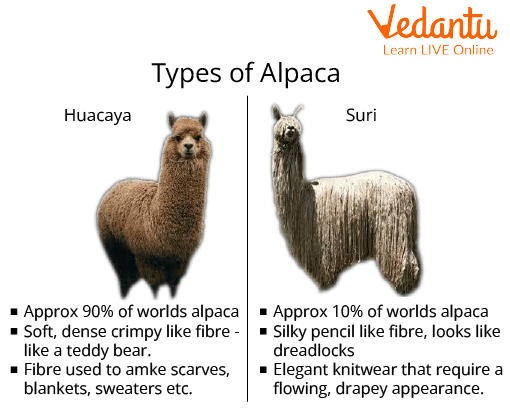
Types of Alpaca
Where do Alpacas Live?
Alpacas can be viewed all through the greater part of South America. They commonly live in mild circumstances in the mountains with high elevations.
They are not difficult to focus on since they are not restricted to a particular sort of climate. Creatures like flamingos, condors, spectacled bears, mountain lions, coyotes, llamas, and sheep live close to alpacas when they are right at home.
The alpaca is economically raised too on different landmasses, outstandingly in North America and Australia. Alpacas are not utilised as pack animals, yet chiefly are esteemed for their fibre, and customarily have been esteemed additionally for meat, hair, stows away, and their fertiliser, utilised as fuel. They have been trained for millennia, even before the Incas, who raised and reproduced alpacas for materials held for sovereignty.
Interesting Facts
The birth weight of an alpaca is for the most part between 8-23 pounds. A female alpaca is thought of as experienced a year and a half and a male alpaca is developed at 2-3 yearsAlpacas normally live 15-20 years. The most seasoned alpaca is 27 years of age.
The antiquated Incas initially trained the alpaca quite a while back. They made robes of alpaca fur for the aristocrats and eminence.
Alpacas' stomachs have three chambers.
The single alpaca species has two varieties: the dreadlocked Suri and the cushy huacaya.
The greater part of the commotion alpacas make is murmuring. Contingent upon the circumstance, this communicates happiness, interest, weariness, mindfulness or trouble.
Alpacas are regularly sheared like clockwork, the suris yielding fine wools of around 3 kg (6.5 pounds) per creature and the huacayas giving coarser wools weighing around 2.5 kg (5.5 pounds). Hair development in two years is around 30 cm (12 inches) in the huacaya and 60 cm (23.6 inches) in the Suri. Individual filaments inside the wool range from around 20 to 40 cm (around 7.9 to 15.7 inches) long at the hour of shearing. Alpacas have a characteristic life expectancy of 15-20 years.
At the point when llamas cross with alpacas, the child is known as a huarizo.
Important Questions
1. What is the Population of Alpacas?
Ans: Alpacas are native to Peru, but can be found throughout the globe in captivity. It currently has the largest population, with over half the world's animals. The population declined drastically after the Spanish Conquistadors invaded the Andes mountains in 1532, after which 98% of the animals were destroyed. The Spanish also brought with them diseases that were fatal to alpacas.
European conquest forced the animals to move higher into the mountains, which remained there permanently. Although alpacas had almost been wiped out completely, they were rediscovered sometime during the 19th century by Europeans. After finding uses for them, the animals became important to societies during the industrial revolution.
2. What is the Lifespan of an Alpaca?
Ans: Alpacas are normally sheared every two years, the suris yielding fine fleeces of about 3 kg (6.5 pounds) per animal and the huacayas giving coarser fleeces weighing about 2.5 kg (5.5 pounds). Hair growth in two years is about 30 cm (12 inches) in the huacaya and 60 cm (23.6 inches) in the suri. Individual fibres within the fleece range from about 20 to 40 cm (about 7.9 to 15.7 inches) in length at the time of shearing. Alpacas have a natural life span of 15–20 years.
Conclusion
Alpaca is a flexible, warm, solid, water-safe crossbreeds delivered on a delicate, strong creature. Alpacas are 'green' creatures, simple guardians that are light on the land, having delicate cushioned feet with toes as opposed to hooves.


FAQs on Scientific Name of Alpaca and Its Taxonomic Classification
1. What is the scientific name of the alpaca?
The scientific name of the alpaca is Vicugna pacos. It belongs to the family Camelidae and is a domesticated South American camelid. Alpacas are closely related to llamas, guanacos, and vicuñas and are primarily bred for their soft fiber.
2. Why is the scientific name of alpaca Vicugna pacos?
The alpaca is named Vicugna pacos because genetic studies show it was domesticated from the wild vicuña (Vicugna vicugna). Earlier, alpacas were classified under the genus Lama, but DNA evidence confirmed their closer evolutionary relationship with vicuñas, leading to their reclassification.
3. What family does the alpaca belong to?
The alpaca belongs to the family Camelidae. This biological family includes:
- Llamas (Lama glama)
- Vicuñas (Vicugna vicugna)
- Guanacos (Lama guanicoe)
- Camels (Camelus species)
4. What is the genus of the alpaca?
The genus of the alpaca is Vicugna. This genus also includes the wild species Vicugna vicugna (vicuña). The classification reflects their close evolutionary and genetic relationship within South American camelids.
5. What is the difference between alpaca and llama scientific names?
The scientific name of the alpaca is Vicugna pacos, while the llama is Lama glama. Key differences include:
- Genus: Alpaca (Vicugna) vs. Llama (Lama)
- Ancestry: Alpaca descended from vicuña; llama descended from guanaco
- Primary use: Alpacas for fiber; llamas mainly as pack animals
6. Is the alpaca a domesticated species?
Yes, the alpaca (Vicugna pacos) is a fully domesticated species. It was domesticated in the Andes Mountains of South America over 6,000 years ago. Unlike its wild ancestor, the vicuña, alpacas are bred and managed by humans primarily for their wool.
7. What order does the alpaca belong to?
The alpaca belongs to the order Artiodactyla. Artiodactyls are even-toed ungulates characterized by:
- Weight-bearing on two main toes
- Hoofed mammals
- Examples including deer, cattle, camels, and pigs
8. What is the complete classification of the alpaca?
The complete biological classification of the alpaca is as follows:
- Kingdom: Animalia
- Phylum: Chordata
- Class: Mammalia
- Order: Artiodactyla
- Family: Camelidae
- Genus: Vicugna
- Species: Vicugna pacos
9. Are alpacas and vicuñas the same species?
No, alpacas and vicuñas are different species, although they are closely related. The alpaca is Vicugna pacos, while the vicuña is Vicugna vicugna. Alpacas are domesticated and bred for fiber, whereas vicuñas are wild animals native to the high Andes.
10. Why is the scientific name important in biology for alpacas?
The scientific name Vicugna pacos is important because it provides a universal and standardized identification of the alpaca. Scientific names:
- Avoid confusion caused by common names
- Indicate evolutionary relationships
- Follow the binomial nomenclature system developed by Carl Linnaeus



