




Dr B R Ambedkar essay biography achievements and contribution to Indian Constitution
Dr. B. R. Ambedkar, fondly known as the Father of the Indian Constitution, was a visionary leader, social reformer, and champion of equality. His life and work stand as a testament to his relentless pursuit of justice, education, and social upliftment. Born into a socially disadvantaged community, he overcame immense challenges to become one of India’s most influential figures. Dr. Ambedkar dedicated his life to eradicating social discrimination, advocating for Dalit rights, and building a framework for an inclusive and democratic India. This essay explores his remarkable journey, contributions, and enduring legacy in 150, 250, 500, and 1000 words.
Also Check for
Essay on B.R. Ambedkar In 1000 Words
Introduction
Dr. Bhimrao Ramji Ambedkar, popularly known as Babasaheb Ambedkar, is one of the most iconic leaders in Indian history. A visionary social reformer, the chief architect of the Indian Constitution, and a staunch advocate for the rights of the underprivileged, Dr. Ambedkar's contributions to the nation are unparalleled. Born into a Dalit family on April 14, 1891, in Mhow (present-day Madhya Pradesh), he overcame societal discrimination and economic hardships to become a global icon of equality and justice. His relentless efforts to uplift marginalised communities and his fight against social evils like caste discrimination have left an indelible mark on India’s social and political landscape.
Early Life and Education
Dr. Ambedkar was born into a Mahar caste, which was considered "untouchable" in the rigid caste hierarchy of India. Despite facing severe discrimination, his father’s emphasis on education inspired him to excel academically.
He pursued higher education from prestigious institutions such as Elphinstone College, Columbia University (USA), and the London School of Economics (UK).
His academic achievements included multiple degrees, including a D.Sc., Ph.D., and Barrister-at-Law, making him one of the most highly educated leaders of his time.
Ambedkar’s Role in Social Reform
Dr. Ambedkar dedicated his life to fighting caste-based discrimination and promoting social equality.
Abolition of Untouchability: He worked tirelessly to eliminate untouchability and caste barriers, advocating for equal rights and opportunities for Dalits.
Temple Entry Movements: He led significant movements like the Mahad Satyagraha (1927), demanding the right of Dalits to access public water sources and enter temples.
Educational Initiatives: Understanding the transformative power of education, he established institutions like the People’s Education Society and urged the oppressed to pursue knowledge.
Architect of the Indian Constitution
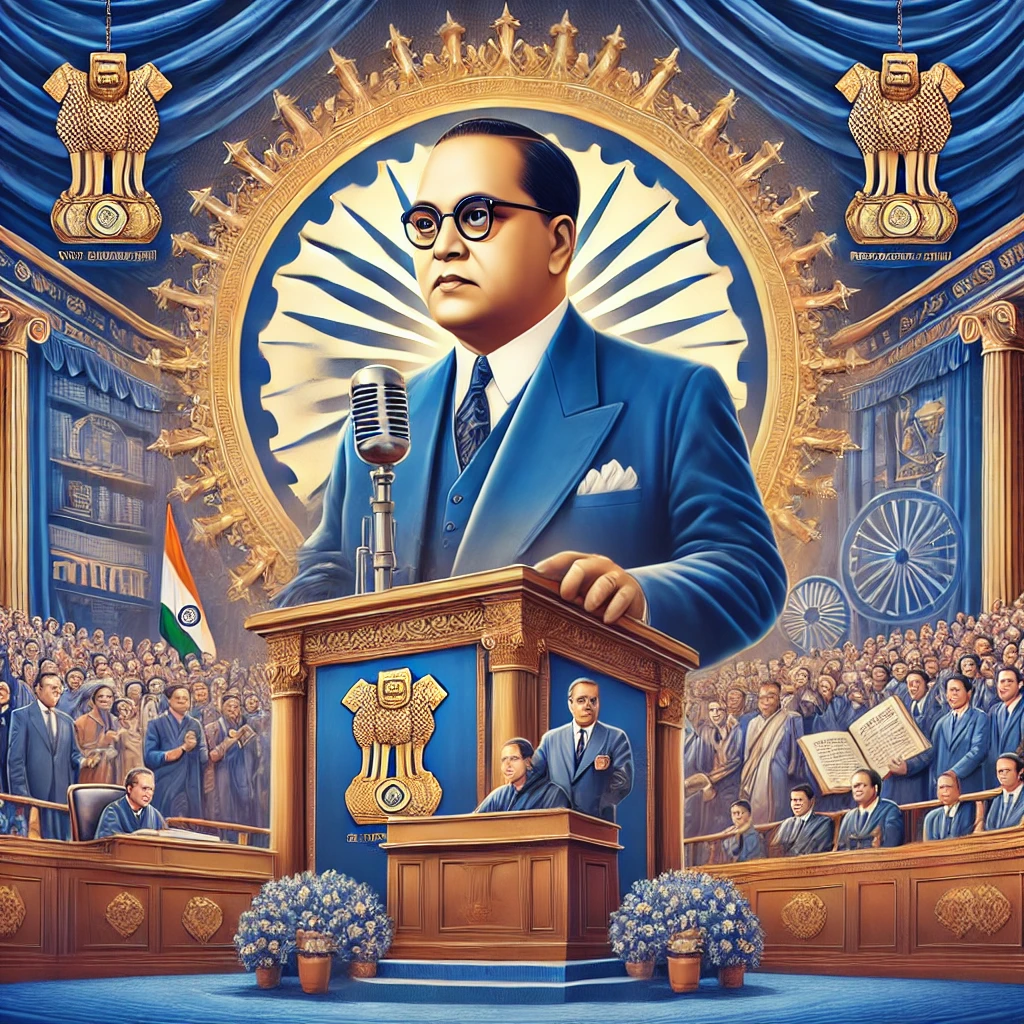
Dr. Ambedkar's most significant contribution to India was his role as the chairman of the Drafting Committee of the Indian Constitution.
Key Contributions:
Advocated for fundamental rights and equal opportunities for all citizens.
Introduced provisions to abolish untouchability (Article 17) and ensure social justice.
Championed reservation policies for Scheduled Castes (SC), Scheduled Tribes (ST), and Other Backward Classes (OBC) to address historical injustices.
Vision for Democracy: Dr. Ambedkar envisioned India as a secular, democratic, and inclusive nation, ensuring justice, liberty, and equality for all.
Political Career
Dr. Ambedkar founded the Independent Labour Party (ILP) in 1936 to address the issues of workers, Dalits, and other marginalized communities.
Later, he established the Scheduled Castes Federation in 1942, aiming to empower Dalits politically.
He served as India’s first Law Minister in Jawaharlal Nehru’s cabinet, where he focused on reforms to promote social justice.
Conversion to Buddhism
In 1956, Dr. Ambedkar, along with millions of his followers, converted to Buddhism.
Reasons for Conversion: He believed that Hinduism perpetuated the caste system and found Buddhism to be a path of equality, compassion, and rationality.
Impact of Conversion: This marked a significant socio-religious movement in India, encouraging Dalits to embrace Buddhism for spiritual liberation and dignity.
Literary Contributions
Dr. Ambedkar was a prolific writer and thinker who authored several groundbreaking works on social, political, and economic issues.
Key Books:
Annihilation of Caste: A powerful critique of the caste system.
The Problem of the Rupee: Insights into India's monetary policy.
Who Were the Shudras?: An analysis of caste hierarchies and their historical origins.
His writings continue to inspire scholars, activists, and policymakers worldwide.
Legacy and Impact
Dr. Ambedkar’s legacy is enduring and multifaceted:
Champion of Human Rights: His advocacy for equality has inspired social movements globally.
Empowerment of Dalits: Through his reforms, he gave Dalits a voice and a platform to fight for their rights.
Role Model: His life story is a testament to resilience, perseverance, and the power of education.
Cultural Icon: His birthday, April 14, is celebrated as Ambedkar Jayanti, and he remains a symbol of social justice and empowerment.
Challenges Faced by Dr. Ambedkar
Despite his monumental achievements, Dr. Ambedkar faced numerous challenges:
Social ostracism and discrimination as a Dalit.
Opposition from orthodox leaders who resisted his reforms.
Struggles to unite marginalised communities and garner political support.
Conclusion
Dr. B. R. Ambedkar’s contributions to India’s social and political fabric are immeasurable. As a reformer, constitution-maker, and advocate for equality, his efforts laid the foundation for a more inclusive and just society. His vision of a democratic India that values justice, liberty, equality, and fraternity continues to guide the nation. Dr. Ambedkar’s life reminds us of the importance of education, perseverance, and standing up for one’s beliefs. He remains a beacon of hope for those striving to create a world free from discrimination and inequality.
Essay on B.R. Ambedkar In 500 Words
Introduction
Dr. B. R. Ambedkar is a symbol of equality and justice in India. Known as the architect of the Indian Constitution, he played a pivotal role in abolishing caste-based discrimination and promoting equality among citizens. Ambedkar envisioned a society built on the principles of friendship, equality, and brotherhood. Despite his significant contributions, he faced severe caste-based discrimination during his early life.
Early Life and Challenges
Born on April 14, 1891, in Mhow, Madhya Pradesh, Bhimrao Ramji Ambedkar, also known as Babasaheb Ambedkar, belonged to the Mahar caste, labeled "untouchables" at the time. His father, Ramji Sakpal, served as a Subedar in the Indian Army, and his mother, Bhimabai, encouraged education. Despite societal discrimination, Ambedkar developed a deep love for learning.
Children from lower castes, including Ambedkar, faced severe restrictions in schools, such as being seated separately and denied access to drinking water. However, government-run schools for military employees enabled Ambedkar to receive basic education. After his mother died in 1896, his aunt took over his upbringing under challenging conditions.
Education
Ambedkar was the first lower-caste student to enroll in Mumbai’s prestigious high school, completing his high school education in 1907. This milestone brought hope and pride to his community.
He pursued higher education with remarkable dedication, earning degrees in Economics and Political Science by 1912. In 1913, he moved to the United States to study at Columbia University, where he completed an M.A. and a Ph.D. by 1916. His research work, including the book Evolution of Provincial Finance in British India, showcased his academic brilliance.
Ambedkar furthered his studies in London, where he pursued law and a doctorate in Economics. Although financial difficulties forced him to temporarily pause his education, he returned in 1923 to complete his doctoral degree.
Contributions and Political Journey
Ambedkar’s contributions spanned various fields, including education, law, and politics. In 1926, he became a member of the Mumbai Legislative Council, advocating for Dalit rights. As the founder of the Independent Labour Party in 1936, Ambedkar contested elections and won 15 seats.
He strongly opposed the partition of India and advocated for a united nation. After India’s independence, Ambedkar served as the country’s first Law Minister and played a crucial role in drafting the Constitution. His efforts culminated in the adoption of the Indian Constitution on January 26, 1950. He also contributed to the establishment of the Reserve Bank of India based on his economic insights.
Legacy and Impact
Ambedkar’s relentless efforts brought significant social reform, ensuring rights for Dalits and women. Despite facing health challenges, he worked tirelessly for the nation. On December 6, 1956, Ambedkar passed away, leaving behind a legacy of equality and justice.
Interesting Facts About Dr. B. R. Ambedkar
Ambedkar Jayanti is one of the largest annual celebrations worldwide.
He is recognised as one of the greatest scholars globally and was the first South Asian to earn a Ph.D. in Economics.
His famous slogan, “Life should be great rather than long,” continues to inspire many.
Known as the "Symbol of Knowledge," Ambedkar earned numerous higher degrees, including MSc, MA, and Ph.D.
Conclusion
Dr. B. R. Ambedkar, or Babasaheb Ambedkar, was a visionary leader, reformer, and scholar. As the chief architect of the Indian Constitution, he championed equality, justice, and social welfare. His legacy continues to inspire millions, cementing his place as one of India’s greatest leaders.
Essay on B.R. Ambedkar in 200 to 250 Words
Introduction
Dr. Bhimrao Ramji Ambedkar, widely known as Babasaheb Ambedkar, was a visionary leader, social reformer, and the architect of the Indian Constitution. Born on April 14, 1891, in Mhow, Madhya Pradesh, into a Dalit family, Dr. Ambedkar overcame societal discrimination and economic hardships to become a symbol of equality and justice in India.
Contributions to Society
Dr. Ambedkar was a staunch advocate for the rights of the underprivileged and dedicated his life to eradicating social discrimination. He led movements to abolish untouchability and fought for equal rights for Dalits and marginalized communities. He also emphasized the importance of education, founding institutions like the People’s Education Society to empower the oppressed through learning.
Architect of the Indian Constitution
As the chairman of the Drafting Committee, Dr. Ambedkar played a pivotal role in framing the Indian Constitution. He introduced provisions to ensure equality, abolish untouchability, and promote social justice. His vision of a democratic, secular, and inclusive India continues to shape the nation.
Legacy and Conclusion
Dr. Ambedkar’s legacy extends beyond politics to literature, education, and social reform. His conversion to Buddhism in 1956 marked a significant socio-religious movement. Babasaheb remains a source of inspiration for millions, reminding us of the power of education, equality, and perseverance. His contributions have left an indelible mark on India’s journey toward justice and progress.
Short Essay on B.R. Ambedkar in 100 to 150 Words
Dr. Bhimrao Ramji Ambedkar, also known as Babasaheb Ambedkar, was a visionary leader, social reformer, and the principal architect of the Indian Constitution. Born on April 14, 1891, in Mhow, Madhya Pradesh, he faced immense discrimination as a Dalit but overcame it through education and determination.
Dr. Ambedkar fought tirelessly to abolish untouchability and secure equal rights for Dalits and marginalized communities. As the chairman of the Drafting Committee, he played a pivotal role in ensuring that the Indian Constitution upheld principles of justice, liberty, equality, and fraternity.
He was a strong advocate for education, women’s rights, and social reform. His conversion to Buddhism in 1956 was a significant step towards spiritual and social liberation. Dr. Ambedkar’s legacy as a champion of equality and justice continues to inspire millions across the globe.
10 Lines on Dr. B.R. Ambedkar in English
Dr. Bhimrao Ramji Ambedkar, also known as Babasaheb Ambedkar, was born on April 14, 1891, in Mhow, Madhya Pradesh.
He was a social reformer, economist, and the chief architect of the Indian Constitution.
Despite facing caste discrimination, he pursued higher education at prestigious institutions like Columbia University and the London School of Economics.
Dr Ambedkar worked tirelessly to eradicate untouchability and fought for the rights of Dalits and marginalised communities.
He chaired the Drafting Committee of the Indian Constitution and ensured justice, liberty, and equality for all citizens.
He established the Independent Labour Party in 1936 and later the Scheduled Castes Federation to address social and political issues.
In 1956, he embraced Buddhism with millions of followers, promoting equality and non-violence.
His famous works include Annihilation of Caste and The Problem of the Rupee.
Dr. Ambedkar’s contributions to education, social justice, and democracy earned him the "Father of the Indian Constitution."
His legacy continues to inspire millions, and his birthday, April 14, is celebrated as Ambedkar Jayanti.


FAQs on Dr B R Ambedkar Essay in English for School and Exams
1. Who was Dr B R Ambedkar?
Dr B R Ambedkar was an Indian jurist, social reformer, economist, and the chief architect of the Indian Constitution. He was born on 14 April 1891 and worked for the upliftment of Dalits and socially backward classes. In an essay on Dr B R Ambedkar, he is often described as a champion of equality, justice, and human rights in India.
2. Why is Dr B R Ambedkar called the Father of the Indian Constitution?
Dr B R Ambedkar is called the Father of the Indian Constitution because he was the Chairman of the Drafting Committee that prepared the Constitution of India.
- He played a key role in framing laws based on justice, liberty, equality, and fraternity.
- He ensured fundamental rights for all citizens.
- He worked to abolish social discrimination through constitutional provisions.
3. How do you write an essay on Dr B R Ambedkar?
To write an essay on Dr B R Ambedkar, start with his early life, describe his achievements, and conclude with his contributions to society.
- Introduction: Brief information about his birth and importance.
- Body Paragraphs: Education, social reforms, role in the Constitution.
- Conclusion: His legacy and impact on modern India.
4. What are the main contributions of Dr B R Ambedkar?
The main contributions of Dr B R Ambedkar include drafting the Indian Constitution and fighting against social discrimination.
- Chairman of the Drafting Committee.
- Promoted education and equality for Dalits.
- Worked for women’s rights and labor reforms.
- Founded the Bahishkrit Hitakarini Sabha.
5. What is the importance of Dr B R Ambedkar in Indian history?
Dr B R Ambedkar is important in Indian history because he fought for social justice and laid the foundation of democratic governance in India. He worked to eliminate untouchability and caste discrimination. His ideas on equality and constitutional rights continue to shape modern India.
6. What are some short lines on Dr B R Ambedkar for students?
Short lines on Dr B R Ambedkar highlight his role as a leader, reformer, and Constitution maker.
- Dr B R Ambedkar was born on 14 April 1891.
- He was the chief architect of the Indian Constitution.
- He fought against caste discrimination.
- He believed that education is the key to social change.
7. What is the conclusion of an essay on Dr B R Ambedkar?
The conclusion of an essay on Dr B R Ambedkar should summarize his achievements and highlight his lasting legacy. You can conclude by stating that he was a महान leader who dedicated his life to equality, justice, and human dignity. End with a sentence emphasizing his continued relevance in promoting social justice and democracy.
8. What qualities of Dr B R Ambedkar should be mentioned in an essay?
An essay on Dr B R Ambedkar should mention his qualities such as determination, intelligence, and leadership.
- Perseverance despite social discrimination.
- Strong belief in equality and human rights.
- Dedication to education and reform.
- Courage to challenge social injustice.
9. When was Dr B R Ambedkar born and when did he die?
Dr B R Ambedkar was born on 14 April 1891 and died on 6 December 1956. His birth anniversary is celebrated as Ambedkar Jayanti across India. His life remains a symbol of struggle for equality and constitutional rights.
10. Why is Dr B R Ambedkar an inspiration for students?
Dr B R Ambedkar is an inspiration for students because he achieved great success through education and hard work despite facing discrimination.
- He earned multiple degrees from prestigious universities like Columbia University and the London School of Economics.
- He believed that education empowers individuals.
- His life teaches perseverance, confidence, and dedication.
