



Meanings of Popular Buddhist Mudra Hand Gestures in Buddhist Practice
Buddhist Mudras are symbolic hand gestures used in Buddhist art, meditation, and ritual practices. The word "mudra" comes from Sanskrit and means seal or gesture. These hand positions are not random movements but carry deep spiritual meanings connected with the life of Gautama Buddha, his teachings, and various states of mind. Buddhist mudras are commonly seen in statues, paintings, and temple carvings across India, Nepal, Tibet, China, Japan, and Southeast Asia. Understanding these mudras helps students and general readers interpret Buddhist art and gain insight into spiritual symbolism.
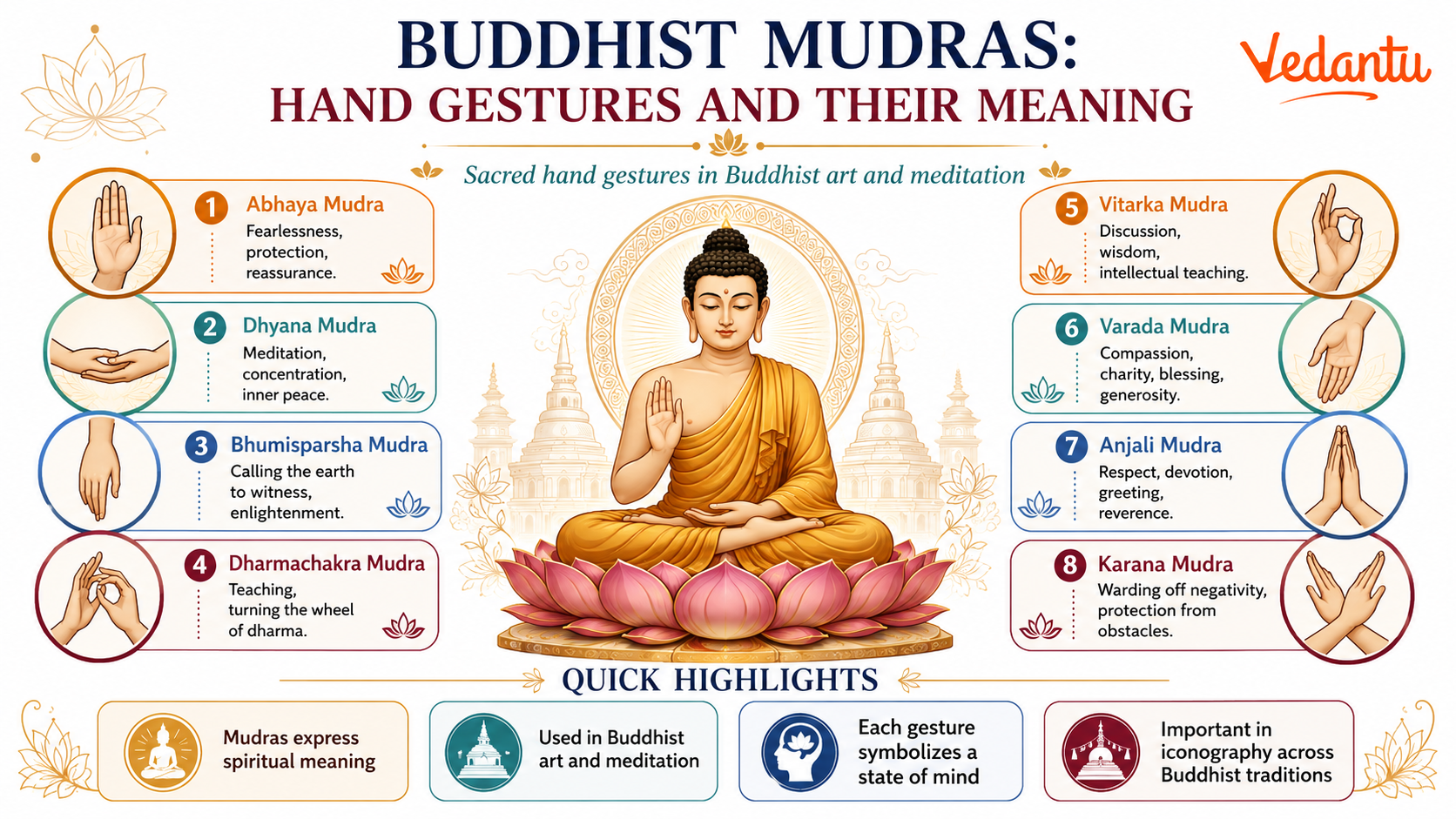
What Are Buddhist Mudras?
Buddhist mudras are codified hand gestures that represent specific teachings, moments from Buddha's life, or spiritual qualities such as compassion, wisdom, fearlessness, and meditation. Each mudra uses a unique arrangement of fingers and palms. These gestures are an essential part of Buddhist iconography and are used in both Theravada and Mahayana traditions.
- They symbolize spiritual states and virtues.
- They are used in meditation and ritual practices.
- They help identify different Buddhas and Bodhisattvas in art.
- They visually communicate Buddhist teachings without words.
Importance of Mudras in Buddhism
Mudras play a significant role in Buddhist spiritual practice and artistic expression. In meditation, certain mudras help practitioners focus their energy and maintain awareness. In sculpture and painting, mudras serve as a visual language that conveys important religious messages.
- Represent key events from Buddha's life.
- Express moral and philosophical ideas.
- Guide practitioners during meditation.
- Strengthen cultural and artistic identity in Buddhist regions.
Major Buddhist Mudras and Their Meanings
| Mudra Name | Hand Position | Meaning |
|---|---|---|
| Abhaya Mudra | Right hand raised, palm outward | Fearlessness and protection |
| Dhyana Mudra | Both hands in lap, palms upward | Meditation and concentration |
| Bhumisparsha Mudra | Right hand touches the earth | Calling the earth to witness enlightenment |
| Dharmachakra Mudra | Hands held near chest forming a circle | Turning the wheel of Dharma |
| Varada Mudra | Palm extended downward | Charity and compassion |
These mudras are commonly found in statues of Buddha across different Buddhist traditions. While the gesture remains similar, artistic styles may vary depending on region and historical period.
Explanation of Key Mudras
1. Abhaya Mudra - Gesture of Fearlessness
In this mudra, the right hand is raised to shoulder height with the palm facing outward. It symbolizes protection, peace, and reassurance. It represents Buddha calming a frightened elephant and offering safety to his followers.
2. Dhyana Mudra - Gesture of Meditation
Both hands are placed in the lap with palms facing upward, and the right hand rests over the left. This mudra represents deep meditation and spiritual concentration. It is commonly associated with Buddha's meditation under the Bodhi tree.
3. Bhumisparsha Mudra - Earth Touching Gesture
The right hand reaches down to touch the earth while the left hand rests in the lap. This gesture symbolizes the moment of enlightenment when Buddha called the earth to witness his victory over temptation.
4. Dharmachakra Mudra - Turning the Wheel of Dharma
This mudra is formed by joining the thumb and index finger of both hands to create circles, held near the chest. It represents Buddha's first sermon at Sarnath, where he explained the Four Noble Truths.
5. Varada Mudra - Gesture of Giving
In this gesture, the palm is extended downward with fingers pointing outward. It signifies generosity, compassion, and the granting of wishes.
Regional Variations of Buddhist Mudras
Although the basic meanings of mudras remain consistent, their artistic representation differs across regions. For example, Tibetan Buddhist art may depict more elaborate hand and finger details, while Southeast Asian statues often show smooth and simplified forms.
- Indian art focuses on symbolic clarity and spiritual depth.
- Tibetan art often combines mudras with ritual objects.
- Chinese and Japanese art emphasizes elegance and balance.
- Thai and Burmese statues highlight grace and elongated fingers.
Educational Significance for General Knowledge
Buddhist mudras are frequently asked in competitive exams under topics such as art and culture, religion, and ancient history. Understanding their meanings helps in interpreting Buddhist sculptures and monuments found in heritage sites such as Sanchi, Ajanta, Ellora, and Bodh Gaya.
- Identify the mudra shown in an image.
- Match the mudra with its meaning.
- Relate the mudra to events in Buddha's life.
- Understand its cultural and historical context.
Conclusion
Buddhist Mudras are powerful symbolic gestures that convey deep spiritual teachings and historical events from the life of Gautama Buddha. They serve as a visual language in Buddhist art and meditation practices across Asia. By understanding the meaning and significance of each mudra, students and readers can better appreciate Buddhist heritage, iconography, and philosophy. Knowledge of these hand gestures enhances both cultural awareness and exam preparation in the field of general knowledge.
FAQs on Buddhist Mudras: Sacred Hand Signs in Buddhism Explained
1. What are Buddhist Mudras?
Buddhist Mudras are symbolic hand gestures used in Buddhism to express spiritual ideas and states of mind.
• The word “Mudra” means “seal” or “gesture” in Sanskrit.
• They are commonly seen in Buddha statues, paintings, and meditation practices.
• Each mudra represents concepts like teaching, protection, meditation, fearlessness, and enlightenment.
• Mudras are important in Buddhist art, iconography, and rituals.
2. What is the meaning of the Abhaya Mudra?
The Abhaya Mudra symbolizes fearlessness, protection, and peace.
• The right hand is raised with the palm facing outward.
• It represents protection from fear and danger.
• It is often associated with the Buddha calming a frightened elephant.
• Commonly seen in Buddhist sculptures across India and Southeast Asia.
3. What does the Dharmachakra Mudra represent?
The Dharmachakra Mudra represents the “Turning of the Wheel of Dharma”, symbolizing the Buddha’s first sermon.
• Both hands are held near the chest forming a circle.
• It signifies teaching and spreading Buddhist wisdom.
• Closely linked to the First Sermon at Sarnath.
• A key symbol in Buddhist philosophy and religious teachings.
4. What is the significance of the Dhyana Mudra?
The Dhyana Mudra symbolizes meditation, concentration, and inner peace.
• Both hands rest on the lap with palms facing upward.
• The right hand lies over the left hand.
• Represents deep meditation and spiritual awakening.
• Commonly seen in statues of the Meditating Buddha.
5. What does the Bhumisparsha Mudra mean?
The Bhumisparsha Mudra signifies the moment of enlightenment of Gautama Buddha.
• The right hand touches the earth.
• It calls the Earth to witness Buddha’s enlightenment.
• Symbolizes victory over Mara (temptation and illusion).
• One of the most iconic gestures in Buddhist iconography.
6. What is the Varada Mudra in Buddhism?
The Varada Mudra represents charity, compassion, and granting of wishes.
• The hand is extended downward with palm open.
• Symbolizes generosity and kindness.
• Often seen alongside other mudras in Mahayana Buddhism.
• Reflects the Buddha’s benevolent nature.
7. Why are Mudras important in Buddhist art?
Mudras are important because they help identify the Buddha’s life events and teachings in art.
• Each gesture conveys a specific spiritual message.
• Used in temples, stupas, manuscripts, and sculptures.
• Help devotees understand Buddhist philosophy visually.
• Essential to Buddhist symbolism and sacred iconography.
8. How many major Buddhist Mudras are there?
There are several mudras, but around 5 to 10 major Buddhist Mudras are most commonly recognized.
• Abhaya (Fearlessness)
• Dharmachakra (Teaching)
• Dhyana (Meditation)
• Bhumisparsha (Earth-touching)
• Varada (Compassion)
• Vitarka (Discussion/Teaching)
• These are widely depicted in Buddhist traditions across Asia.
9. What is the Vitarka Mudra?
The Vitarka Mudra symbolizes discussion, intellectual debate, and transmission of teachings.
• The thumb and index finger form a circle.
• Other fingers point upward.
• Represents reasoning and explanation of Dharma.
• Common in depictions of the Teaching Buddha.
10. Are Buddhist Mudras used in meditation today?
Yes, Buddhist Mudras are still used in modern meditation and spiritual practices.
• Practitioners use mudras to enhance focus and mindfulness.
• Believed to channel spiritual energy and balance.
• Common in Tibetan Buddhism, Zen Buddhism, and yoga practices.
• Help deepen concentration, awareness, and inner calm.
