



DNA and RNA differences: structure and functions explained simply
DNA and RNA are the two most important molecules responsible for storing and expressing genetic information in living organisms. They control heredity, protein synthesis, growth, and cellular functions. Understanding DNA and RNA is essential for students preparing for competitive exams like NEET, as questions related to molecular biology, replication, transcription, and translation are frequently asked. This page provides a complete and structured explanation of DNA and RNA, including their structure, functions, differences, and importance in biology.
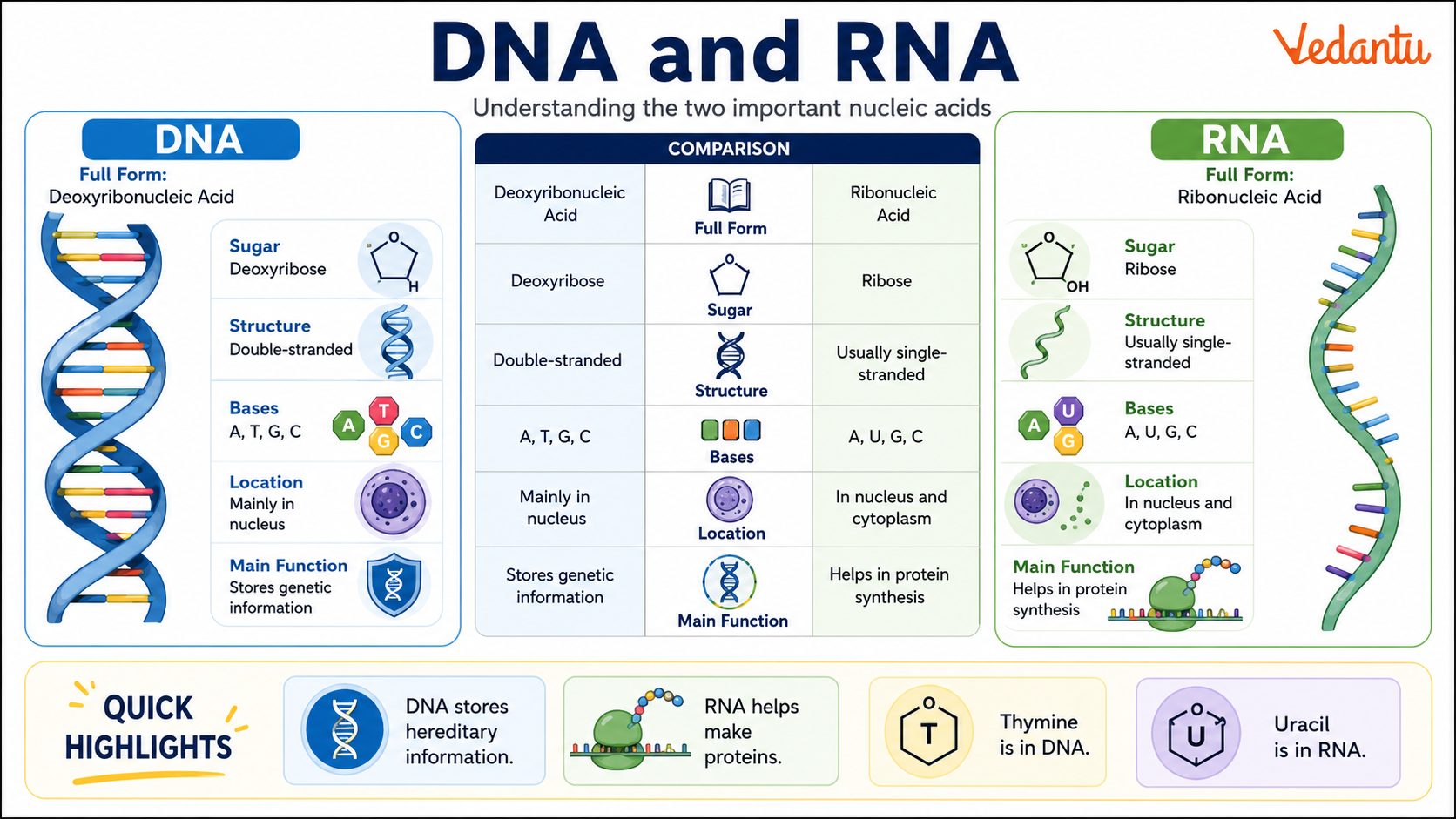
What is DNA?
DNA stands for Deoxyribonucleic Acid. It is the hereditary material present in almost all living organisms. DNA carries genetic instructions that determine the structure, function, and behavior of cells. In eukaryotes, DNA is mainly found in the nucleus, while in prokaryotes it is present in the cytoplasm.
Structure of DNA
DNA has a double helix structure discovered by James Watson and Francis Crick in 1953. It consists of two strands that coil around each other.
- Each strand is made up of nucleotides.
- A nucleotide contains a deoxyribose sugar, a phosphate group, and a nitrogenous base.
- The nitrogenous bases are Adenine (A), Thymine (T), Cytosine (C), and Guanine (G).
- A pairs with T and C pairs with G through hydrogen bonds.
Functions of DNA
- Stores genetic information.
- Controls protein synthesis.
- Transfers hereditary information from parents to offspring.
- Regulates cell division and growth.
What is RNA?
RNA stands for Ribonucleic Acid. It plays a crucial role in converting genetic information from DNA into proteins. RNA is usually single stranded and is found in the nucleus as well as in the cytoplasm.
Structure of RNA
RNA is made up of nucleotides similar to DNA, but it has some structural differences.
- Contains ribose sugar instead of deoxyribose.
- Has Uracil (U) instead of Thymine (T).
- Usually single stranded.
- Nitrogenous bases are Adenine (A), Uracil (U), Cytosine (C), and Guanine (G).
Types of RNA
- mRNA (Messenger RNA) - Carries genetic information from DNA to ribosomes.
- tRNA (Transfer RNA) - Brings amino acids to the ribosome during protein synthesis.
- rRNA (Ribosomal RNA) - Forms the structural and functional component of ribosomes.
Difference Between DNA and RNA
| Basis of Comparison | DNA | RNA |
|---|---|---|
| Sugar | Deoxyribose | Ribose |
| Strands | Double stranded | Single stranded |
| Base | Thymine present | Uracil present |
DNA is mainly responsible for long term storage of genetic information, whereas RNA plays an active role in protein synthesis. The structural differences between them help in performing their specific biological functions.
DNA Replication
DNA replication is the process by which DNA makes an identical copy of itself before cell division. It is a semi conservative process, meaning each new DNA molecule contains one old strand and one newly synthesized strand.
- Unwinding of the double helix by helicase enzyme.
- Complementary base pairing with free nucleotides.
- Formation of new strands by DNA polymerase.
- Joining of fragments by DNA ligase.
Transcription and Translation
Transcription
Transcription is the process in which genetic information from DNA is copied into mRNA. It occurs in the nucleus in eukaryotic cells.
Translation
Translation is the process in which the mRNA sequence is used to synthesize proteins at the ribosome. tRNA brings specific amino acids according to the codon sequence on mRNA.
Importance of DNA and RNA in NEET
DNA and RNA form the core of molecular genetics and biotechnology. NEET frequently includes questions on base pairing rules, types of RNA, replication enzymes, and differences between DNA and RNA.
- Focus on structural differences and base pairing.
- Understand enzymes involved in replication and transcription.
- Practice diagrams of DNA double helix and RNA structure.
- Revise types and functions of RNA thoroughly.
Conclusion
DNA and RNA are fundamental biomolecules that govern life processes. DNA stores genetic information, while RNA helps in converting this information into functional proteins. Their coordinated action ensures growth, development, and inheritance in living organisms. A strong understanding of DNA and RNA not only builds conceptual clarity in biology but also strengthens preparation for competitive exams like NEET.
FAQs on DNA and RNA: Understanding Genetic Material and Protein Synthesis
1. What is DNA and what is its main function?
DNA (Deoxyribonucleic Acid) is the hereditary material that stores and transmits genetic information in living organisms.
• It carries genetic instructions for growth, development, reproduction, and functioning.
• DNA is located mainly in the nucleus of eukaryotic cells and in the cytoplasm of prokaryotes.
• It is structured as a double helix made of nucleotides.
• It controls protein synthesis through gene expression.
People also ask: What is the role of DNA in cells? How does DNA store genetic information?
2. What is RNA and how is it different from DNA?
RNA (Ribonucleic Acid) is a single-stranded molecule that helps in protein synthesis and gene expression.
• RNA contains ribose sugar, while DNA contains deoxyribose sugar.
• RNA has the base uracil (U) instead of thymine (T).
• RNA is usually single-stranded, whereas DNA is double-stranded.
• RNA works in the cytoplasm and nucleus during protein production.
People also search: Difference between DNA and RNA, DNA vs RNA structure, types of RNA.
3. What are the main structural components of DNA?
DNA is made up of nucleotides that form its unique double-helix structure.
• Each nucleotide contains a phosphate group, deoxyribose sugar, and a nitrogenous base.
• The four nitrogen bases are Adenine (A), Thymine (T), Guanine (G), and Cytosine (C).
• Base pairing follows Chargaff’s rule: A–T and G–C.
People also ask: What are nucleotides? What is the structure of DNA made of?
4. What are the different types of RNA?
There are three main types of RNA involved in protein synthesis.
• mRNA (Messenger RNA) – carries genetic code from DNA to ribosomes.
• tRNA (Transfer RNA) – brings amino acids to ribosomes.
• rRNA (Ribosomal RNA) – forms the core of ribosomes.
Other types include snRNA and miRNA involved in gene regulation.
People also search: Types of RNA and functions, role of mRNA, tRNA, rRNA.
5. What is DNA replication?
DNA replication is the process by which DNA makes an identical copy of itself before cell division.
• It occurs during the S-phase of the cell cycle.
• The enzyme DNA polymerase synthesizes new strands.
• Replication follows a semi-conservative model (each new DNA has one old and one new strand).
People also ask: How does DNA replicate? What is semi-conservative replication?
6. What is transcription in DNA and RNA?
Transcription is the process of copying genetic information from DNA to RNA.
• It occurs in the nucleus of eukaryotic cells.
• The enzyme RNA polymerase synthesizes mRNA.
• The mRNA formed carries the genetic message for protein production.
People also search: Steps of transcription, transcription vs translation, gene expression process.
7. What is translation in protein synthesis?
Translation is the process by which ribosomes convert mRNA into proteins.
• It takes place in the cytoplasm.
• Ribosomes read mRNA codons in sets of three bases.
• tRNA brings specific amino acids to form a polypeptide chain.
People also ask: What happens during translation? How are proteins made from DNA?
8. Where are DNA and RNA found in the cell?
DNA and RNA are found in different parts of the cell depending on their function.
• DNA is mainly present in the nucleus and also in mitochondria.
• RNA is found in the nucleus and cytoplasm.
• In prokaryotes, DNA is located in the nucleoid region.
People also search: Location of DNA in cell, where is RNA found?
9. Why is DNA called the genetic blueprint of life?
DNA is called the genetic blueprint of life because it contains the complete set of instructions for building and maintaining an organism.
• It determines traits and characteristics.
• It controls cell structure and function.
• It is passed from parents to offspring during reproduction.
People also ask: Why is DNA important? How does DNA control traits?
10. Who discovered the structure of DNA?
The double-helix structure of DNA was discovered by James Watson and Francis Crick in 1953.
• Their discovery was based on X-ray diffraction data by Rosalind Franklin.
• Maurice Wilkins also contributed to the research.
• This discovery revolutionized molecular biology and genetics.
People also search: Discovery of DNA structure, Watson and Crick model, history of DNA discovery.
