



What Are the Main Powers and Responsibilities of the Enforcement Directorate in India?
The Enforcement Directorate Functions form a crucial part of India’s financial crime control framework. The Enforcement Directorate - ED is a specialized financial investigation agency under the Department of Revenue, Ministry of Finance. It is primarily responsible for enforcing economic laws and fighting financial crimes such as money laundering and foreign exchange violations. Understanding the functions of the Enforcement Directorate is important for students, competitive exam aspirants, and anyone interested in India’s anti-corruption and financial regulatory system.
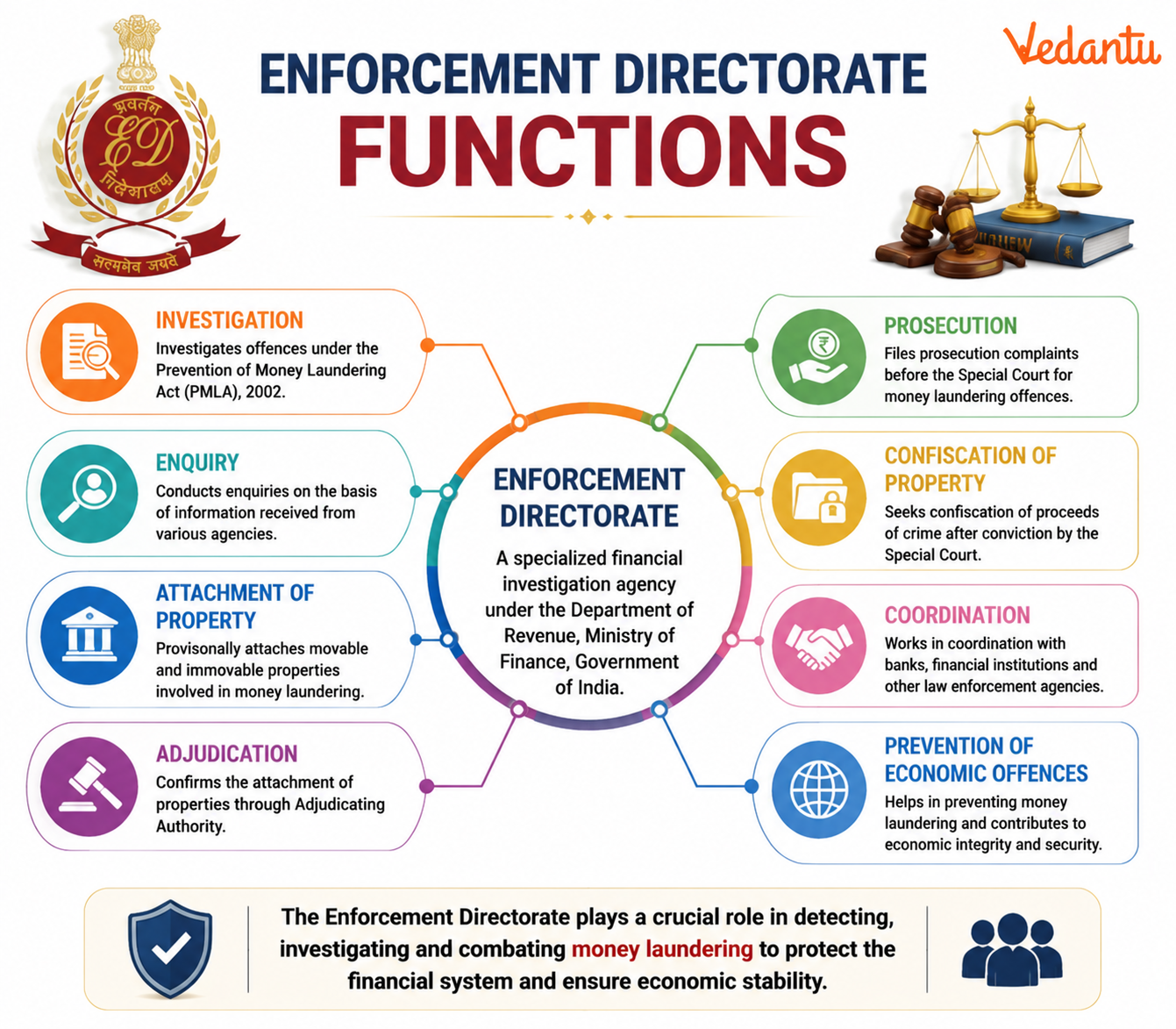
What is the Enforcement Directorate?
The Enforcement Directorate was established in 1956 and is headquartered in New Delhi. It functions as a law enforcement agency with nationwide jurisdiction. The ED investigates cases of financial fraud, money laundering, foreign exchange violations, and economic offenses that have national and international implications.
- Established - 1956
- Parent Ministry - Ministry of Finance
- Department - Department of Revenue
- Headquarters - New Delhi
Major Laws Enforced by the Enforcement Directorate
The Enforcement Directorate performs its duties mainly under two key laws. These laws empower the agency to investigate, attach property, and prosecute offenders involved in financial crimes.
Key Acts Enforced by ED
| Act | Year | Main Objective |
|---|---|---|
| Prevention of Money Laundering Act - PMLA | 2002 | Prevent money laundering and confiscate proceeds of crime |
| Foreign Exchange Management Act - FEMA | 1999 | Regulate foreign exchange transactions |
Under PMLA, the ED can attach properties acquired through illegal means and prosecute offenders. Under FEMA, it investigates violations related to foreign exchange transactions and cross-border financial dealings.
Core Functions of the Enforcement Directorate
1. Investigation of Money Laundering Cases
The primary function of the ED is to investigate offenses related to money laundering under the PMLA. Money laundering involves disguising illegally obtained money to make it appear legal. The ED traces the origin of such funds and identifies the individuals involved.
2. Attachment and Confiscation of Property
The ED has the power to provisionally attach properties that are believed to be proceeds of crime. After legal proceedings, these properties can be confiscated by the government if the accused is found guilty.
3. Adjudication and Prosecution
The ED files prosecution complaints before special courts designated under PMLA. It ensures that accused persons are tried under the provisions of the relevant law.
4. Enforcement of FEMA Provisions
Under FEMA, the ED investigates cases involving violations of foreign exchange regulations such as unauthorized foreign investments, illegal remittances, and contravention of Reserve Bank of India guidelines.
5. Coordination with Other Agencies
The ED works in coordination with other investigative agencies such as:
- Central Bureau of Investigation - CBI
- Income Tax Department
- Serious Fraud Investigation Office - SFIO
- State Police Departments
It also cooperates with international organizations to track cross-border financial crimes.
Powers of the Enforcement Directorate
The ED has significant investigative powers under the laws it enforces. These powers enable it to effectively combat economic offenses.
- Power to summon individuals for questioning
- Power to conduct search and seizure operations
- Power to arrest accused persons under PMLA
- Power to attach and confiscate properties
Organizational Structure of ED
The Enforcement Directorate is headed by a Director. The Director is assisted by Special Directors, Additional Directors, Joint Directors, Deputy Directors, and Assistant Directors. The agency has zonal and regional offices across India to ensure nationwide coverage.
Importance of Enforcement Directorate in India
The Enforcement Directorate plays a vital role in maintaining the financial integrity of the country. It helps in:
- Preventing corruption and black money circulation
- Ensuring transparency in financial transactions
- Strengthening India’s economic security
- Enhancing international cooperation in financial crime control
Challenges Faced by the Enforcement Directorate
Despite its significant role, the ED faces certain challenges in carrying out its functions effectively.
- Complex cross-border financial transactions
- Legal challenges and judicial scrutiny
- Allegations of political misuse
- Increasing sophistication of financial crimes
Conclusion
The Enforcement Directorate Functions are central to India’s fight against money laundering and financial crimes. By enforcing PMLA and FEMA, the ED ensures that illegal financial activities are investigated and punished according to law. Its powers of investigation, attachment, and prosecution make it a key institution in safeguarding India’s economic system. For competitive exams and general awareness, understanding the structure, powers, and functions of the Enforcement Directorate is essential.
FAQs on Enforcement Directorate Functions and Key Roles Explained
1. What is the Enforcement Directorate (ED) and what does it do?
The Enforcement Directorate (ED) is a financial investigation agency of the Government of India responsible for enforcing economic laws and combating financial crimes.
• Established in 1956 under the Department of Revenue, Ministry of Finance
• Enforces the Prevention of Money Laundering Act (PMLA), 2002
• Implements the Foreign Exchange Management Act (FEMA), 1999
• Investigates cases related to money laundering, hawala transactions, foreign exchange violations, and economic fraud
This agency plays a key role in maintaining financial integrity and preventing illegal financial activities in India.
2. What are the main functions of the Enforcement Directorate?
The primary function of the Enforcement Directorate is to investigate and prosecute economic offences under specific financial laws.
• Investigates offences under PMLA and FEMA
• Attaches and confiscates properties obtained through proceeds of crime
• Conducts searches, surveys, and arrests under PMLA provisions
• Files prosecution complaints in special PMLA courts
• Coordinates with agencies like CBI, RBI, and international financial bodies
These functions help curb black money, financial fraud, and cross-border economic crimes.
3. Under which ministry does the Enforcement Directorate work?
The Enforcement Directorate works under the Department of Revenue in the Ministry of Finance, Government of India.
• Administrative control: Ministry of Finance
• Operational authority under PMLA and FEMA
• Headquarters located in New Delhi
This structure ensures coordination in handling financial investigations, economic offences, and anti-money laundering enforcement.
4. What is the role of ED under the Prevention of Money Laundering Act (PMLA)?
Under the Prevention of Money Laundering Act (PMLA), 2002, the ED investigates and prosecutes money laundering offences.
• Identifies and traces proceeds of crime
• Attaches and confiscates illegally acquired assets
• Conducts arrest and interrogation of accused persons
• Files cases before Special PMLA Courts
This role is central to controlling financial crimes, corruption, terror funding, and economic security threats in India.
5. What is the role of ED under the Foreign Exchange Management Act (FEMA)?
Under the Foreign Exchange Management Act (FEMA), 1999, the ED ensures compliance with foreign exchange laws.
• Investigates violations related to foreign exchange transactions
• Imposes penalties for illegal forex dealings
• Regulates cross-border investments and remittances
• Handles cases of hawala and illegal foreign fund transfers
FEMA enforcement helps maintain India’s foreign exchange stability and economic regulation.
6. Can the Enforcement Directorate arrest individuals?
Yes, the Enforcement Directorate has the power to arrest individuals under the PMLA, 2002.
• Arrest is made if there is material evidence of money laundering
• The accused must be informed of the grounds of arrest
• The individual must be produced before a court within 24 hours
• ED officials have powers similar to civil courts for investigation
This authority strengthens the agency’s role in tackling economic offences and financial fraud.
7. What is the difference between ED and CBI?
The Enforcement Directorate (ED) and Central Bureau of Investigation (CBI) differ mainly in their areas of investigation.
• ED focuses on money laundering and foreign exchange violations
• CBI investigates corruption, criminal cases, and major frauds
• ED works under Ministry of Finance
• CBI works under Department of Personnel and Training (DoPT)
Both agencies cooperate in cases involving economic crimes and corruption, but their legal mandates are different.
8. When was the Enforcement Directorate established?
The Enforcement Directorate was established in 1956 to handle violations of foreign exchange laws.
• Initially created to enforce the Foreign Exchange Regulation Act (FERA)
• Later empowered under FEMA (1999)
• Given expanded powers under PMLA (2002)
Over time, the ED evolved into a major agency for combating money laundering and economic offences in India.
9. What powers does the Enforcement Directorate have?
The Enforcement Directorate has extensive investigative and quasi-judicial powers under financial laws.
• Conducts search and seizure operations
• Attaches and confiscates properties
• Issues summons for recording statements
• Arrests accused persons under PMLA
• Files prosecution complaints in special courts
These powers enable the ED to effectively combat black money, financial scams, and economic threats.
10. Why is the Enforcement Directorate important for India?
The Enforcement Directorate is important because it safeguards India’s financial system from illegal activities and economic crimes.
• Prevents money laundering and terror financing
• Protects foreign exchange reserves
• Strengthens financial transparency and accountability
• Supports anti-corruption and anti-fraud mechanisms
By enforcing PMLA and FEMA, the ED contributes to national economic security, regulatory compliance, and financial stability.
