



Key Provisions and Educational Reforms under the Charter Act 1813
The Charter Act of 1813 was a significant legislation passed by the British Parliament to renew the East India Company’s charter for another 20 years. It marked a turning point in British policy towards India by ending the Company’s monopoly over trade, introducing provisions for education, and allowing Christian missionaries to operate in India. The Act played a crucial role in shaping administrative, economic, and educational developments in colonial India. Understanding the features of the Charter Act of 1813 is essential for students and competitive exam aspirants studying Modern Indian History.
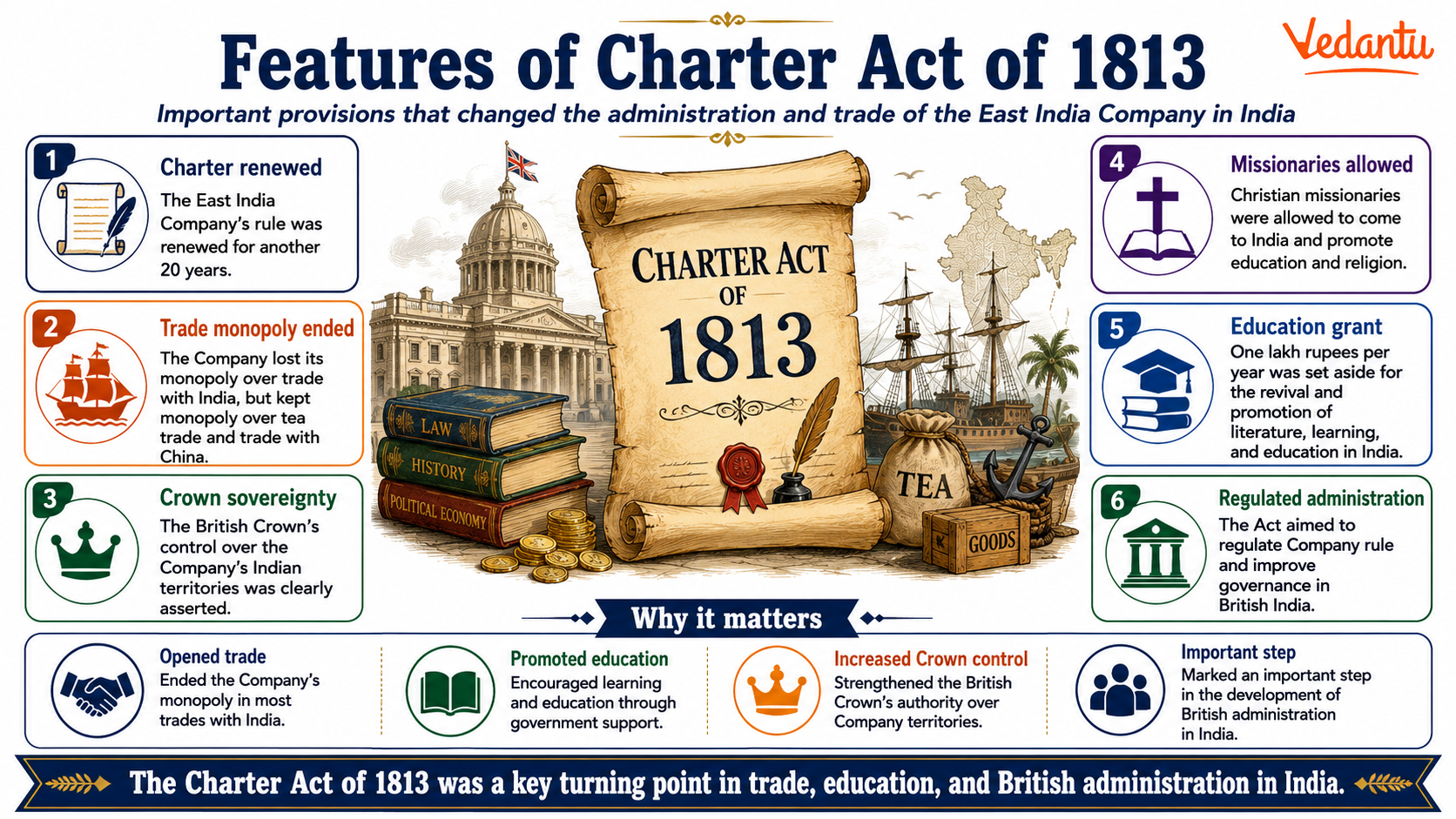
Background of the Charter Act of 1813
The East India Company was originally granted a charter in 1600, which was renewed periodically by the British Parliament. By 1813, the Company had established strong political control over large parts of India. However, there was growing pressure in Britain from merchants, industrialists, and missionaries to end the Company’s trade monopoly and open India to free trade and Christian missionary activities.
- Industrial Revolution increased demand for Indian markets.
- British merchants demanded free trade with India.
- Missionaries sought permission to spread Christianity in India.
- Parliament wanted greater control over the Company’s administration.
Major Features of Charter Act of 1813
1. End of Trade Monopoly
The Act ended the East India Company’s monopoly over trade with India. However, the Company retained its monopoly over trade with China and the trade in tea. This provision opened Indian markets to private British traders.
2. Permission to Christian Missionaries
For the first time, Christian missionaries were officially allowed to enter India and propagate their religion. This led to the establishment of schools, churches, and printing presses.
3. Promotion of Education
The Act made a significant provision for education by allocating one lakh rupees annually for the promotion of education in India. This was the first time the British government accepted responsibility for educating Indians.
4. Assertion of Crown Sovereignty
The Act clearly stated that the sovereignty of British territories in India rested with the British Crown. The Company was allowed to govern Indian territories on behalf of the Crown.
5. Regulation of Company’s Powers
The Act strengthened the control of the British Parliament over the East India Company by renewing its charter for 20 years and introducing greater oversight.
6. Financial Provisions
The Company was required to maintain separate accounts for its commercial and territorial revenues. This separation helped in better financial management and accountability.
Key Provisions of the Charter Act of 1813
| Provision | Details | Impact |
|---|---|---|
| Trade Monopoly | Ended in India but retained for China and tea | Boosted private British trade |
| Education Grant | One lakh rupees annually | Foundation of modern education policy |
| Missionary Entry | Official permission granted | Spread of Western education and Christianity |
The above provisions demonstrate how the Charter Act of 1813 brought economic liberalization, administrative reforms, and educational initiatives under British rule in India.
Significance of the Charter Act of 1813
- Marked the beginning of free trade in India under British control.
- Initiated state responsibility towards education in India.
- Facilitated the spread of Western ideas and institutions.
- Strengthened parliamentary control over the Company.
Limitations of the Charter Act of 1813
Despite its reforms, the Act had certain limitations. The education fund of one lakh rupees was insufficient for a vast country like India. The Company continued to hold significant political power. Moreover, the opening of trade benefited British merchants more than Indian industries.
Conclusion
The Charter Act of 1813 was a landmark legislation in the history of British India. It ended the East India Company’s trade monopoly in India, introduced state-sponsored education, and allowed missionary activities. While it strengthened British control, it also laid the foundation for educational and economic changes in India. For students and competitive exam aspirants, understanding the features and significance of the Charter Act of 1813 is crucial for mastering Modern Indian History.
FAQs on Features of the Charter Act of 1813: Key Provisions and Impact on India
1. What was the Charter Act of 1813?
The Charter Act of 1813 was a significant legislation passed by the British Parliament to renew the charter of the East India Company and redefine its powers in India.
Key features include:
• Ended the trade monopoly of the East India Company (except tea and trade with China)
• Allowed Christian missionaries to enter India
• Asserted the sovereignty of the British Crown over Indian territories
• Allocated ₹1 lakh annually for education
This Act is often searched under topics like British constitutional development in India, Company rule reforms, and features of Charter Acts.
2. Why was the Charter Act of 1813 passed?
The Charter Act of 1813 was passed to renew the East India Company’s charter and respond to growing criticism of its monopoly.
Main reasons:
• Pressure from British merchants to end trade monopoly
• Demand for spreading Christianity and Western education in India
• Need for better administrative control over Indian territories
• Parliamentary review after 20 years (as per policy)
It addressed concerns related to trade liberalization, missionary activities, and education reforms in colonial India.
3. What were the main features of the Charter Act of 1813?
The main features of the Charter Act of 1813 reshaped British economic and administrative policy in India.
Important provisions:
• Abolished Company’s trade monopoly in India (except tea and China trade)
• Recognized British Crown’s sovereignty over India
• Permitted Christian missionaries to preach in India
• Provided ₹1 lakh per year for education
• Strengthened powers of the Board of Control
These features are crucial for UPSC, SSC, and State PSC exams.
4. How did the Charter Act of 1813 affect the East India Company?
The Charter Act of 1813 significantly reduced the commercial powers of the East India Company.
Major impacts:
• Ended its monopoly over Indian trade
• Continued monopoly only in tea and China trade
• Increased control of the British Parliament
• Transformed the Company more into an administrative body
This marked the beginning of the decline of the Company’s commercial dominance in India.
5. What was the educational provision in the Charter Act of 1813?
The Charter Act of 1813 introduced the first official step toward state-sponsored education in India.
Educational provision included:
• Allocation of ₹1 lakh per annum for education
• Promotion of literature and scientific knowledge
• Encouragement of Western education
This provision later led to debates like the Anglicist vs Orientalist controversy and influenced modern education policy in colonial India.
6. Did the Charter Act of 1813 allow Christian missionaries in India?
Yes, the Charter Act of 1813 officially allowed Christian missionaries to enter and operate in India.
Key points:
• Missionaries could preach and spread Christianity
• Promoted establishment of schools and printing presses
• Encouraged social and educational reforms
This change is often linked with religious reforms and cultural impact of British rule in India.
7. How did the Charter Act of 1813 assert British Crown sovereignty?
The Charter Act of 1813 clearly stated that Indian territories were under the sovereignty of the British Crown.
This meant:
• Company ruled India on behalf of the Crown
• Strengthened parliamentary supervision
• Reduced independent authority of the Company
It laid the groundwork for later acts like the Charter Act of 1833 and Government of India Act 1858.
8. What was the significance of the Charter Act of 1813 in Indian history?
The Charter Act of 1813 was significant because it marked the beginning of major constitutional and educational reforms in British India.
Its importance includes:
• Start of education reforms
• End of Company’s commercial monopoly
• Entry of missionaries and Western ideas
• Increased British governmental control
It is a key milestone in the constitutional development of India.
9. How is the Charter Act of 1813 different from the Charter Act of 1833?
The Charter Act of 1813 and Charter Act of 1833 differ mainly in administrative and commercial reforms.
Differences:
• 1813: Ended monopoly except tea and China trade
• 1833: Ended Company’s remaining trade monopoly completely
• 1833: Made Governor-General of Bengal as Governor-General of India
• 1833: Introduced law reforms and centralization
Both Acts are important in understanding British constitutional evolution in India.
10. Why is the Charter Act of 1813 important for competitive exams?
The Charter Act of 1813 is frequently asked in UPSC, SSC, Banking, and State PSC exams due to its constitutional and educational significance.
Exam-relevant points:
• End of East India Company trade monopoly
• Provision of ₹1 lakh for education
• Permission to Christian missionaries
• Assertion of British Crown sovereignty
Understanding this Act helps in mastering topics like British Acts in India, colonial administration, and modern Indian history.
