



Why Was the Gandhi-Irwin Agreement Signed and What Were Its Main Terms?
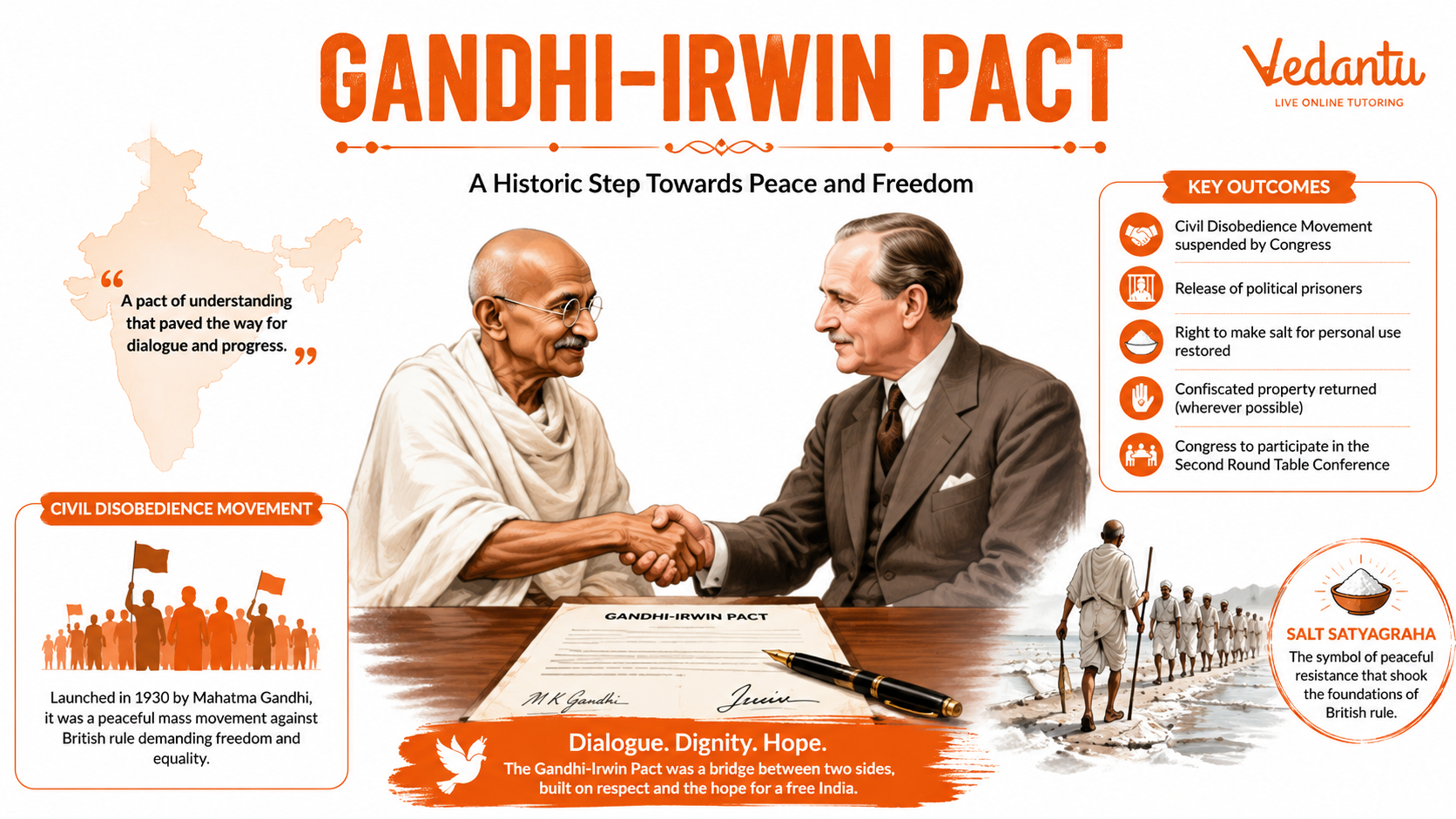
The Gandhi-Irwin Pact was a significant political agreement signed on 5 March 1931 between Mahatma Gandhi and Lord Irwin, the then Viceroy of India. It marked a temporary truce between the British Government and the Indian National Congress during the Civil Disobedience Movement. The pact is considered an important milestone in India’s freedom struggle as it led to the suspension of the movement and opened the door for constitutional negotiations between Indian leaders and the British authorities.
Background of the Gandhi-Irwin Pact
The Gandhi-Irwin Pact emerged in the context of the Civil Disobedience Movement launched by Mahatma Gandhi in 1930. The movement began with the historic Dandi March against the British salt tax and soon spread across the country. Thousands of Indians participated in protests, boycotts, and acts of non-violent resistance.
The British government responded with strict repression. Thousands of leaders and volunteers were arrested, including Gandhi himself. However, the movement gained massive public support and international attention. Realizing the need for negotiation, Lord Irwin initiated talks with Gandhi, leading to the signing of the pact in 1931.
Main Provisions of the Gandhi-Irwin Pact
- The Indian National Congress agreed to suspend the Civil Disobedience Movement.
- Congress agreed to participate in the Second Round Table Conference in London.
- The British government agreed to release political prisoners who were not involved in violent crimes.
- Confiscated properties of satyagrahis were to be returned.
- The government permitted peaceful picketing of liquor and foreign cloth shops.
- The government allowed the manufacture of salt by Indians living near the sea.
Objectives of the Pact
From the Indian National Congress
The Congress aimed to secure concessions from the British government, ensure the release of political prisoners, and create a platform for constitutional dialogue. Gandhi wanted to achieve recognition of the Congress as a legitimate representative of the Indian people.
From the British Government
The British government wanted to restore peace and order in the country and ensure Congress participation in the Round Table Conference. It was also an attempt to control the growing national movement through negotiation rather than repression.
Significance of the Gandhi-Irwin Pact
- It marked the first time the British government negotiated with the Indian National Congress on equal terms.
- It demonstrated the effectiveness of non-violent resistance.
- It led to Gandhi’s participation in the Second Round Table Conference in 1931.
- It provided temporary relief to political prisoners and activists.
Criticism of the Gandhi-Irwin Pact
Despite its importance, the pact faced criticism from various sections of Indian society.
- Revolutionary groups criticized it because political prisoners involved in violent activities were not released.
- Some Congress leaders felt that the pact did not achieve major constitutional concessions.
- The execution of Bhagat Singh, Rajguru, and Sukhdev shortly after the pact created dissatisfaction among the masses.
Gandhi-Irwin Pact at a Glance
| Aspect | Details | Year |
|---|---|---|
| Agreement Between | Mahatma Gandhi and Lord Irwin | 1931 |
| Related Movement | Civil Disobedience Movement | 1930-1934 |
| Outcome | Suspension of Movement and Round Table Conference Participation | 5 March 1931 |
The table above summarizes the key aspects of the Gandhi-Irwin Pact, highlighting its context, participants, and outcomes in a concise format for quick revision.
Impact on the Indian Freedom Struggle
The Gandhi-Irwin Pact represented a strategic pause in the struggle for independence. Although it did not grant immediate self-rule, it strengthened the position of the Indian National Congress as the principal representative of Indian aspirations. The pact showed that mass movements combined with non-violence could compel the British government to negotiate.
However, the failure of the Second Round Table Conference and the resumption of the Civil Disobedience Movement in 1932 indicated that the pact was only a temporary settlement. Despite its limitations, it remains a landmark event in India’s struggle for freedom.
Key Points for Quick Revision
- Signed on 5 March 1931 between Mahatma Gandhi and Lord Irwin.
- Led to the suspension of the Civil Disobedience Movement.
- Allowed Congress participation in the Second Round Table Conference.
- Political prisoners not involved in violence were released.
- Considered a significant step in constitutional negotiations.
Understanding the Gandhi-Irwin Pact is essential for students preparing for competitive examinations and general studies. It highlights the dynamics of negotiation, non-violent resistance, and constitutional development in colonial India.
FAQs on Gandhi-Irwin Pact of 1931: Background, Provisions and Significance
1. What was the Gandhi-Irwin Pact?
The Gandhi-Irwin Pact (1931) was a political agreement between Mahatma Gandhi and Lord Irwin to suspend the Civil Disobedience Movement and promote constitutional dialogue.
• Signed on 5 March 1931
• Also called the Delhi Pact
• Agreement between the Indian National Congress and the British Government
• Aimed to ease tensions after the Civil Disobedience Movement and Salt Satyagraha
• Led to Congress participation in the Second Round Table Conference
2. When and where was the Gandhi-Irwin Pact signed?
The Gandhi-Irwin Pact was signed on 5 March 1931 in Delhi between Gandhi and the Viceroy of India.
• Location: Delhi
• Signatories: Mahatma Gandhi and Lord Irwin
• Period: During British colonial rule in India
• Context: After nationwide protests under the Civil Disobedience Movement
3. What were the main terms of the Gandhi-Irwin Pact?
The main terms of the Gandhi-Irwin Pact included concessions by both the British Government and the Indian National Congress.
• Release of political prisoners (except those involved in violence)
• Return of confiscated properties
• Permission to make salt for personal use in coastal areas
• Withdrawal of ordinances and prosecutions
• Congress agreed to suspend the Civil Disobedience Movement and attend the Round Table Conference
4. Why was the Gandhi-Irwin Pact important in Indian history?
The Gandhi-Irwin Pact was important because it marked the first official negotiation between the British Government and the Indian National Congress.
• Recognized Congress as a major political force
• Strengthened Gandhi’s leadership in the freedom struggle
• Temporarily reduced political repression
• Opened the path for constitutional discussions in London
• Became a key event in the Indian Freedom Movement
5. Why did Mahatma Gandhi agree to the Gandhi-Irwin Pact?
Mahatma Gandhi agreed to the pact to secure political concessions and continue the freedom struggle through negotiations.
• Release of thousands of political prisoners
• Restoration of civil liberties
• Opportunity to present India’s case at the Second Round Table Conference
• Strategic pause in the Non-violent Civil Disobedience Movement
6. How did the Gandhi-Irwin Pact affect the Civil Disobedience Movement?
The Gandhi-Irwin Pact led to the temporary suspension of the Civil Disobedience Movement.
• Congress stopped mass protests and boycotts
• Salt Satyagraha activities were halted
• Political negotiations replaced direct action temporarily
• Movement resumed later after the failure of talks in London
7. What was the reaction of Indian leaders to the Gandhi-Irwin Pact?
The reaction to the Gandhi-Irwin Pact was mixed among Indian leaders and revolutionaries.
• Some Congress leaders supported Gandhi’s decision
• Revolutionaries criticized the pact for not saving Bhagat Singh and his associates
• Youth leaders felt it gave limited concessions
• Debate increased within the Indian National Congress
8. Did the Gandhi-Irwin Pact lead to India’s independence?
The Gandhi-Irwin Pact did not directly lead to independence but was a significant step in the freedom struggle.
• It initiated formal negotiations with the British
• Highlighted the strength of mass movements
• Failed to achieve complete self-rule (Purna Swaraj)
• Independence was achieved later in 1947
9. What was the connection between the Gandhi-Irwin Pact and the Round Table Conference?
The Gandhi-Irwin Pact allowed the Indian National Congress to participate in the Second Round Table Conference in London.
• Gandhi attended as the sole representative of Congress
• Discussions focused on constitutional reforms
• Talks failed to meet Indian demands
• Led to the revival of the Civil Disobedience Movement
10. Why is the Gandhi-Irwin Pact also called the Delhi Pact?
The Gandhi-Irwin Pact is also called the Delhi Pact because it was signed in Delhi in 1931.
• Agreement finalized at the Viceroy’s House
• Symbolized political compromise in the capital city
• Commonly referred to as Delhi Pact 1931 in history and competitive exams
• Important topic in General Knowledge (GK) and UPSC preparation
