



History of Medieval India Timeline, Major Dynasties, and Key Events Explained
The History of Medieval India is a crucial part of General Knowledge and plays an important role in competitive examinations and academic studies. The medieval period in India generally spans from the 8th century to the 18th century. This era witnessed the rise and fall of powerful dynasties, the establishment of the Delhi Sultanate and the Mughal Empire, major cultural transformations, the spread of Islam, and significant developments in art, architecture, administration, and society. A complete study of Medieval India helps students understand the political, social, economic, and cultural foundations of modern India.
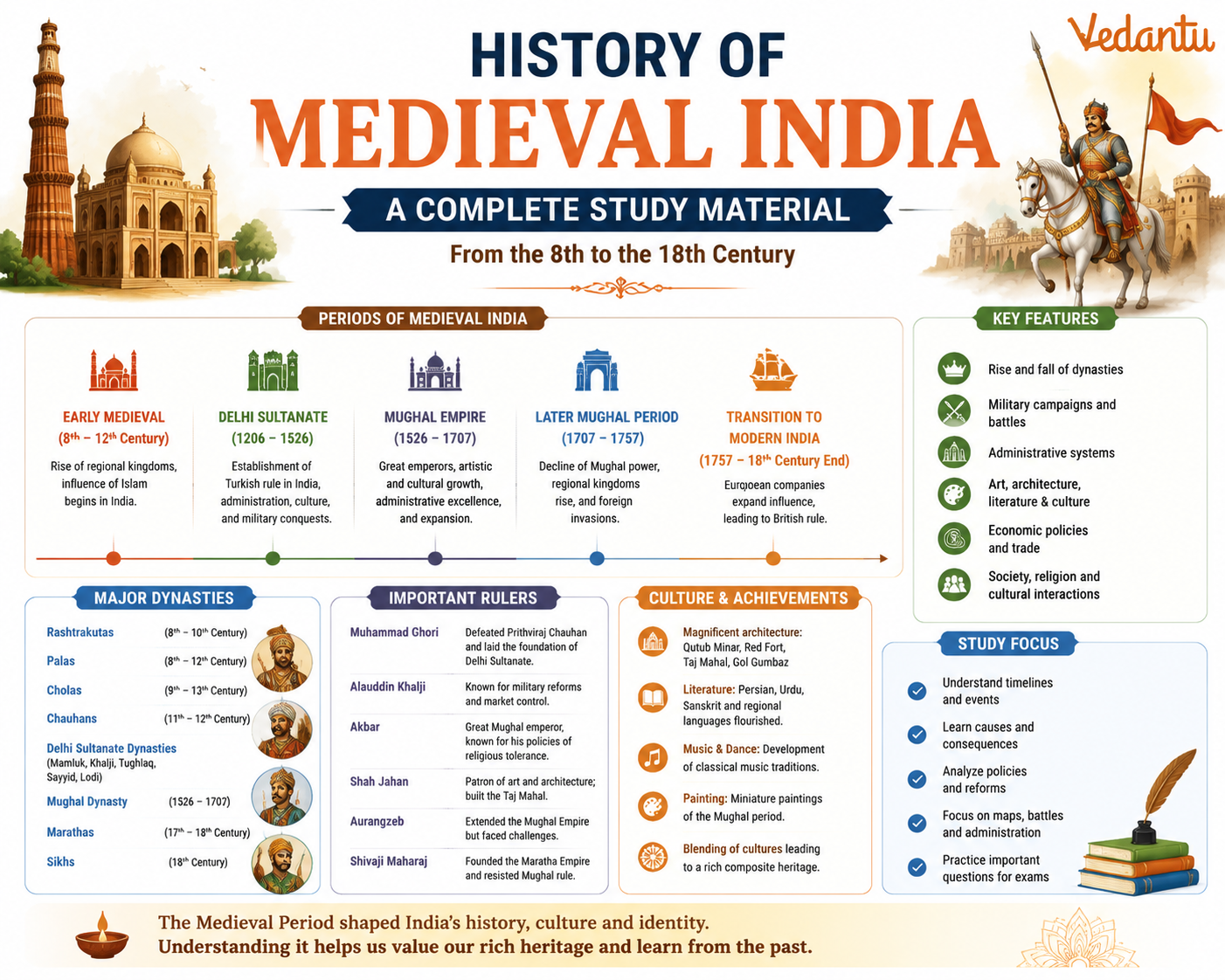
Periodization of Medieval India
Historians usually divide Medieval India into two main phases for better understanding. This classification helps in organizing events and developments chronologically.
- Early Medieval Period - From 8th century to 13th century
- Late Medieval Period - From 13th century to 18th century
Early Medieval India
Major Rajput Kingdoms
After the decline of the Gupta Empire, several regional kingdoms emerged in North India. The Rajputs became prominent rulers during this time. They were known for their bravery, feudal administration, and patronage of art and architecture.
- Pratiharas of Kannauj
- Chauhans of Ajmer and Delhi
- Paramaras of Malwa
- Solankis of Gujarat
Invasions of Mahmud of Ghazni and Muhammad Ghori
Mahmud of Ghazni invaded India multiple times between 1000 and 1027 AD mainly to plunder wealth. Muhammad Ghori defeated Prithviraj Chauhan in the Second Battle of Tarain in 1192, which laid the foundation for Muslim rule in India.
The Delhi Sultanate
The Delhi Sultanate was established in 1206 by Qutbuddin Aibak. It marked the beginning of centralized Muslim rule in India. The Sultanate period is known for administrative reforms, expansion of territory, and Indo-Islamic cultural synthesis.
The Five Dynasties of Delhi Sultanate
| Dynasty | Founder | Period |
|---|---|---|
| Slave Dynasty | Qutbuddin Aibak | 1206 - 1290 |
| Khilji Dynasty | Jalaluddin Khilji | 1290 - 1320 |
| Tughlaq Dynasty | Ghiyasuddin Tughlaq | 1320 - 1414 |
| Sayyid and Lodi Dynasties | Khizr Khan and Bahlul Lodi | 1414 - 1526 |
Important rulers included Iltutmish, Razia Sultan, Alauddin Khilji, and Muhammad bin Tughlaq. Alauddin introduced market control measures, while Muhammad bin Tughlaq is known for his ambitious but controversial policies.
The Mughal Empire
The Mughal Empire was established by Babur after defeating Ibrahim Lodi in the First Battle of Panipat in 1526. The Mughal period represents political unity, administrative efficiency, and cultural achievements in Medieval India.
Important Mughal Rulers
| Ruler | Major Contribution | Period |
|---|---|---|
| Babur | Founder of Mughal Empire | 1526 - 1530 |
| Akbar | Administrative reforms and religious tolerance | 1556 - 1605 |
| Shah Jahan | Construction of Taj Mahal | 1628 - 1658 |
| Aurangzeb | Expansion of empire to maximum extent | 1658 - 1707 |
Akbar introduced the Mansabdari system and promoted Sulh i Kul policy. The Mughal administration was centralized and efficient, contributing to political stability and economic prosperity.
Administration and Economy
Administrative Features
- Centralized monarchy
- Iqta system during Sultanate
- Mansabdari and Jagirdari system during Mughal period
- Land revenue as main source of income
Economic Life
- Agriculture was the backbone of the economy
- Growth of trade and commerce
- Development of handicrafts and textile industry
- Introduction of new crops and irrigation methods
Society and Culture
Medieval India witnessed cultural synthesis between Hindu and Islamic traditions. This period saw the rise of Bhakti and Sufi movements, which emphasized devotion and unity of God.
- Bhakti saints like Kabir, Mirabai, and Tulsidas
- Sufi saints like Khwaja Moinuddin Chishti and Nizamuddin Auliya
- Development of Urdu language
- Indo-Islamic architecture such as Qutub Minar and Taj Mahal
Decline of Medieval Empires
The decline of the Delhi Sultanate was due to weak successors and invasions such as Timur's invasion. The Mughal Empire declined after Aurangzeb due to administrative weakness, regional revolts, economic crisis, and foreign invasions. This decline eventually paved the way for the rise of regional powers and the establishment of British rule in India.
Importance of Studying Medieval India
- Helps understand the roots of modern Indian society
- Important for competitive exams and academic curriculum
- Explains cultural and religious diversity in India
- Provides insight into administrative and economic systems
A complete study of the History of Medieval India provides a strong foundation for understanding India's political evolution, cultural integration, and socio-economic transformation. By focusing on major dynasties, administrative systems, cultural movements, and economic developments, students can effectively prepare for examinations and gain a comprehensive understanding of this significant historical period.
FAQs on History of Medieval India: Complete Study Material for Students
1. What is the History of Medieval India?
The History of Medieval India refers to the period between the 8th and 18th centuries, marked by powerful dynasties, cultural transformation, and political developments.
• Divided into Early Medieval Period (750–1200 CE) and Late Medieval Period (1200–1707 CE)
• Rise of the Delhi Sultanate and Mughal Empire
• Growth of Bhakti and Sufi movements
• Development of art, architecture, trade, and administration
This period is crucial for understanding Indian culture, governance systems, and medieval society for GK and competitive exams.
2. Which are the major dynasties of Medieval India?
The major dynasties of Medieval India shaped its political and cultural landscape.
• Rajput Dynasties – Pratiharas, Chauhans
• Delhi Sultanate – Slave, Khilji, Tughlaq, Sayyid, Lodi dynasties
• Vijayanagara Empire in South India
• Mughal Empire – Babur to Aurangzeb
• Regional kingdoms like Bahmani Kingdom and Marathas
These ruling powers are frequently asked in UPSC, SSC, and other competitive exams.
3. What was the Delhi Sultanate and why is it important?
The Delhi Sultanate (1206–1526 CE) was a series of Muslim dynasties that ruled northern India and introduced new administrative systems.
• Founded by Qutb-ud-din Aibak
• Included five dynasties – Mamluk, Khilji, Tughlaq, Sayyid, Lodi
• Introduced Iqtadari system and centralized governance
• Expanded trade and Indo-Islamic architecture like Qutub Minar
It laid the foundation for the rise of the Mughal Empire and medieval administration.
4. Who founded the Mughal Empire in India?
The Mughal Empire was founded by Babur in 1526 after defeating Ibrahim Lodi in the First Battle of Panipat.
• Babur was a descendant of Timur and Genghis Khan
• Introduced gunpowder warfare in India
• Established strong centralized rule
• Expanded by rulers like Akbar, Jahangir, Shah Jahan, and Aurangzeb
The Mughal period is known for administrative reforms, architecture, and cultural synthesis.
5. What were the key achievements of Akbar?
Emperor Akbar (1556–1605) is known for consolidating the Mughal Empire and promoting religious tolerance.
• Introduced Mansabdari system
• Abolished Jizya tax
• Promoted Din-i-Ilahi for religious harmony
• Expanded empire through Rajput alliances
• Built architectural marvels like Fatehpur Sikri
Akbar’s policies are widely discussed in medieval Indian history studies.
6. What was the Bhakti and Sufi Movement in Medieval India?
The Bhakti and Sufi Movements were spiritual reform movements promoting devotion and social equality in medieval India.
• Bhakti saints like Kabir, Tulsidas, Mirabai emphasized devotion to one God
• Sufi saints like Khwaja Moinuddin Chishti spread Islamic mysticism
• Rejected caste discrimination and rituals
• Encouraged unity and communal harmony
These movements deeply influenced Indian religion, literature, and society.
7. What were the main features of Medieval Indian administration?
The administration of Medieval India was centralized with structured revenue and military systems.
• Iqtadari system under Delhi Sultanate
• Mansabdari and Jagirdari systems under Mughals
• Efficient revenue reforms by Raja Todar Mal
• Strong military organization and bureaucracy
These systems influenced later governance and are key topics in Indian polity and history exams.
8. What are the important architectural achievements of Medieval India?
Medieval India is famous for its Indo-Islamic architecture and grand monuments.
• Qutub Minar – Delhi Sultanate
• Humayun’s Tomb – Early Mughal architecture
• Taj Mahal – Built by Shah Jahan
• Red Fort and Jama Masjid
• Temples of Vijayanagara Empire
These monuments reflect cultural fusion and advanced engineering of the medieval period.
9. What led to the decline of the Mughal Empire?
The decline of the Mughal Empire began after Aurangzeb due to political and economic instability.
• Weak successors after Aurangzeb
• Continuous wars and financial crisis
• Rise of regional powers like Marathas, Sikhs, Jats
• Foreign invasions by Nadir Shah and Ahmad Shah Abdali
This decline paved the way for British expansion in India.
10. Why is Medieval Indian History important for competitive exams?
Medieval Indian History is important for competitive exams because it covers major dynasties, reforms, and cultural developments frequently asked in GK sections.
• Questions on Delhi Sultanate and Mughal rulers
• Topics like administration, revenue systems, battles
• Cultural aspects such as Bhakti-Sufi movement and architecture
• Appears in UPSC, SSC, Banking, Railways, State PCS exams
A complete study of this period strengthens historical understanding and scoring potential.
