



List of East and West Flowing Rivers in India: Differences, Origins, and Drainage Features
Rivers are the lifelines of India and play a vital role in agriculture, transportation, culture, and economy. Based on the direction in which they flow and the sea into which they drain, Indian rivers are classified into East flowing rivers and West flowing rivers. Most of the major rivers of India flow towards the east and drain into the Bay of Bengal, while a few rivers flow towards the west and drain into the Arabian Sea. Understanding the list of East and West flowing rivers in India with their characteristics is important for school studies, competitive exams, and general awareness.
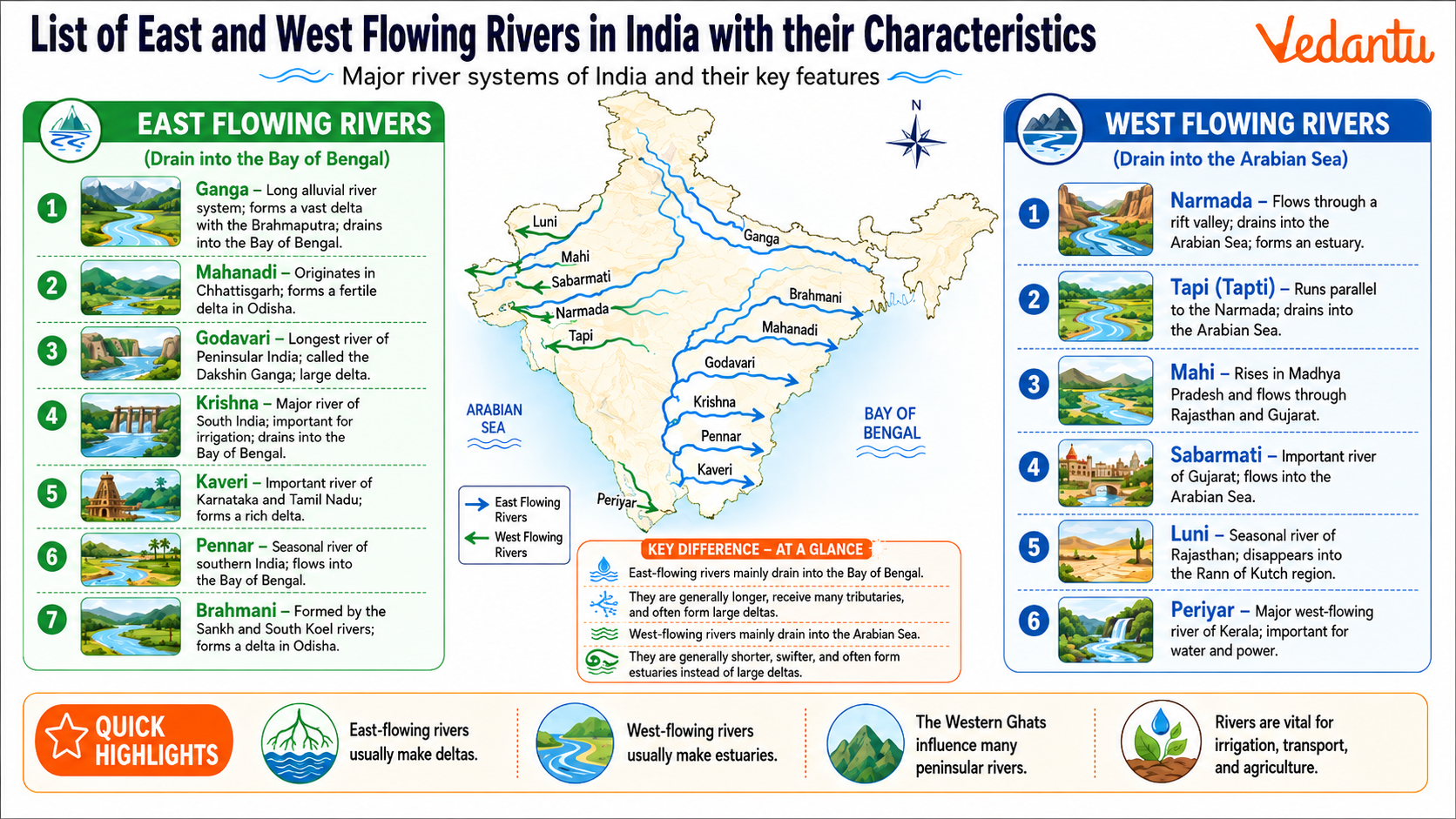
Classification of Rivers Based on Direction of Flow
The direction of river flow in India mainly depends on the slope of the land. The Peninsular Plateau slopes towards the east, which is why most rivers flow into the Bay of Bengal. However, some rivers flow westwards due to local geographical features and rift valleys.
- East Flowing Rivers - Drain into the Bay of Bengal
- West Flowing Rivers - Drain into the Arabian Sea
Major East Flowing Rivers in India
East flowing rivers form large deltas before entering the Bay of Bengal. These rivers are generally longer and carry a large amount of sediment. They support fertile plains and dense populations.
List of Major East Flowing Rivers
Major East Flowing Rivers and Their Characteristics
| River | Origin | Key Characteristics |
|---|---|---|
| Ganga | Gangotri Glacier | Forms largest delta with Brahmaputra, drains into Bay of Bengal |
| Godavari | Trimbak Plateau | Longest Peninsular river, forms fertile delta |
| Krishna | Western Ghats | Major irrigation source in South India |
| Kaveri | Brahmagiri Hills | Forms delta in Tamil Nadu, sacred river |
| Mahanadi | Chhattisgarh Highlands | Known for Hirakud Dam and large delta |
These rivers are mainly perennial in nature if they originate from the Himalayas, while Peninsular rivers depend largely on monsoon rainfall. They create wide and fertile deltas suitable for agriculture.
Common Features of East Flowing Rivers
- Flow from west to east due to plateau slope
- Drain into the Bay of Bengal
- Form large deltas at their mouths
- Carry heavy silt deposits
- Support dense population and agriculture
Major West Flowing Rivers in India
West flowing rivers are fewer in number and generally shorter in length compared to east flowing rivers. They usually form estuaries instead of deltas because of the steep slope and narrow coastal plains.
List of Major West Flowing Rivers
Major West Flowing Rivers and Their Characteristics
| River | Origin | Key Characteristics |
|---|---|---|
| Narmada | Amarkantak Plateau | Flows through rift valley, forms estuary |
| Tapi | Satpura Range | Parallel to Narmada, drains into Arabian Sea |
| Mahi | Madhya Pradesh | Crosses Tropic of Cancer twice |
| Sabarmati | Aravalli Hills | Flows through Rajasthan and Gujarat |
| Periyar | Western Ghats | Important river of Kerala |
Most west flowing rivers originate in the Western Ghats and have shorter courses. They form estuaries due to strong tidal currents in the Arabian Sea, which prevent delta formation.
Common Features of West Flowing Rivers
- Drain into the Arabian Sea
- Generally shorter in length
- Form estuaries instead of deltas
- Flow through rift valleys in some cases
- Have swift flow due to steep gradient
Key Differences Between East and West Flowing Rivers
Comparison of East and West Flowing Rivers
| Basis | East Flowing Rivers | West Flowing Rivers |
|---|---|---|
| Direction | West to East | East to West |
| Drainage | Bay of Bengal | Arabian Sea |
| Delta Formation | Large deltas | Estuaries |
| Length | Generally longer | Generally shorter |
This comparison helps students quickly revise the important differences for exams. Questions are often asked about which rivers form deltas, which flow through rift valleys, and which sea they drain into.
Importance of Studying East and West Flowing Rivers
- Important for Geography sections of competitive exams
- Helps understand Indian agriculture and irrigation systems
- Useful in environmental and ecological studies
- Frequently asked in GK quizzes and government exams
In conclusion, east and west flowing rivers of India differ mainly in their direction, drainage pattern, and landforms formed at their mouths. While east flowing rivers are more numerous and form large deltas, west flowing rivers are fewer and form estuaries. A clear understanding of their origin, characteristics, and differences is essential for academic success and general awareness.
FAQs on List of East & West Flowing Rivers in India and Their Key Characteristics
1. What are east flowing and west flowing rivers in India?
East flowing and west flowing rivers in India are classified based on the direction in which they drain into the sea.
• East flowing rivers drain into the Bay of Bengal and usually form large deltas.
• West flowing rivers drain into the Arabian Sea and mostly form estuaries.
• The direction depends on India’s peninsular slope and topography.
• This topic is important for Geography GK, UPSC, SSC, and other competitive exams.
2. Which are the major east flowing rivers in India?
The major east flowing rivers of India primarily originate from the Western Ghats and central highlands and drain into the Bay of Bengal.
• Ganga – Forms the largest delta (Sundarbans).
• Brahmaputra – Joins Ganga in Bangladesh.
• Godavari – Known as the "Dakshin Ganga".
• Krishna – Flows through Maharashtra, Karnataka, and Andhra Pradesh.
• Kaveri – Important river of South India.
• Mahanadi – Forms a fertile delta in Odisha.
3. Which are the important west flowing rivers in India?
The important west flowing rivers in India drain into the Arabian Sea and generally form estuaries instead of deltas.
• Narmada – Flows through a rift valley.
• Tapi (Tapti) – Runs parallel to Narmada.
• Mahi – Flows through Rajasthan and Gujarat.
• Sabarmati – Passes through Ahmedabad.
• Periyar – Major river of Kerala.
• These rivers are shorter but fast flowing due to the Western Ghats slope.
4. Why do most Indian rivers flow towards the east?
Most Indian rivers flow eastward because the Peninsular Plateau slopes from west to east.
• The Western Ghats act as a water divide.
• The land gradually slopes towards the Bay of Bengal.
• This results in formation of large river deltas.
• It is a key concept in Indian Physical Geography and People Also Ask queries.
5. What is the difference between east flowing and west flowing rivers?
The main difference between east and west flowing rivers lies in their drainage pattern, length, and landforms formed.
• Drainage: East → Bay of Bengal; West → Arabian Sea.
• Length: East flowing rivers are generally longer.
• Landforms: East form deltas; West form estuaries.
• Examples: Godavari (East), Narmada (West).
• Frequently asked in GK questions on Indian rivers.
6. Which west flowing rivers form estuaries in India?
Most west flowing rivers in India form estuaries due to steep gradients and strong tidal currents.
• Narmada Estuary – Located in Gujarat.
• Tapi Estuary – Near Surat.
• Mandovi and Zuari – In Goa.
• Estuaries are tidal river mouths where freshwater meets seawater.
• This concept is common in Geography MCQs and competitive exams.
7. Which east flowing rivers form deltas in India?
Major east flowing rivers form fertile deltas before draining into the Bay of Bengal.
• Ganga-Brahmaputra Delta – Largest delta in the world.
• Godavari Delta – Known for agriculture.
• Krishna Delta – Important rice-growing area.
• Mahanadi Delta – Located in Odisha.
• Deltas are formed by deposition of alluvial soil.
8. What are the characteristics of east flowing rivers in India?
East flowing rivers in India have distinct physical and economic characteristics important for geography studies.
• Generally longer in length.
• Form large and fertile deltas.
• Flow over the Deccan Plateau.
• Support irrigation and agriculture in eastern India.
• Examples include Godavari, Krishna, Kaveri, and Mahanadi.
9. What are the characteristics of west flowing rivers in India?
West flowing rivers in India are shorter and faster flowing due to steep gradients from the Western Ghats.
• Shorter course compared to east flowing rivers.
• Form estuaries instead of deltas.
• Flow through rift valleys (e.g., Narmada).
• Provide hydroelectric power potential.
• Important rivers include Narmada, Tapi, and Mahi.
10. Which rivers in India flow through rift valleys?
The rivers flowing through rift valleys in India are mainly west flowing rivers.
• Narmada River – Flows between Vindhya and Satpura ranges.
• Tapi (Tapti) River – Runs parallel to Narmada.
• These rivers follow structural depressions formed due to tectonic activity.
• This topic is frequently asked in Indian Geography GK and UPSC Prelims.
