



Why Is Stubble Burning a Serious Environmental Problem in India?
Stubble burning is a major environmental issue in India and several other agricultural countries. It refers to the practice of setting fire to crop residues left in the field after harvesting, especially paddy crops. Farmers mainly burn stubble to quickly clear fields for the next crop. Although it saves time and labor costs, it causes severe air pollution and health hazards. Understanding the problem and solution of stubble burning is important for students, competitive exam aspirants, and general readers, as it is frequently discussed in environmental studies and current affairs.
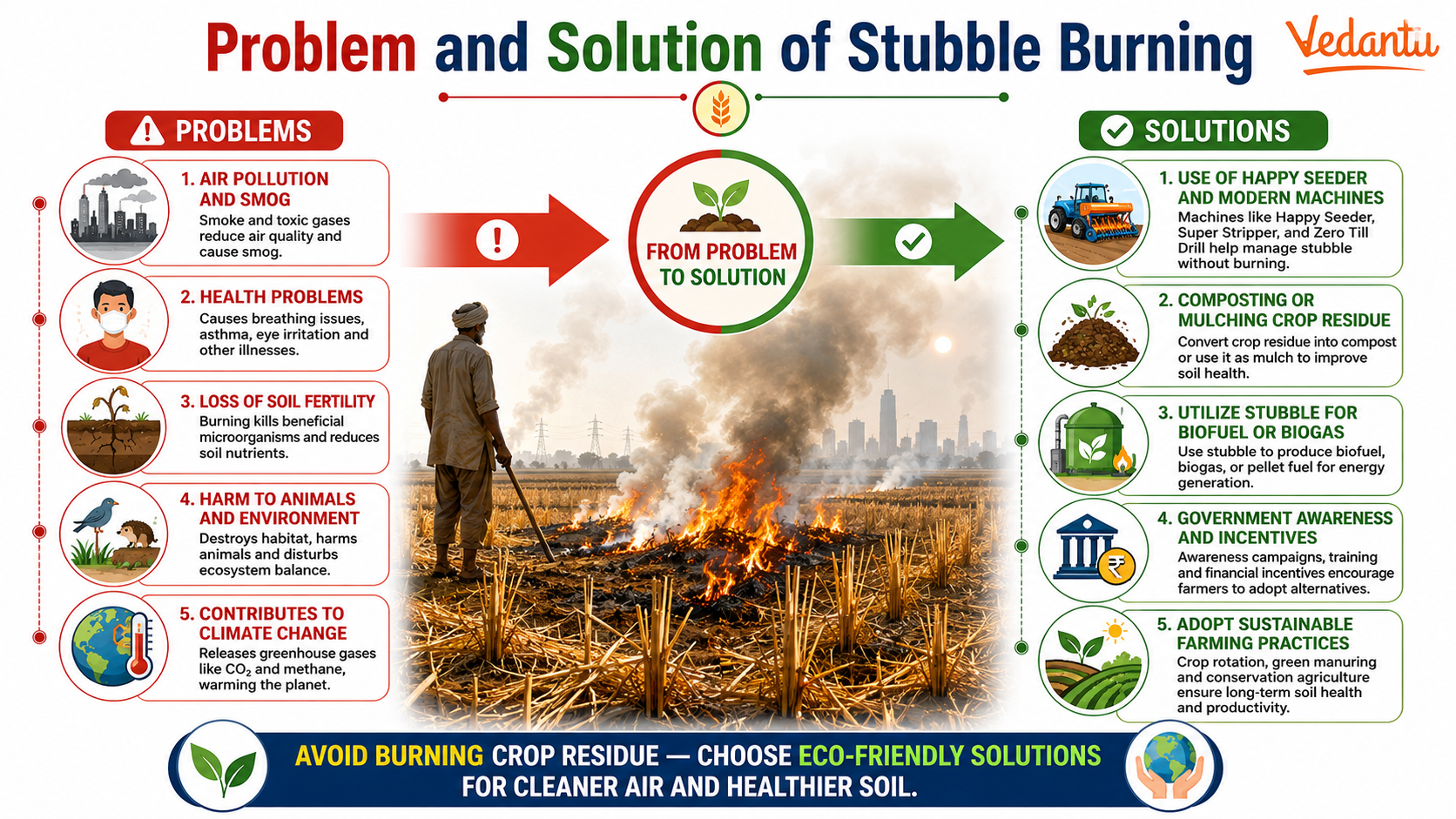
What is Stubble Burning?
Stubble burning is the practice of intentionally setting fire to the straw and agricultural residue left after harvesting crops like rice, wheat, and sugarcane. It is most common in states such as Punjab, Haryana, and Uttar Pradesh in India. Farmers use this method to quickly prepare fields for the next sowing season, especially between the harvesting of paddy and the sowing of wheat.
Major Causes of Stubble Burning
- Short gap between harvesting and sowing seasons.
- High cost of machines required for residue management.
- Lack of awareness about eco-friendly alternatives.
- Low market demand for crop residue.
- Limited financial support for small and marginal farmers.
Environmental Impact of Stubble Burning
Stubble burning significantly contributes to air pollution, especially during winter months. The smoke contains harmful gases and fine particulate matter that reduce air quality. It also affects soil fertility and biodiversity.
- Release of carbon dioxide, methane, and nitrous oxide into the atmosphere.
- Increase in PM2.5 and PM10 levels leading to smog formation.
- Loss of soil nutrients and beneficial microorganisms.
- Contribution to global warming and climate change.
- Reduced visibility and disruption of transportation.
Health Effects of Stubble Burning
Air pollution caused by stubble burning leads to various health problems, especially among children, elderly people, and those with respiratory diseases.
- Asthma and bronchitis.
- Eye irritation and throat infections.
- Increased risk of lung and heart diseases.
- Reduced immunity due to prolonged exposure to polluted air.
Key Problems and Their Impact
| Problem | Immediate Effect | Long Term Impact |
|---|---|---|
| Air Pollution | Smog and poor visibility | Climate change and health crises |
| Soil Degradation | Loss of nutrients | Reduced crop productivity |
The table above highlights how stubble burning creates both immediate and long term environmental and agricultural challenges. These impacts make it necessary to find sustainable solutions.
Solutions to Stubble Burning
1. Use of Agricultural Machinery
Machines like Happy Seeder, Super Straw Management System, and Rotavator help manage crop residue without burning. These machines cut and spread straw evenly, allowing it to decompose naturally and enrich the soil.
2. Government Initiatives
The government provides subsidies to farmers for purchasing crop residue management equipment. Awareness campaigns and financial incentives are also introduced to discourage burning practices.
3. Crop Diversification
Encouraging farmers to grow alternative crops that produce less residue can reduce the need for burning. Crop diversification also improves soil health and water conservation.
4. Bioenergy Production
Crop residue can be used to produce biofuel, biogas, and electricity. This approach converts waste into a valuable resource and reduces environmental damage.
5. Awareness and Community Participation
Educating farmers about the harmful effects of stubble burning and promoting community based solutions can bring long term change. Collective efforts are essential for effective implementation.
Advantages of Stubble Management Without Burning
- Improves soil fertility and moisture retention.
- Reduces air pollution and greenhouse gas emissions.
- Enhances crop yield in the long term.
- Promotes sustainable agriculture practices.
Conclusion
The problem and solution of stubble burning is a crucial environmental topic with social, economic, and health dimensions. While farmers burn stubble due to practical challenges, the environmental cost is very high. Sustainable solutions such as advanced machinery, government support, crop diversification, and bioenergy production can help reduce this practice. A combined effort from farmers, government, scientists, and society is necessary to protect air quality and promote sustainable agricultural development.
FAQs on Stubble Burning: Causes, Effects, and Smart Solutions
1. What is stubble burning?
Stubble burning is the practice of setting fire to leftover crop residue after harvesting to quickly clear fields for the next crop cycle.
• It mainly occurs in Punjab, Haryana, and Uttar Pradesh.
• Farmers burn paddy straw (crop residue) after harvesting rice.
• It is a major cause of air pollution in North India.
• Also known as crop residue burning or farm fires (People also ask: What is crop burning?).
2. Why do farmers practice stubble burning?
Farmers practice stubble burning because it is a quick and low-cost method to prepare fields for the next sowing season.
• Short gap between paddy harvesting and wheat sowing.
• Lack of affordable farm machinery like Happy Seeder.
• High cost of labor for manual removal.
• Immediate clearing saves time and money.
• Also searched as reasons for crop residue burning.
3. What are the environmental effects of stubble burning?
Stubble burning severely harms the environment by increasing air pollution and greenhouse gas emissions.
• Releases carbon dioxide (CO₂), methane (CH₄), and nitrous oxide (N₂O).
• Causes smog formation in Delhi-NCR.
• Reduces soil fertility by killing beneficial microorganisms.
• Contributes to climate change and global warming (PAS: environmental impact of stubble burning).
4. How does stubble burning affect human health?
Stubble burning negatively impacts human health by increasing toxic air pollutants in the atmosphere.
• Causes respiratory diseases like asthma and bronchitis.
• Leads to eye irritation and allergies.
• Increases risk of lung infections and heart problems.
• Raises Air Quality Index (AQI) to hazardous levels (People also ask: How does crop burning affect health?).
5. What are the economic impacts of stubble burning?
Stubble burning causes economic losses by damaging soil health and increasing healthcare expenses.
• Decreases long-term agricultural productivity.
• Raises public health costs due to pollution-related diseases.
• Affects transport and aviation due to low visibility.
• Leads to government spending on pollution control measures.
6. What are the solutions to stubble burning?
The solution to stubble burning lies in sustainable farming techniques and government support systems.
• Use of Happy Seeder and Super Straw Management System (SMS).
• Promotion of crop residue management techniques.
• Providing subsidies and financial incentives to farmers.
• Converting stubble into biofuel, compost, and biogas (PAS: alternatives to stubble burning).
7. What is the role of the government in controlling stubble burning?
The government controls stubble burning through policies, subsidies, and awareness campaigns.
• Implementation of National Green Tribunal (NGT) guidelines.
• Financial aid under Crop Residue Management Scheme.
• Imposing penalties and fines for violations.
• Promoting environment-friendly agricultural practices.
8. How does stubble burning contribute to climate change?
Stubble burning contributes to climate change by releasing greenhouse gases that trap heat in the atmosphere.
• Emits large amounts of CO₂ and methane.
• Increases global warming effects.
• Produces black carbon which accelerates ice melting.
• Impacts regional and global climate patterns (People also search: crop burning and global warming).
9. Which states in India are most affected by stubble burning?
Stubble burning mainly affects northern Indian states, especially during the winter season.
• Punjab and Haryana are major contributors.
• Impacts Delhi-NCR due to wind patterns.
• Also reported in Uttar Pradesh and Rajasthan.
• Causes seasonal smog crisis in North India.
10. Why is stubble burning an important topic for competitive exams and GK?
Stubble burning is important for GK and competitive exams because it relates to environment, geography, and current affairs.
• Frequently asked in UPSC, SSC, and State PCS exams.
• Linked to topics like air pollution, climate change, and sustainable development.
• Connected with government schemes and environmental policies.
• Relevant under Environmental Studies and General Awareness sections.
