



Why World Oceans Day Is Celebrated and How It Protects Marine Life
World Oceans Day is celebrated every year on 8 June to highlight the importance of oceans in sustaining life on Earth and to promote their conservation. Oceans cover about 71 percent of the Earth’s surface and play a crucial role in regulating climate, producing oxygen, supporting biodiversity, and sustaining millions of livelihoods. This international observance spreads awareness about marine pollution, climate change, overfishing, and the need for sustainable use of ocean resources.
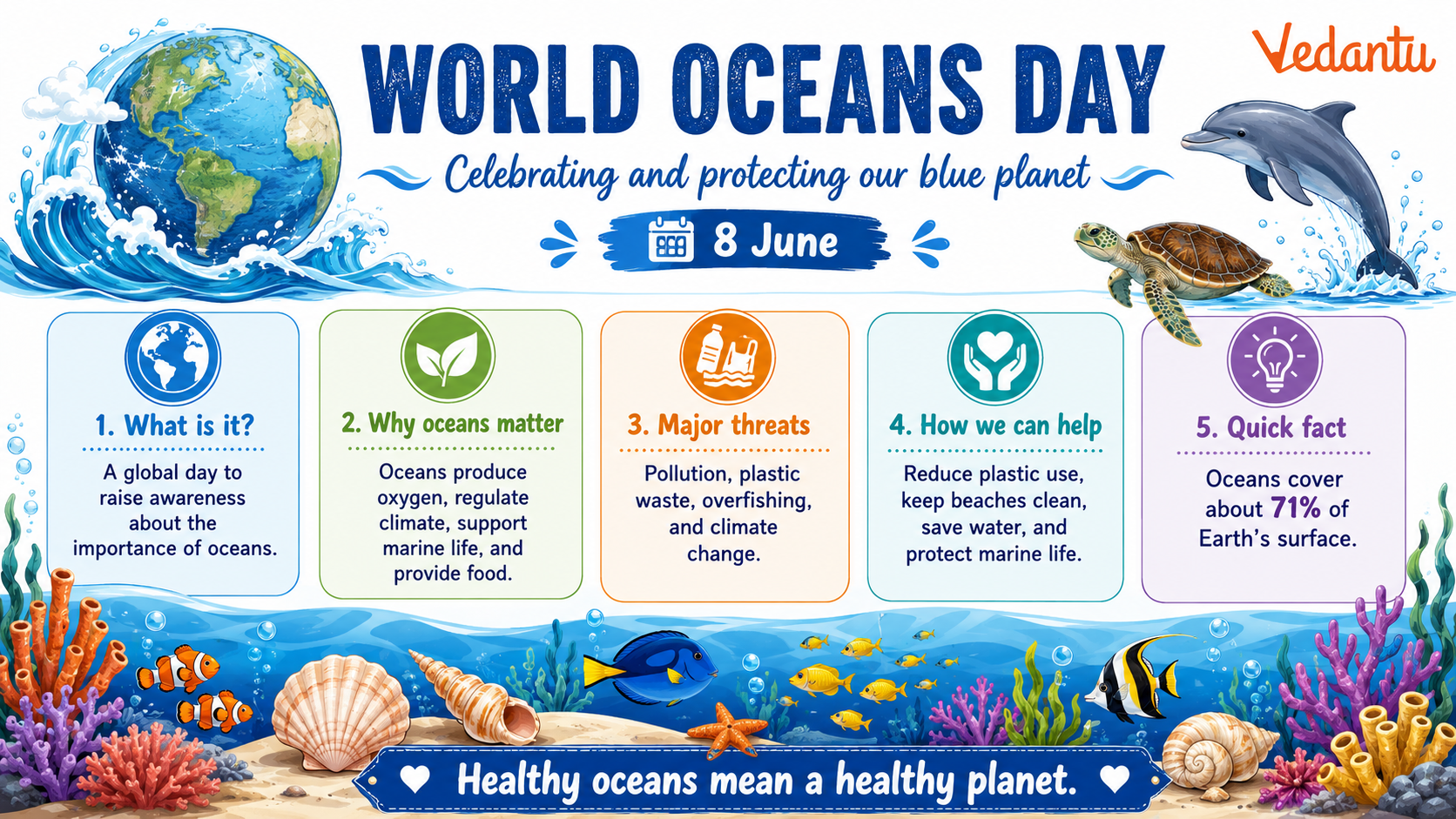
Overview of World Oceans Day
Key Facts About World Oceans Day
| Particular | Details | Significance |
|---|---|---|
| Date | 8 June | Annual global observance |
| Declared By | United Nations (2008) | Official recognition worldwide |
| First Proposed | 1992 Earth Summit, Rio de Janeiro | Global ocean awareness initiative |
World Oceans Day was first proposed in 1992 at the Earth Summit in Rio de Janeiro, Brazil. Later, in 2008, the United Nations officially recognized 8 June as World Oceans Day. Since then, it has been observed annually with a specific theme to address pressing marine issues.
Importance of Oceans
Oceans are essential for the survival of all living organisms. They influence weather patterns, support marine biodiversity, and contribute significantly to the global economy.
- Produce over 50 percent of the world’s oxygen through marine plants and phytoplankton.
- Absorb a large amount of carbon dioxide, helping to reduce global warming.
- Provide food and livelihood to billions of people worldwide.
- Support diverse ecosystems such as coral reefs, mangroves, and deep sea habitats.
- Facilitate international trade and transportation.
Major Threats to Oceans
Despite their importance, oceans face several serious threats due to human activities. World Oceans Day emphasizes the need to address these challenges effectively.
1. Marine Pollution
Plastic waste, oil spills, chemical runoff, and sewage disposal severely harm marine life. Microplastics have entered the food chain, affecting both aquatic organisms and humans.
2. Climate Change
Rising global temperatures cause ocean warming and coral bleaching. Increased carbon dioxide leads to ocean acidification, which negatively impacts shell forming organisms.
3. Overfishing
Excessive fishing reduces fish populations and disrupts marine ecosystems. Unsustainable fishing practices threaten biodiversity and food security.
4. Habitat Destruction
Coastal development, dredging, and destructive fishing methods damage coral reefs, mangroves, and other vital marine habitats.
Themes of World Oceans Day
Each year, World Oceans Day is celebrated with a unique theme to address specific ocean related issues. Themes focus on innovation, sustainability, conservation, and community involvement. For example, recent themes have highlighted planetary health, ocean action, and protecting marine biodiversity.
How World Oceans Day is Celebrated
Various activities are organized globally to mark this day and spread awareness.
- Beach clean up drives and plastic waste collection campaigns.
- Educational seminars, workshops, and webinars.
- Social media campaigns promoting ocean conservation.
- Art competitions and exhibitions focusing on marine life.
- Community initiatives to reduce single use plastics.
Five Major Oceans of the World
List of Major Oceans
| Ocean | Area Rank | Key Feature |
|---|---|---|
| Pacific Ocean | Largest | Deepest ocean, contains Mariana Trench |
| Atlantic Ocean | Second Largest | Major trade routes |
| Indian Ocean | Third Largest | Warmest ocean |
| Southern Ocean | Fourth Largest | Surrounds Antarctica |
| Arctic Ocean | Smallest | Covered largely by ice |
These five oceans are interconnected and together form a single global ocean system that regulates the Earth’s climate and supports diverse life forms.
Steps to Protect Oceans
Every individual can contribute to ocean conservation by adopting responsible practices.
- Reduce the use of single use plastics and recycle waste properly.
- Support sustainable seafood choices.
- Participate in beach and river clean up programs.
- Spread awareness about marine conservation.
- Conserve water and reduce carbon footprint.
Conclusion
World Oceans Day reminds us that oceans are vital for life, climate stability, and economic development. Protecting oceans is not only the responsibility of governments and organizations but also of individuals. By promoting sustainable practices and spreading awareness, we can ensure that future generations inherit healthy and thriving oceans.
FAQs on World Oceans Day 2026: Meaning, History and Importance for Students
1. What is World Oceans Day?
World Oceans Day is a global awareness day celebrated annually on 8 June to highlight the importance of oceans and promote marine conservation.
- First proposed at the 1992 Earth Summit (Rio de Janeiro)
- Officially recognized by the United Nations in 2008
- Focuses on marine biodiversity, ocean protection, and sustainable use of ocean resources
- Encourages action against plastic pollution, climate change, and overfishing
2. Why is World Oceans Day celebrated on 8 June?
World Oceans Day is celebrated on 8 June to mark the proposal made at the 1992 Earth Summit for recognizing the vital role of oceans in sustaining life.
- Date chosen during the UN Conference on Environment and Development
- Highlights the role of oceans in climate regulation and global economy
- Promotes awareness about marine ecosystems and ocean sustainability
3. What is the importance of oceans for Earth?
Oceans are essential for life on Earth as they regulate climate, produce oxygen, and support biodiversity.
- Cover about 71% of the Earth's surface
- Produce nearly 50% of the world's oxygen
- Absorb large amounts of carbon dioxide (CO₂)
- Provide food and livelihood to billions through fisheries and marine industries
4. What are the major threats to the oceans?
Oceans face several serious threats due to human activities and environmental changes.
- Plastic pollution and marine debris
- Overfishing and illegal fishing practices
- Climate change and ocean acidification
- Oil spills and industrial waste dumping
- Destruction of coral reefs and marine habitats
5. What is the theme of World Oceans Day?
The theme of World Oceans Day changes every year to focus on specific ocean-related issues and conservation goals.
- Themes address topics like marine pollution, ocean restoration, and sustainable fishing
- Announced annually by the United Nations
- Encourages global participation in ocean protection campaigns
6. How can students participate in World Oceans Day?
Students can actively participate in World Oceans Day by spreading awareness and adopting eco-friendly habits.
- Organize or join beach clean-up drives
- Reduce use of single-use plastics
- Participate in essay writing, poster making, and debates
- Promote marine conservation awareness through social media and school events
7. How do oceans help in controlling climate change?
Oceans play a key role in controlling climate change by absorbing heat and carbon dioxide from the atmosphere.
- Absorb about 30% of global CO₂ emissions
- Store excess solar heat energy
- Support phytoplankton that produce oxygen
- Help maintain global temperature balance
8. What are the five major oceans of the world?
The five major oceans of the world are vast bodies of saltwater that cover most of the Earth’s surface.
- Pacific Ocean (largest and deepest)
- Atlantic Ocean
- Indian Ocean
- Southern Ocean
- Arctic Ocean
9. What is marine biodiversity?
Marine biodiversity refers to the variety of life forms in oceans and seas, including plants, animals, and microorganisms.
- Includes coral reefs, fish, whales, plankton, and sea plants
- Maintains ecological balance
- Supports food chains and marine ecosystems
- Essential for sustainable development and blue economy
10. Who organizes World Oceans Day globally?
World Oceans Day is officially coordinated by the United Nations along with environmental organizations worldwide.
- Recognized by the UN General Assembly in 2008
- Supported by NGOs, marine conservation groups, and governments
- Promotes global campaigns for ocean conservation and sustainable marine resources
