




10C charge is given to a conducting spherical shell and a -3C point charge is placed inside the shell. For this arrangement, find the correct statements(s).
A. the charge on the inner surface of the shell will be +3C, and it can be distributed uniformly or nonuniformly.
B. the charge on the inner surface of the shell will be +3C, and it’s distribution would be uniform.
C. The net charge on the outer surface of the shell will be +7C, and it can be distributed uniformly or nonuniformly.
D. the net charge on the outer surface of the shell will be +7C, and it’s distribution would be uniform.
Answer
 Verified
231.6k+ views
Hint: The charge placed inside the shell is given, we shall find the net charge outside the shell by calculating the difference between the charge given and the charge placed within the shell. This is based on the distribution of charges on a conducting spherical shell given by the combination of electrostatic forces and Gauss’s law.
Complete step-by-step answer:
If a spherical conducting shell carries a negative charge like -3C, it can be expected that the excess electrons mutually repel each other and become uniformly distributed over the surface of the shell. The electric field lines produce outside a charge distribution like this will be pointed towards the surface of the conductor. As the excess electrons are free to move through the conductor, the parallel components of the field may cause redistribution of charges on the shell.
The charges distributed on different faces because of induction is shown in the picture
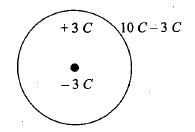
From the question, we know charge on the inner surface of the shell is +3C
Therefore, the net charge on the outer surface will be $10C-3C=7C$
The distribution of charges will be uniform on the inner surface only if the charge is placed at center, or else it would be nonuniform. The charges on the outer surface will be uniformly distributed because the displacement of the charges on the inner surface does not affect the charges on the outer surface.
Therefore, the correct answers for the given question are options (A) and (D).
Note: If a conductor is not uniformly shaped, the distribution will also be non uniform. The charges will accumulate to a maximum at a pointed end or where the radius or curvature is maximum. It is also said that charged conductors with sharp points on the surface will lose their charge rapidly.
Complete step-by-step answer:
If a spherical conducting shell carries a negative charge like -3C, it can be expected that the excess electrons mutually repel each other and become uniformly distributed over the surface of the shell. The electric field lines produce outside a charge distribution like this will be pointed towards the surface of the conductor. As the excess electrons are free to move through the conductor, the parallel components of the field may cause redistribution of charges on the shell.
The charges distributed on different faces because of induction is shown in the picture
From the question, we know charge on the inner surface of the shell is +3C
Therefore, the net charge on the outer surface will be $10C-3C=7C$
The distribution of charges will be uniform on the inner surface only if the charge is placed at center, or else it would be nonuniform. The charges on the outer surface will be uniformly distributed because the displacement of the charges on the inner surface does not affect the charges on the outer surface.
Therefore, the correct answers for the given question are options (A) and (D).
Note: If a conductor is not uniformly shaped, the distribution will also be non uniform. The charges will accumulate to a maximum at a pointed end or where the radius or curvature is maximum. It is also said that charged conductors with sharp points on the surface will lose their charge rapidly.
Recently Updated Pages
JEE General Topics in Chemistry Important Concepts and Tips

JEE Extractive Metallurgy Important Concepts and Tips for Exam Preparation
JEE Amino Acids and Peptides Important Concepts and Tips for Exam Preparation
JEE Atomic Structure and Chemical Bonding important Concepts and Tips
Electricity and Magnetism Explained: Key Concepts & Applications
Algebra Made Easy: Step-by-Step Guide for Students
Trending doubts
JEE Main 2026: Admit Card Out, City Intimation Slip, Exam Dates, Syllabus & Eligibility
JEE Main 2026 Application Login: Direct Link, Registration, Form Fill, and Steps
JEE Main Marking Scheme 2026- Paper-Wise Marks Distribution and Negative Marking Details
Understanding the Angle of Deviation in a Prism
Hybridisation in Chemistry – Concept, Types & Applications
How to Convert a Galvanometer into an Ammeter or Voltmeter
Other Pages
JEE Advanced Marks vs Ranks 2025: Understanding Category-wise Qualifying Marks and Previous Year Cut-offs
Understanding the Electric Field of a Uniformly Charged Ring
Derivation of Equation of Trajectory Explained for Students
Understanding Electromagnetic Waves and Their Importance
Inductive Effect and Its Role in Acidic Strength
JEE Advanced Weightage 2025 Chapter-Wise for Physics, Maths and Chemistry