




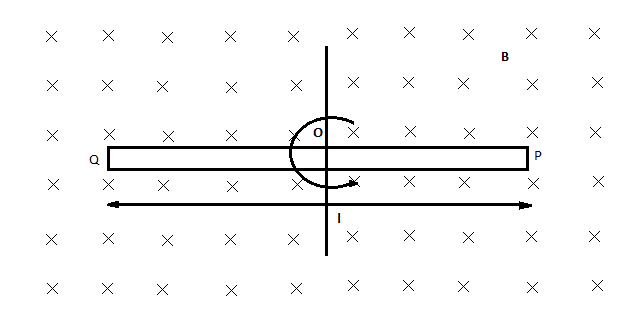
A metallic rod PQ of length $l$ is rotated with an angular velocity $\omega $ about an axis passing through its mid-point O and perpendicular to the plane of the paper, in uniform magnetic field B, as shown in the figure. What is the potential difference developed between the two ends of the rod, P and Q?
Answer
 Verified
232.8k+ views
Hint: All the points of the rod move when the rod moves with the angular velocity $\omega $. We can find a relation between angular velocity and the translational velocity along the center of mass. Then use the relation equation to find the potential difference between the ends. The rod is rotating along the axis through the midpoint of the rod, perpendicular to the length, therefore divide the rod into two parts, calculate the magnitude of the emf for both the parts and finally calculate the potential difference between two ends.
Complete step by step solution:
Step 1: In the above figure a rod PQ of length $l$ is kept in a magnetic field $\overrightarrow B $. When the rod is rotated along the axis passing through the midpoint of the rod, then some emf will induce in the rod. Now let us split the rod and think about the OP part of the rod of length $\dfrac{l}{2}$ . The center of mass of the OP part of the rod is in the middle of O and P. Therefore, the distance of the center of mass is $\dfrac{l}{4}$. Now express the relation between angular velocity and the translational velocity of the rod.
\[\therefore {v_t} = \omega \times \dfrac{l}{4}\]…..equation(1).
Step 2: we can calculate the potential difference between O and P. express the formula for the potential difference between two ends of the rod
\[\therefore \left| {{V_P}} \right| = B{v_t}L\]
Where $B$ is the magnetic field, $L$is the length of the rod which is $\dfrac{l}{2}$ for OP.
Now substitute the value of ${v_t}$ from equation 1 and $\dfrac{l}{2}$ for $L$ .
$\therefore \left| {{V_P}} \right| = B \times \omega \times \dfrac{l}{4} \times \dfrac{l}{2}$
$ \Rightarrow \left| {{V_P}} \right| = B \times \omega \times \dfrac{{{l^2}}}{8}$
Therefore, the magnitude of the potential difference between O and P is obtained above.
Step 3: Now if you see the figure carefully you will find that all the conditions for the other part of the rod OQ and OP are the same. Therefore the magnitude of the potential difference between O and Q will be the same as between O and P.
$\therefore \left| {{V_Q}} \right| = B \times \omega \times \dfrac{{{l^2}}}{8}$
Step 4: Now calculate the potential difference between P and Q.
$\therefore {V_{PQ}} = {V_Q} - {V_P}$
$ \Rightarrow {V_{PQ}} = B \times \omega \times \dfrac{{{l^2}}}{8} - B \times \omega \times \dfrac{{{l^2}}}{8}$
$ \Rightarrow {V_{PQ}} = 0$
Hence the potential difference between P and Q will be zero.
Note: The potential difference induced by the rotation in a magnetic field may vary if the axis of rotation is not in the mid of the ends, the metallic rod is not uniformly thick, the magnetic field is not uniform, etc. in the relation between angular velocity and translation velocity the distance will vary for each point on the rod but eventually when we will calculate the potential difference between P and Q the result will be the same.
Complete step by step solution:
Step 1: In the above figure a rod PQ of length $l$ is kept in a magnetic field $\overrightarrow B $. When the rod is rotated along the axis passing through the midpoint of the rod, then some emf will induce in the rod. Now let us split the rod and think about the OP part of the rod of length $\dfrac{l}{2}$ . The center of mass of the OP part of the rod is in the middle of O and P. Therefore, the distance of the center of mass is $\dfrac{l}{4}$. Now express the relation between angular velocity and the translational velocity of the rod.
\[\therefore {v_t} = \omega \times \dfrac{l}{4}\]…..equation(1).
Step 2: we can calculate the potential difference between O and P. express the formula for the potential difference between two ends of the rod
\[\therefore \left| {{V_P}} \right| = B{v_t}L\]
Where $B$ is the magnetic field, $L$is the length of the rod which is $\dfrac{l}{2}$ for OP.
Now substitute the value of ${v_t}$ from equation 1 and $\dfrac{l}{2}$ for $L$ .
$\therefore \left| {{V_P}} \right| = B \times \omega \times \dfrac{l}{4} \times \dfrac{l}{2}$
$ \Rightarrow \left| {{V_P}} \right| = B \times \omega \times \dfrac{{{l^2}}}{8}$
Therefore, the magnitude of the potential difference between O and P is obtained above.
Step 3: Now if you see the figure carefully you will find that all the conditions for the other part of the rod OQ and OP are the same. Therefore the magnitude of the potential difference between O and Q will be the same as between O and P.
$\therefore \left| {{V_Q}} \right| = B \times \omega \times \dfrac{{{l^2}}}{8}$
Step 4: Now calculate the potential difference between P and Q.
$\therefore {V_{PQ}} = {V_Q} - {V_P}$
$ \Rightarrow {V_{PQ}} = B \times \omega \times \dfrac{{{l^2}}}{8} - B \times \omega \times \dfrac{{{l^2}}}{8}$
$ \Rightarrow {V_{PQ}} = 0$
Hence the potential difference between P and Q will be zero.
Note: The potential difference induced by the rotation in a magnetic field may vary if the axis of rotation is not in the mid of the ends, the metallic rod is not uniformly thick, the magnetic field is not uniform, etc. in the relation between angular velocity and translation velocity the distance will vary for each point on the rod but eventually when we will calculate the potential difference between P and Q the result will be the same.
Recently Updated Pages
Circuit Switching vs Packet Switching: Key Differences Explained

JEE General Topics in Chemistry Important Concepts and Tips
JEE Extractive Metallurgy Important Concepts and Tips for Exam Preparation
JEE Amino Acids and Peptides Important Concepts and Tips for Exam Preparation
JEE Atomic Structure and Chemical Bonding important Concepts and Tips
Electricity and Magnetism Explained: Key Concepts & Applications
Trending doubts
JEE Main 2026 Application Login: Direct Link, Registration, Form Fill, and Steps
JEE Main Marking Scheme 2026- Paper-Wise Marks Distribution and Negative Marking Details
Understanding Uniform Acceleration in Physics
Why does capacitor block DC and allow AC class 12 physics JEE_Main
Understanding How a Current Loop Acts as a Magnetic Dipole
Step-by-Step Guide to Young’s Double Slit Experiment Derivation
Other Pages
JEE Advanced Weightage 2025 Chapter-Wise for Physics, Maths and Chemistry
Understanding Average and RMS Value in Electrical Circuits
Understanding Collisions: Types and Examples for Students
Ideal and Non-Ideal Solutions Explained for Class 12 Chemistry
JEE Main Participating Colleges 2026 - A Complete List of Top Colleges
Electric field due to uniformly charged sphere class 12 physics JEE_Main