




Conversion of phenol to salicylic acid and to salicyaldehyde are known as? (respectively)
(A) Reimer-Tiemann reaction and Kolbe’s reaction
(B) Williamson’s synthesis and Hydroboration-oxidation
(C) Kolbe’s reaction and Williamson’s synthesis
(D) Kolbe’s reaction and Reimer-Tiemann reaction
Answer
 Verified
529.3k+ views
Hint:The conversion of phenol to salicylic acid takes place through a base, and hydrolysis. If we talk about the conversion of phenol of salicylaldehyde takes place through the action of chloroform. So, we identify the naming reactions in which these conversions take place.
Complete step by step solution:
First, we will discuss the conversion of phenol to salicylic acid.
The phenol will be deprotonated by strong base i.e. hydroxide ion. There will be addition of phenoxide ions formed to the carbon-dioxide.
So, we can say that the addition further leads to the carboxylate formation. Then, it will further lead to the formation of carboxylic acid, i.e. salicylic acid.
The chemical reaction is
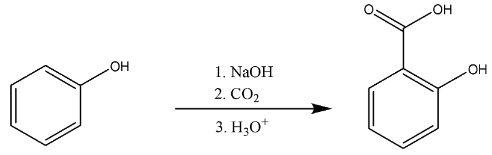
Thus, we know this whole mechanism takes place in Kolbe’s reaction, it is used for the synthesis of aspirin also known as salicylic acid in the industries.
Now, the next we have conversion of phenol to salicylaldehyde. It was proposed by Karl Riemer, mainly used for the ortho- phenols.
In this reaction too like Kolbe’s reaction, there is deprotonation of chloroform by strong base like KOH.
This reaction takes place through the nucleophilic attack, and the basic hydrolysis is done, leading to the formation of salicylaldehyde.
The chemical reaction is
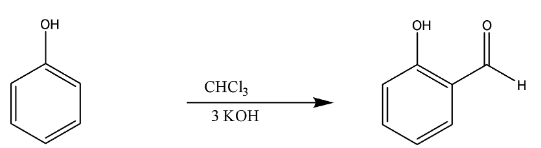
Thus, we can say this whole mechanism takes place in the Riemer –Tiemann reaction.
In the last, we can conclude that conversion of phenol to salicylic acid and to salicylaldehyde are known as Kolbe’ reaction, and Riemer-Tiemann reaction.
Hence, the correct option is (D).
Note: Don’t get confused between both these reactions. These both takes place through deprotonation by a strong base, as we discussed; but the product formation will be different. In case 1 there is addition of carbon-dioxide, and in case 2 there is nucleophilic attack.
Complete step by step solution:
First, we will discuss the conversion of phenol to salicylic acid.
The phenol will be deprotonated by strong base i.e. hydroxide ion. There will be addition of phenoxide ions formed to the carbon-dioxide.
So, we can say that the addition further leads to the carboxylate formation. Then, it will further lead to the formation of carboxylic acid, i.e. salicylic acid.
The chemical reaction is
Thus, we know this whole mechanism takes place in Kolbe’s reaction, it is used for the synthesis of aspirin also known as salicylic acid in the industries.
Now, the next we have conversion of phenol to salicylaldehyde. It was proposed by Karl Riemer, mainly used for the ortho- phenols.
In this reaction too like Kolbe’s reaction, there is deprotonation of chloroform by strong base like KOH.
This reaction takes place through the nucleophilic attack, and the basic hydrolysis is done, leading to the formation of salicylaldehyde.
The chemical reaction is
Thus, we can say this whole mechanism takes place in the Riemer –Tiemann reaction.
In the last, we can conclude that conversion of phenol to salicylic acid and to salicylaldehyde are known as Kolbe’ reaction, and Riemer-Tiemann reaction.
Hence, the correct option is (D).
Note: Don’t get confused between both these reactions. These both takes place through deprotonation by a strong base, as we discussed; but the product formation will be different. In case 1 there is addition of carbon-dioxide, and in case 2 there is nucleophilic attack.
Recently Updated Pages
JEE General Topics in Chemistry Important Concepts and Tips

JEE Extractive Metallurgy Important Concepts and Tips for Exam Preparation
JEE Amino Acids and Peptides Important Concepts and Tips for Exam Preparation
Electricity and Magnetism Explained: Key Concepts & Applications
Algebra Made Easy: Step-by-Step Guide for Students
JEE Energetics Important Concepts and Tips for Exam Preparation
Trending doubts
JEE Main 2026: Admit Card Out, City Intimation Slip, Exam Dates, Syllabus & Eligibility
JEE Main 2026 Application Login: Direct Link, Registration, Form Fill, and Steps
JEE Main Marking Scheme 2026- Paper-Wise Marks Distribution and Negative Marking Details
Understanding the Angle of Deviation in a Prism
Hybridisation in Chemistry – Concept, Types & Applications
How to Convert a Galvanometer into an Ammeter or Voltmeter
Other Pages
JEE Advanced Marks vs Ranks 2025: Understanding Category-wise Qualifying Marks and Previous Year Cut-offs
NCERT Solutions For Class 12 Chemistry Chapter 1 Solutions (2025-26)
Solutions Class 12 Chemistry Chapter 1 CBSE Notes - 2025-26
NCERT Solutions For Class 12 Chemistry Chapter 4 The d and f Block Elements (2025-26)
Biomolecules Class 12 Chemistry Chapter 10 CBSE Notes - 2025-26
NCERT Solutions For Class 12 Chemistry Chapter 10 Biomolecules (2025-26)