




If the central portion of a convex lens is wrapped in black paper as shown in the figure:

(A) No image will be formed by the remaining portion of the lens.
(B) The full image will be formed but it will be less bright.
(C) The central portion of the image will be missing.
(D) There will be two images each produced by one of the exposed portions of the lens.
Answer
 Verified
233.1k+ views
Hint: The black paper covered region blocks some light rays entering. This makes a slight difference in the intensity. It reduces the brightness of the image more than usual. So the image formed is complete but less bright.
Complete step-by-step answer:
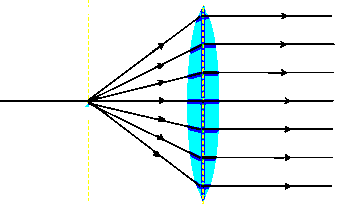
The light beam passing through the lens undergoes refraction and forms an image on the other side of the lens. When the central part of the lens is covered with black paper it avoids the light ray passing through it to some extent but not completely. As a large number of rays are passing through the lens only a small percentage of the rays are cut off. It does not make any difference in the size and shape of the image. But since small values of light rays are blocked the intensity of the image is slightly reduced than the normal refraction.
Hence, the correct option is B.
Note: The image formed by a convex lens is real and inverted or virtual and erect depending on the position of the object. The image formed by the concave lens on the other hand is always virtual and erect regardless of the position of the object.
Complete step-by-step answer:
The light beam passing through the lens undergoes refraction and forms an image on the other side of the lens. When the central part of the lens is covered with black paper it avoids the light ray passing through it to some extent but not completely. As a large number of rays are passing through the lens only a small percentage of the rays are cut off. It does not make any difference in the size and shape of the image. But since small values of light rays are blocked the intensity of the image is slightly reduced than the normal refraction.
Hence, the correct option is B.
Note: The image formed by a convex lens is real and inverted or virtual and erect depending on the position of the object. The image formed by the concave lens on the other hand is always virtual and erect regardless of the position of the object.
Recently Updated Pages
JEE Main 2023 April 6 Shift 1 Question Paper with Answer Key

JEE Main 2023 April 6 Shift 2 Question Paper with Answer Key
JEE Main 2023 (January 31 Evening Shift) Question Paper with Solutions [PDF]
JEE Main 2023 January 30 Shift 2 Question Paper with Answer Key
JEE Main 2023 January 25 Shift 1 Question Paper with Answer Key
JEE Main 2023 January 24 Shift 2 Question Paper with Answer Key
Trending doubts
JEE Main 2026: Session 2 Registration Open, City Intimation Slip, Exam Dates, Syllabus & Eligibility
JEE Main 2026 Application Login: Direct Link, Registration, Form Fill, and Steps
JEE Main Marking Scheme 2026- Paper-Wise Marks Distribution and Negative Marking Details
Understanding the Angle of Deviation in a Prism
Hybridisation in Chemistry – Concept, Types & Applications
How to Convert a Galvanometer into an Ammeter or Voltmeter
Other Pages
JEE Advanced Marks vs Ranks 2025: Understanding Category-wise Qualifying Marks and Previous Year Cut-offs
Dual Nature of Radiation and Matter Class 12 Physics Chapter 11 CBSE Notes - 2025-26
Understanding Uniform Acceleration in Physics
Understanding the Electric Field of a Uniformly Charged Ring
JEE Advanced Weightage 2025 Chapter-Wise for Physics, Maths and Chemistry
Derivation of Equation of Trajectory Explained for Students