



Derivation and Formula of Excess Pressure in Liquid Drops
Excess pressure inside a liquid drop is a fundamental concept in the study of surface tension. It arises due to the molecular forces acting at the liquid surface, resulting in a difference between the internal and external pressures. Understanding this pressure difference is essential for topics related to the mechanical properties of fluids and is frequently tested in competitive examinations such as JEE Main.
Surface Tension and Its Role in Liquid Drops
Surface tension is the property of a liquid’s surface that enables it to resist an external force, due to the cohesive nature of its molecules. This property is responsible for the spherical shape of small liquid drops, as the system tends to minimize its surface area for a given volume, thereby reducing surface energy. More details on this phenomenon can be found at Surface Tension and Contact Angle.
Origin of Excess Pressure Inside a Liquid Drop
The curved surface of a drop creates a situation where molecules on the surface experience a net inward force due to unbalanced molecular interactions. This causes the pressure inside the drop to exceed the external atmospheric pressure. This pressure difference, known as excess pressure, is necessary to maintain equilibrium and keep the surface stable.
Derivation of Excess Pressure Inside a Liquid Drop
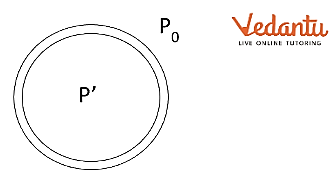
Consider a spherical liquid drop of radius $r$. Let $P_{\text{in}}$ be the pressure inside the drop and $P_{\text{out}}$ be the pressure outside. The surface tension of the liquid is denoted by $T$. The excess pressure is defined as $\Delta P = P_{\text{in}} - P_{\text{out}}$.
Suppose the radius of the drop increases by a small amount $\delta r$. The increase in surface area is given by:
$\Delta A = 4\pi (r + \delta r)^2 - 4\pi r^2 \approx 8\pi r\, \delta r$
The work done in increasing the surface area is used in overcoming surface tension and is:
$\delta W = T \cdot \Delta A = T \cdot 8\pi r\, \delta r$
The forces acting are due to the difference in pressure across the surface of the drop. The work done by the excess pressure for the small increase in volume is:
$\delta W = \Delta P \cdot 4\pi r^2 \delta r$
Equate the two expressions for work:
$\Delta P \cdot 4\pi r^2 \delta r = T \cdot 8\pi r\, \delta r$
Simplifying gives:
$\Delta P = \dfrac{2T}{r}$
Therefore, the excess pressure inside a liquid drop is inversely proportional to its radius and directly proportional to the surface tension of the liquid.
Physical Significance and Applications
Excess pressure explains why smaller droplets exhibit higher internal pressure compared to larger ones. This relationship impacts fluid behaviors in biological systems, technology, and meteorology. The tendency of drops to become spherical is a direct result of surface tension minimizing the pressure difference.
Comparison: Excess Pressure in Drops, Bubbles, and Soap Bubbles
In a liquid drop, only the outer surface contributes to surface tension. For a soap bubble, both the inner and outer surfaces create tension. The table below summarizes the key differences:
| System | Excess Pressure $\Delta P$ |
|---|---|
| Liquid drop (radius $r$) | $\dfrac{2T}{r}$ |
| Soap bubble (radius $r$) | $\dfrac{4T}{r}$ |
Key Points on Excess Pressure Inside a Liquid Drop
- Surface tension leads to excess internal pressure
- Excess pressure is inversely proportional to radius
- Liquid drops have one surface, soap bubbles have two
- Relevant to the stability of droplets and bubbles
Related Fluid Properties
Excess pressure in liquid drops is closely linked to other fluid properties such as viscosity and general fluid pressure. Additional information on these topics can be reviewed at Fluid Pressure and Viscosity and Viscous Force.
Summary
Excess pressure inside a liquid drop is quantitatively described by $\Delta P = \dfrac{2T}{r}$, where $T$ is the surface tension and $r$ is the radius of the drop. This concept underpins the behavior of small droplets, soap bubbles, and similar structures, and is an important aspect of fluid mechanics covered in the JEE Main curriculum.
To further strengthen the understanding of this topic, students may also study topics like Statics and Dynamics and Latent Heat for a comprehensive view of mechanical properties of fluids.


FAQs on Understanding Excess Pressure Inside a Liquid Drop
1. What is the excess pressure inside a liquid drop?
Excess pressure inside a liquid drop is the difference between the pressure inside the drop and the pressure outside it, caused by surface tension acting on the curved surface.
Key points:
- It results from the curved liquid surface and surface tension.
- For a spherical drop of radius r, excess pressure ΔP = 2T/r, where T is surface tension.
- This keeps the drop stable and affects phenomena like droplet formation and capillarity.
2. Derive the formula for excess pressure inside a soap bubble and a liquid drop.
Excess pressure inside a liquid drop and a soap bubble is derived by balancing surface tension forces and pressure difference across the surface.
- For a liquid drop (single interface): ΔP = 2T/r
- For a soap bubble (two interfaces): ΔP = 4T/r
- Here, T = surface tension, r = radius of drop/bubble
- Soap bubbles have double the excess pressure due to inner and outer liquid-gas interfaces.
3. Why is the excess pressure inside a soap bubble double that inside a liquid drop of the same radius?
The excess pressure inside a soap bubble is double because a soap bubble has two surfaces (inside and outside), both contributing to surface tension.
- Liquid drop: one liquid-air interface — ΔP = 2T/r
- Soap bubble: two liquid-air interfaces — ΔP = 4T/r
- Bubbles must balance the pressure for both surfaces, hence excess pressure is doubled.
4. On what factors does the excess pressure inside a liquid drop depend?
The excess pressure inside a liquid drop depends mainly on two factors:
- Surface tension (T): Higher surface tension increases excess pressure.
- Radius (r): Smaller drops have higher excess pressure (inversely proportional to radius).
5. What is the significance of excess pressure in small liquid drops?
Excess pressure in small liquid drops is significant because it explains why tiny drops tend to be spherical and why they evaporate faster than larger drops.
- Promotes stability and minimizes energy due to surface tension.
- Influences processes like condensation, cloud formation, and droplet behavior.
- High excess pressure leads to higher vapor pressure for smaller drops.
6. Explain the surface tension’s role in creating excess pressure inside a drop.
Surface tension acts along the surface of a drop, causing the surface to contract and generating excess pressure inside the drop.
- This pressure balances the inward force due to surface tension.
- The greater the surface tension, the more excess pressure is needed to maintain equilibrium.
- Surface tension is responsible for the drop’s spherical shape and internal pressure difference.
7. How does excess pressure inside a liquid drop vary with radius?
Excess pressure inside a liquid drop is inversely proportional to its radius: as the radius increases, the excess pressure decreases.
- Formula: ΔP = 2T/r
- Smaller drops have higher excess pressure because surface tension is acting on a smaller area.
- This principle is crucial in nucleation, raindrop formation, and micro-droplet physics.
8. Why do smaller drops of liquid tend to be spherical?
Smaller liquid drops tend to be spherical because surface tension minimizes surface area for a given volume, and a sphere has the smallest surface area.
- Excess pressure inside keeps the drop compact.
- Spherical shape leads to energy efficiency and stability.
- This phenomenon is observed in dew drops, raindrops, and oil droplets.
9. What happens to the excess pressure if the radius of the drop is halved?
If the radius of a liquid drop is halved, the excess pressure inside the drop doubles.
- Because ΔP = 2T/r, reducing radius increases excess pressure proportionally.
- This means very small drops have much higher internal pressures.
10. State the formula for excess pressure inside a soap bubble and explain its terms.
The formula for excess pressure inside a soap bubble is ΔP = 4T/r.
- ΔP = excess pressure
- T = surface tension of the soap solution
- r = radius of the bubble
- The factor 4 is due to two liquid-gas surfaces (inner and outer) in a soap bubble.
11. What are the real-life applications of excess pressure in liquid drops?
Excess pressure in liquid drops affects several real-life and exam-relevant phenomena:
- Formation of dew drops and raindrops
- Cloud and fog formation
- Inkjet printing and spray technologies
- Pharmaceutical emulsions and aerosols
12. What is the difference between excess pressure in a soap bubble and an air bubble inside water?
The main difference is the number of liquid-gas interfaces:
- Soap bubble: Excess pressure ΔP = 4T/r due to two surfaces (inside and outside).
- Air bubble in water: Excess pressure ΔP = 2T/r because there's only one interface.
