



How to Compare Decimals Using Place Value Method with Solved Examples
Decimal numbers are quite often seen in our day-to-day life. It is useful for the calculation in our daily life but also by the scientist as it could not have been possible to find the accurate distance between any two bodies like the sun, moon, stars, etc. The main advantages of the decimal number system are easy readability, use by humans, and ease of manipulation.
What are decimal numbers?
The number that is present between two consecutive numbers then all such numbers are decimal numbers. There are infinite decimal numbers between two consecutive numbers. Is it confusing? Don't worry we are here to explain well and to clear your doubt. Let us first understand what a decimal number is. A decimal number is a fraction whose numerator is expressed in a figure and the denominator is a power of ten. It consists of two parts: one is a whole number, and the other is a fractional part separated by a decimal point. The dot present between the whole number and the fractional part is called the decimal part.
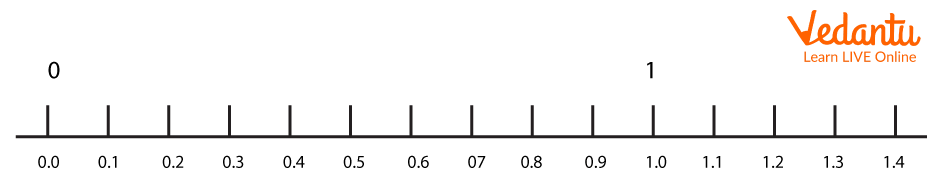
Decimal Numbers
You can clearly see there are so many decimal numbers between two consecutive numbers. And we can also clearly see that the first part is a whole number and the second one is a fractional one.
Let us take some examples:
33.45,66.87, 650.98, etc.
How to compare decimals?
There are some rules to compare decimals:
While comparing the natural numbers we first compare the total number of digits in both numbers and if they are equal then we compare the digit and the extreme left.
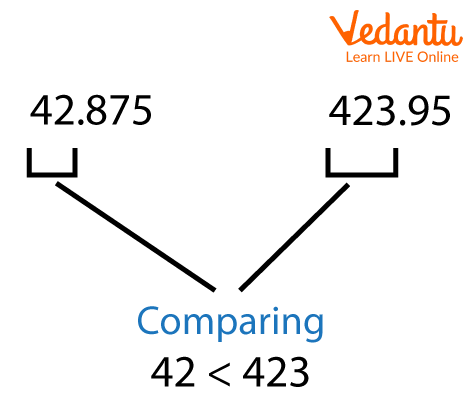
Comparing the Natural Numbers
After that, compare the entire number. Compare them if they are not equal; otherwise, move on to the next stage.
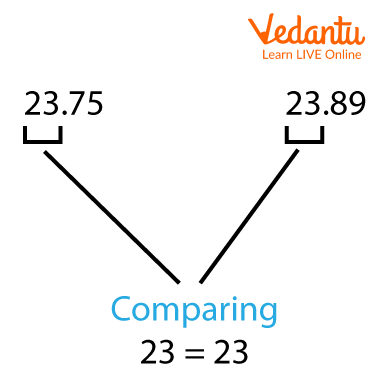
Compare the Whole Number
Compare tenth-place numbers. If the numbers are different then compare them, if not then go to the next step.
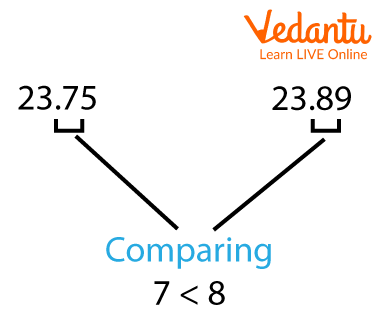
Compare Tenth Place Numbers
Now compare the hundredth number. If the numbers are different then compare them, if not then again go to the next step.
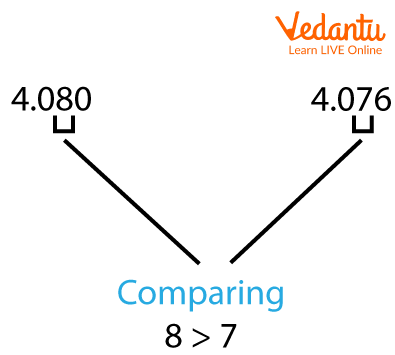
Compare the Hundredth Place Number
Etc…..
Compare decimal number
Steps to the comparison of decimal fractions are given below:
Step 1: First we will compare the whole number.
For example:
564> 363.
432<876
\[654 = 654\]
Step 2: When the integer part is the same then compare the tenths part
For example:
3.5>3.1
7.8<7.9
3.8=3.8
Step 3: When the tenths place is the same compare the hundredths place
For example:
12.34> 12.31
32.76<32.78
\[56.76 = 56.76\]
In this way, we will compare the number.
For example, 9.8 is greater than 7.7
First, we compare the whole number. If the digits are equal then we will proceed to the next step. But here 9 and 7, that is the whole number is different so from the first step only we could clearly indicate that 9.8 is greater than 7.7.
For example, 4.62 is greater than 4.21
First, we will compare the whole number which is the same in this example. Now we will go to the next step i.e we will compare the tenth place number which is 6 and 2 so we will compare these two, so this state that 4.62 is greater than 4.21
Solved Examples
1: Which is the smaller number 187.654 or 187.765?
First check the integer number
187=187
Now check the tenth number
6<7
So 187.654< 187.765
2: Find the greater number; 23.54 or 54.76?
First check the integer number
23< 54
So from this, we get to know that 23.54< 54.76
3: Which number is greater 293.82 or 293.62
first check the integer part,
\[293 = 293\]
Then check the tenth place
8> 6
Now check the hundredth place \[2 = 2\]
Therefore, 293.82 > 293.62
Conclusion
A decimal is a combination of a whole number and a fraction of a whole number. Decimal fraction encourages students to learn about precise quantities. This will help them to understand the weight or distance at an accurate level. By practicing every day with the students it will become quite easy to understand and solve the problem. We can easily compare decimal numbers with daily practice.
FAQs on Decimal Comparison Step by Step Guide to Compare Decimals Easily
1. What is decimal comparison?
Decimal comparison is the process of determining which of two or more decimal numbers is greater, smaller, or equal. It involves comparing digits place by place from left to right.
- First compare the whole number part.
- If equal, compare the tenths place.
- Then compare hundredths, thousandths, and so on.
2. How do you compare decimal numbers step by step?
To compare decimal numbers, align them by place value and compare digits from left to right.
- Write numbers vertically with decimal points aligned.
- Add zeros if needed (e.g., 3.5 = 3.50).
- Compare whole numbers first.
- Move to tenths, hundredths, etc.
3. Why do we add zeros when comparing decimals?
We add zeros to decimals to make place values equal without changing their value. Adding trailing zeros does not change a decimal number.
- For example, 5.2 = 5.20 = 5.200.
- This helps compare digits in the same place value.
4. How do you compare decimals with different numbers of decimal places?
To compare decimals with different lengths, add zeros to the shorter decimal and then compare place values. This ensures each number has the same number of decimal places.
- Example: Compare 6.8 and 6.75.
- Rewrite 6.8 as 6.80.
- Now compare 6.80 and 6.75.
5. Which is greater: 0.5 or 0.05?
The decimal 0.5 is greater than 0.05 because 0.5 represents five tenths while 0.05 represents five hundredths. Write them with equal decimal places:
- 0.5 = 0.50
- 0.05 = 0.05
6. How do you compare negative decimals?
When comparing negative decimals, the number closer to zero is greater. For negative numbers, a smaller absolute value means a larger number.
- Example: Compare −2.3 and −2.7.
- Since −2.3 is closer to 0, it is greater.
7. What is the rule for ordering decimals from least to greatest?
To order decimals from least to greatest, compare them using place value from left to right. Follow these steps:
- Align decimal points.
- Add zeros if necessary.
- Compare whole numbers first.
- Then compare tenths, hundredths, etc.
8. How do place values help in comparing decimals?
Place value determines the value of each digit in a decimal number and is key to decimal comparison. Each position represents tenths, hundredths, thousandths, etc.
- Example: In 3.482, 4 is in the tenths place.
- The 8 is in the hundredths place.
9. Can you give an example of comparing three decimal numbers?
Yes, to compare three decimals, align them and compare digit by digit. Example: Compare 0.62, 0.602, and 0.65.
- Rewrite as 0.620, 0.602, 0.650.
- Compare hundredths and thousandths.
10. What are common mistakes when comparing decimal numbers?
A common mistake in decimal comparison is ignoring place value and comparing digits incorrectly. Students often think a longer decimal is larger, which is not always true.
- Mistake: Thinking 0.345 > 0.5 because 345 > 5.
- Correct method: Rewrite 0.5 as 0.500.
