



What Are Equal Angles Definition Properties and Solved Examples
An angle is a figure in Plane Geometry generated by two rays or lines that share a common endpoint. "Angle" comes from the Latin word "angulus," which means "corner." The angle in the plane is present in two forms: a positive angle and a negative angle. A positive angle is formed when the angle is rotated counterclockwise. A negative angle is one that is measured in a clockwise direction.
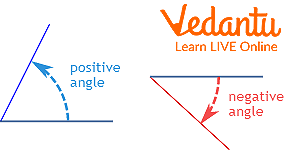
Types of Angle
What are Angles?
When two rays arise from the same spot, an angle is generated. These rays form an angle known as the arms of the angle, and their origin is known as the vertex of the angle.
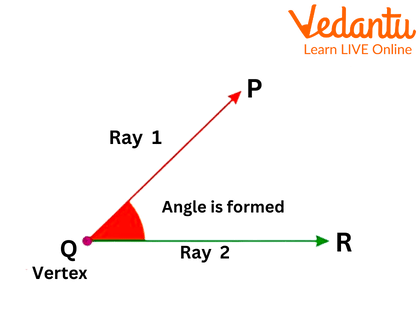
Angle Formed by Two Rays
An angle is denoted by the symbol \[\angle \]. The created angle is indicated by \[\angle \]PQR in the diagram above. \[\angle \]RQP is another way to represent the same angle. The degree is used to measure angles.
The above two rays may be combined in a variety of ways to generate the many sorts of angles in geometry.
Types of Angles
Based on the degree of the angle formed there are different types of angles.
Zero Angle – The angle formed is zero degrees.
Acute Angle – The angle formed is greater than zero and less than \[90^\circ \].
Right Angle – The angle formed is \[90^\circ \].
Obtuse Angle – The angle formed is greater than \[90^\circ \]and less than \[180^\circ \].
Straight Angle – The angle is at \[180^\circ \]and appears like a straight line.
Reflex Angle – The angle is greater than \[180^\circ \]but less than \[360^\circ \].
Complete Angle – The angle which is of \[360^\circ \]is the complete angle.
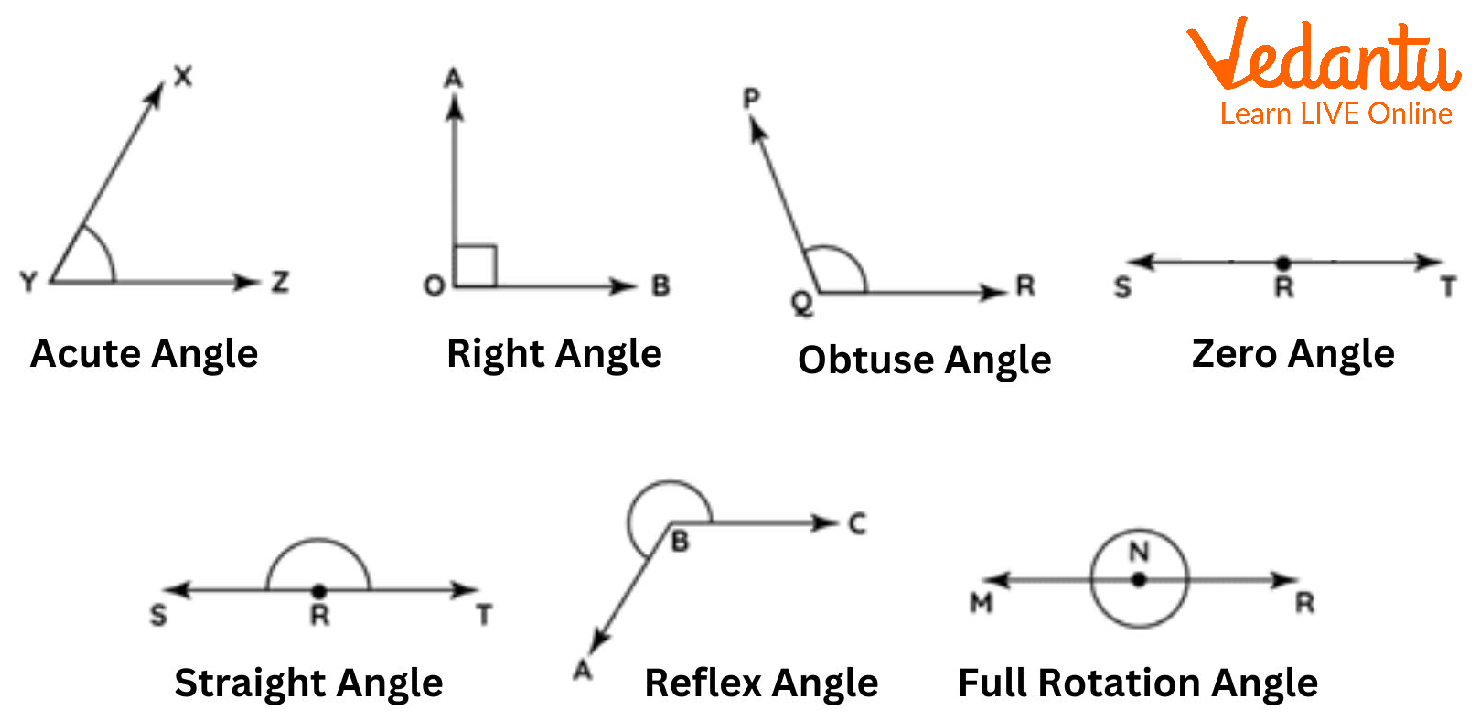
Types of Angles Based on the Degree of Angle Formed
Angles Based on Their Pairing
Based on the pairing of two angles there are different types of angles.
Complementary Angles – When two angles add up to form \[90^\circ \]then it is called complementary angles. For example, if we add \[30^\circ \]and \[60^\circ \] we get \[90^\circ \].
Supplementary Angles – When two angles add up to form \[180^\circ \]then we call it a supplementary angle. For example, if we add \[110^\circ \]and \[70^\circ \]we will get \[180^\circ \].
Linear Angles – Two angles are termed to be linear if they are produced by two intersecting lines. Their total is always \[180^\circ \].
Adjacent Angles – Adjacent angles are two angles that share a vertex and a side but do not intersect.
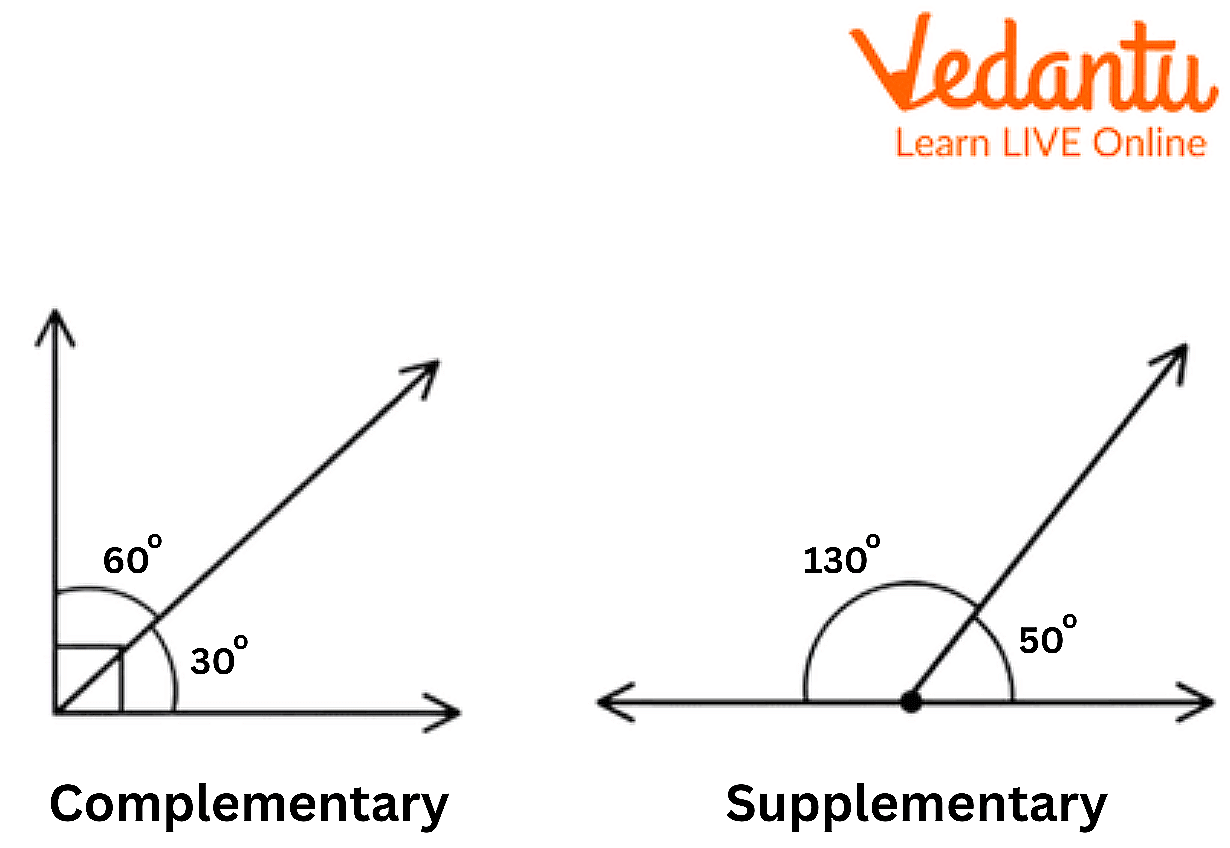
Complementary and Supplementary Angles
Construction of Angles
To construct the angle you need to follow these simple steps.
Step 1: Draw an OA line segment.
Step 2: Set the protractor's center at point O.
Step 3: Working clockwise from point A, mark a point at 50 degrees by glancing at the protractor's outer circle. Make this point B.
The \[\angle \]BOA represents the needed \[50^\circ \] angle.
For the construction of equal angles, you need to use a compass. The method of its construction is bit complex and would be taught to you in higher classes.
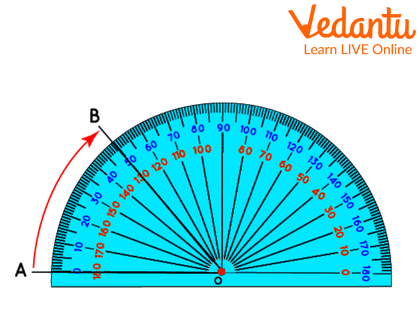
Construction of Angle
Conclusion
Angle is constructed by the two line segments who have a common end-point. Angles can be formed by two-line segments using a mathematical tool named a protractor. Two equal supplementary angles will result to form a whole circle or whole angle of \[360^\circ \]. The different types of angles formed can be calculated using the simple operations of addition and subtraction.
Sample Questions
1. The angle complementary to \[40^\circ \] is
a. \[30^\circ \]
b. \[40^\circ \]
c. \[50^\circ \]
d. \[60^\circ \]
Ans: \[50^\circ \]
Explanation: For angles to be complementary their sum should be equal to 90.
\[\begin{array}{l}40 + x = 90\\x = 90 - 40\\x = 50^\circ \end{array}\]
2. The angle supplementary to \[60^\circ \] is
a. \[160^\circ \]
b. \[140^\circ \]
c. \[120^\circ \]
d. \[100^\circ \]
Ans: \[120^\circ \]
Explanation: For angles to be supplementary their sum should be equal to 180.
\[\begin{array}{l}60 + x = 180^\circ \\x = 180^\circ \ - 60^\circ \\x = 120^\circ \end{array}\]
3. Find the measure of all angles of an equilateral triangle?
a. \[60^\circ \]
b. \[10^\circ \]
c. \[120^\circ \]
d. \[100^\circ \]
Ans: \[60^\circ \]
Explanation: The angles in the equilateral triangle are also equal. The sum of all the angles in a triangle is 180.
\[\begin{array}{l}3x = 180\\x = \dfrac{{180}}{3} = 60^\circ \end{array}\]
So, in an equilateral triangle, each angle is 60 degrees.
FAQs on Equal Angles in Geometry Explained Clearly
1. What are equal angles in geometry?
Equal angles are angles that have the same measure in degrees or radians. If two or more angles have identical numerical values, they are called equal or congruent angles.
For example:
- If ∠A = 45° and ∠B = 45°, then ∠A and ∠B are equal angles.
- Equal angles may appear in different shapes or positions but must have the same measure.
2. How do you prove that two angles are equal?
Two angles are proved equal by showing they have the same numerical measure using geometric rules or algebra.
Common methods include:
- Using parallel line properties (corresponding or alternate angles).
- Applying the Isosceles Triangle Theorem (base angles are equal).
- Using vertical opposite angle property.
- Solving algebraic expressions and equating values.
3. What is the symbol for equal angles?
The symbol used to show equal angles is ∠A = ∠B or sometimes the congruence symbol ≅.
For example:
- ∠ABC = ∠PQR
- ∠ABC ≅ ∠PQR
4. Are vertical opposite angles always equal?
Yes, vertical opposite angles are always equal when two straight lines intersect.
Key facts:
- They are formed opposite each other at the intersection.
- If one angle is 120°, the vertically opposite angle is also 120°.
5. Why are base angles in an isosceles triangle equal?
Base angles in an isosceles triangle are equal because the two equal sides create equal opposite angles.
According to the Isosceles Triangle Theorem:
- If two sides of a triangle are equal,
- Then the angles opposite those sides are equal.
6. What are corresponding angles and are they equal?
Corresponding angles are angles in matching positions formed by a transversal crossing parallel lines, and they are equal when the lines are parallel.
Properties:
- They lie on the same side of the transversal.
- If lines are parallel, corresponding angles have equal measures.
7. What is the difference between equal angles and supplementary angles?
Equal angles have the same measure, while supplementary angles add up to 180°.
Comparison:
- Equal angles: 40° and 40°
- Supplementary angles: 110° and 70° (sum = 180°)
8. Can two different shapes have equal angles?
Yes, two different shapes can have equal angles if the angle measures are the same in degrees or radians.
For example:
- A 90° angle in a square
- A 90° angle in a right triangle
9. How do you find equal angles using algebra?
Equal angles can be found by setting their algebraic expressions equal to each other and solving for the variable.
Example:
- If ∠A = 3x + 10 and ∠B = 5x − 10
- Set them equal: 3x + 10 = 5x − 10
- Solve: 20 = 2x → x = 10
10. Where are equal angles used in real life?
Equal angles are used in construction, engineering, design, and architecture to ensure symmetry and stability.
Common applications include:
- Designing roofs with equal slopes
- Building symmetrical bridges
- Creating geometric patterns in art
