



Definition Proof and Examples of the Factor of Itself Property
We know about factors, a number that divides other numbers without leaving any reminder called a factor. There are many properties related to the factors; one of these properties is that every number is a factor of itself. So now let us discuss what this property means.

Showing Factors of 18
How Every Number is a Factor of Itself:
Factors are those numbers that divide a number completely, so a number can divide itself completely, hence every number is a factor of itself. So let’s discuss this property with the help of an example. Let’s take example of some numbers in which we have to find the factors of that numbers, let’s say those number are 1,2,3,5,7,9,12,25
Factors of 1–1
Factors of 2–1,2
Factors of 3–1,3
Factors of 4–1,2,4
Factors of 5–1,5
Factors of 7–1,7
Factors of 9–1,3,9
Factors of 12–1, 2,3,4,6,12
Factors of 25–1, 5,25
Hence,from these examples we can conclude that 1 Is a factor of every number and every number is a factor of itself.
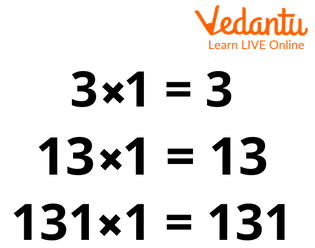
Showing Every Number is a Factor of Itself
Why Integers have Finite Number of Factors:
A number can be said as a factor of another number if it can be expressed as a product of that number. We know that the factors of a number is always less than or equal to the number.Let’s understand this with the help of example:
Factors of 40 –1,2,4,5,8,10,20,40
So from this example we can conclude that factors of another number can lie between one and the number itself, As every number is a finite number so factors of that number which lie between 1 and the number itself are finite.
Why Factor of Number is Always Less than or Equal to the Number:
Factor of a number is nothing but just a part of the number as any part of a number cannot be greater than the number itself. That's why the factor of a number is always less than or equal to the number. Let’s understand this with the help of an example: let I have a pizza now cut the pizza into slices, any slice of the pizza cannot be greater than the pizza itself, same is the case of factors as any factor a number cannot be greater than the number.
Factors of 8–1,2,4,8
Factors of 16–1,2,4,8,16
From the above examples it is clear that the factor of a number cannot be greater than the number itself; they are always less than or equal to the number.
Showing Factors of Every Number is always Less Than or Equal to the Number
Exceptional Numbers which do not have at least Two Factors:
We know that the factor of every number is always 1 and the number itself in case of prime numbers, in case of numbers that are other than prime number factors may be more than two.0 and 1 are two exceptional numbers which do not have at least two factors. We know that the smallest prime number is 2 so in this case zero and one or not prime numbers because prime numbers are those numbers which are divided by 1 and the number itself. In case of 1 the factor is only 1 itself. 0 too is not a prime number.
Conclusion:
In this article we learned about some properties of factors along with some examples which prove the properties. In this we learned that every prime number has at least two factors and composite numbers can have more than two factors which cannot be greater than the number itself. An exceptional number which does not have at least two factors is 0 and 1.
FAQs on Understanding Why Every Number Is a Factor of Itself
1. What does it mean that every number is a factor of itself?
Every number is a factor of itself because it divides itself exactly without leaving a remainder. In other words, for any number n, we can write n ÷ n = 1, which is a whole number. Since a factor is a number that divides another number completely, each number is always one of its own factors.
2. Why is every number divisible by itself?
Every number is divisible by itself because dividing a number by the same number always gives 1 as the quotient. For example:
- 7 ÷ 7 = 1
- 15 ÷ 15 = 1
3. Is 1 a factor of every number?
Yes, 1 is a factor of every number because dividing any number by 1 leaves the number unchanged. For example:
- 12 ÷ 1 = 12
- 45 ÷ 1 = 45
4. Is every number always a factor of itself?
Yes, every non-zero number is always a factor of itself because it divides itself exactly once. For any number n ≠ 0, we have n ÷ n = 1. However, division by zero is undefined, so zero is not considered in this rule.
5. Can you give an example to show that a number is a factor of itself?
Yes, a simple example is 9, which is a factor of itself because 9 ÷ 9 = 1. The steps are:
- Take the number 9.
- Divide it by itself: 9 ÷ 9.
- The result is 1 with remainder 0.
6. How many factors does a number always have at minimum?
Every number greater than 1 has at least two factors: 1 and itself. For example:
- Factors of 5: 1, 5
- Factors of 11: 1, 11
7. Does this rule apply to prime and composite numbers?
Yes, both prime and composite numbers are factors of themselves. A prime number has exactly two factors (1 and itself), while a composite number has more than two factors. In both cases, the number itself is always included as a factor.
8. Is zero a factor of itself?
No, zero is not considered a factor of itself because division by zero is undefined. Since 0 ÷ 0 has no defined value in arithmetic, zero does not follow the standard factor rule applied to non-zero integers.
9. What is the difference between a factor and a multiple in this context?
A factor divides a number exactly, while a multiple is the result of multiplying a number by an integer. For example, with 6:
- Factors of 6: 1, 2, 3, 6
- Multiples of 6: 6, 12, 18, 24
10. Why is this property important in mathematics?
The property that every number is a factor of itself is important because it forms the foundation of factorization, prime numbers, and divisibility rules. It ensures that every integer has at least one definite factor besides 1, which helps in finding HCF, LCM, and simplifying fractions.
