



Types of Fractions in Maths with Definitions Examples and Properties
An Introduction to Types of Fractions
A fraction is defined as a part or portion of any quantity out of a whole, where the whole can be any number, a specific value, or a thing.
Types of fractions are categorised mostly on the basis of their numerator and denominator. A fraction is composed of two parts; these are the numerator and the denominator. The number placed on the top of the fractional bar is known as the numerator and the number placed at the bottom is known as the denominator. The numerator shows the number of parts that are being considered while the denominator indicates the total number of parts in the whole.
Types of Fractions with Examples
There are many types of fractions but the three main types of fractions which are differentiated on the basis of the numerator and the denominator are given below.
Proper fractions
Improper fractions
Mixed fractions
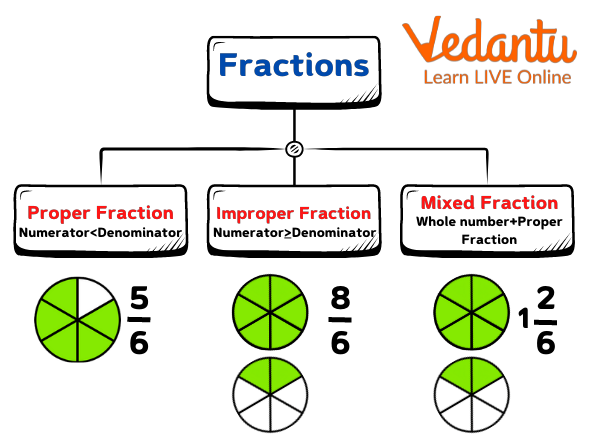
Let’s understand each type of fraction in detail.
1. Proper Fractions
A proper fraction is defined as a fraction whose numerator is less than its denominator. The examples of the proper fractions are $\frac{4}{7}$ and $\frac{8}{15}$ because 4 < 7 and 8 < 15. Example: Rohan took a stick and he broke it into 3 equal parts. He took 1 part and gave 2 parts to his friend. We can represent Rohan's portion as 1/3 and his friend’s portion as 2/3. Both of these fractions are proper fractions here.
2. Improper Fractions
An improper fraction is defined as a fraction whose numerator is greater than or equal to its denominator.
For example, $\frac{7}{2}$ and $\frac{8}{15}$ are improper fractions because 7 > 2 and 19>7.
3. Mixed Fractions
A mixed fraction is a combination of a whole number and a proper fraction. For example, $1\frac{4}{9}$ and $2\frac{4}{17}$ are mixed numbers or mixed fractions. In the first example, 1 is the whole number part and $\frac{4}{9}$ is the proper fraction. In the second example, 2 is the whole number part and $1\frac{4}{17}$ is the proper fraction.
Group of Fractions
There are some types of fractions that are classified into groups. Groups of fractions are helpful in comparing fractions. These are as follows.
Like fractions
Unlike fractions
Equivalent fractions
1. Like Fractions
In like fractions, the denominators of two or more fractions are the same. For example $\frac{1}{8}$, $\frac{3}{8}$, $\frac{7}{8}$, $\frac{19}{8}$ are like fractions. Mathematical operations such as addition and subtraction can be easily performed on like fractions.
2. Unlike Fractions
In unlike fractions, the denominators of two or more fractions are different. For example $\frac{2}{7}$, $\frac{1}{3}$, $\frac{5}{7}$, $\frac{1}{6}$ etc. In order to perform mathematical operations in unlike fractions we may convert them into like fractions.
3.Equivalent Fractions
When equivalent fractions are simplified or reduced they give the same value while these fractions have different numerators and different denominators. For example, $\frac{12}{24}$, $\frac{6}{12}$, $\frac{4}{8}$ are all equivalent fractions because they all get reduced to $\frac{1}{2}$.
Important Points
Some important points related to the different types of fractions are given below.
A mixed fraction is a fraction which is the combination of a fraction and a whole number. The conversion of a mixed fraction can be converted into an improper fraction and vice versa. For example, $3\frac{1}{4}=\frac{3х4+1}{4}=\frac{13}{4}$
In an improper fraction, we know that the value of a numerator is greater than or equal to its denominator. So its value will always be greater than unity.
In a proper fraction, the numerator is less than its denominator so its value is always less than unity.
Do You Know?
Units fractions are those fractions where the value of the numerator is 1 and the denominator is a positive integer. For example,$\frac{1}{3}$, $\frac{1}{8}$, $\frac{1}{19}$, $\frac{1}{23}$ and so on are known as unit fractions.
Conclusion
Fraction and its types are important and basic concepts of mathematics. In this article, we have learnt about how many types of fractions are there with examples, such as proper and improper fractions, mixed fractions, equivalent fractions, like and unlike fractions.
FAQs on How Many Types of Fractions Are There in Mathematics
1. How many types of fractions are there in Maths?
There are six main types of fractions in Maths: proper, improper, mixed, unit, like, and unlike fractions.
- Proper fraction – numerator is less than denominator (e.g., 3/5).
- Improper fraction – numerator is greater than or equal to denominator (e.g., 7/4).
- Mixed fraction – combination of whole number and proper fraction (e.g., 1 3/4).
- Unit fraction – numerator is 1 (e.g., 1/8).
- Like fractions – same denominators (e.g., 2/9 and 5/9).
- Unlike fractions – different denominators (e.g., 1/3 and 2/5).
2. What is a proper fraction?
A proper fraction is a fraction where the numerator is smaller than the denominator.
- Numerator < Denominator
- Value of the fraction is less than 1.
- Example: 4/7, where 4 < 7.
3. What is an improper fraction?
An improper fraction is a fraction where the numerator is greater than or equal to the denominator.
- Numerator ≥ Denominator
- Value is equal to or greater than 1.
- Example: 9/5 or 6/6.
4. What is a mixed fraction with example?
A mixed fraction is a number made up of a whole number and a proper fraction.
- Example: 2 1/3
- This means 2 whole parts and 1/3 of another part.
5. What is a unit fraction?
A unit fraction is a fraction with numerator equal to 1.
- Form: 1/n, where n is a positive integer.
- Example: 1/2, 1/7, 1/10.
6. What are like and unlike fractions?
Like fractions have the same denominator, while unlike fractions have different denominators.
- Like fractions: 3/8 and 5/8.
- Unlike fractions: 2/3 and 4/7.
7. What is the difference between proper and improper fractions?
The main difference is that a proper fraction is less than 1, while an improper fraction is greater than or equal to 1.
- Proper fraction: numerator < denominator (e.g., 5/9).
- Improper fraction: numerator ≥ denominator (e.g., 9/5).
8. How do you convert an improper fraction to a mixed fraction?
To convert an improper fraction to a mixed fraction, divide the numerator by the denominator.
- Step 1: Divide numerator by denominator.
- Step 2: Write the quotient as the whole number.
- Step 3: Write the remainder over the original denominator.
9. What are equivalent fractions?
Equivalent fractions are different fractions that represent the same value.
- They are formed by multiplying or dividing numerator and denominator by the same non-zero number.
- Example: 1/2 = 2/4 = 4/8.
10. What is the simplest form of a fraction?
The simplest form of a fraction is when the numerator and denominator have no common factor other than 1.
- Divide both numerator and denominator by their HCF (Highest Common Factor).
- Example: 8/12 → HCF of 8 and 12 is 4.
- 8 ÷ 4 = 2 and 12 ÷ 4 = 3.
