



How To Find The Lowest Form Of A Fraction With Steps And Examples
The simplest form of a fraction is one with a reasonably prime denominator and numerator. It indicates that, except from 1, there is no common factor between the fraction's numerator (upper portion or top) and denominator (lower part or bottom).
How to Find the Lowest Form of Fractions?
Any fraction can be easily found in its simplest form. By dividing both the numerator and denominator by the greatest common factor that entirely divides them, we need to simplify the fraction's numerator and denominator. Both the numerator and the denominator should still be whole numbers after division. Reducing fractions is another name for this process of simplifying fractions.
Since the common factor "c" is subtracted from both the numerator and the denominator, the simplified form of a fraction like "\[\dfrac{{ac}}{{bc}}\] " will be "\[\dfrac{a}{b}\] ".
![Showing Simplest Form of \[\dfrac{8}{{24}}\]](https://lh4.googleusercontent.com/8alQuxgClJp-4iW9HsI-RcXipD9IdMAJBZrF0Jl7gLhcXHktxiydfFAeLFYIVvHAQ3clRx9S_H-nXTnwAhPQXTVCc98uaYfovUNRI6tpCd05mFMZNUXZvJWslZ6GtKBKfAb8_69quqq61I2jSdfpqg)
Showing Simplest Form of \[\dfrac{8}{{24}}\]
Steps to find Lowest Form:
Find the fraction's GCF for the numerator and denominator.
By the generated GCF, divide the numerator and denominator.
Write the given fraction's reduced fraction.
Simple Form Ratio:
A ratio is denoted by the ratio \[a:b\], where a and b are whole numbers. When we express a ratio in its simplest form, we are simplifying it down to its most basic components.
Reduce the Fraction to Lowest Term Illustration:
Let's use the fractions \[\dfrac{5}{9}\] and \[\dfrac{6}{9}\] as an illustration to help you comprehend. \[\dfrac{5}{9}\] is expressed in the simplest terms possible because there is just one element that connects 5 and 9. However, \[\dfrac{6}{9}\] is not since 6 and 9 share a factor of 3.
Divide both the numerator and the denominator by the highest common factor, in this case 3 (since both are divisible by 3), to express 69 in the simplest words possible:
\[\dfrac{{6 \div 3}}{{9 \div 3}}\]
\[\dfrac{6}{9}\] is \[\dfrac{2}{3}\] when expressed in the simplest terms.
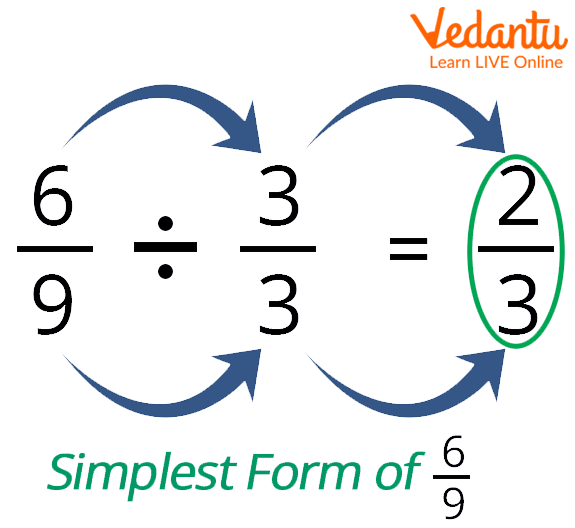
Simplest Form for 6 / 9
These are also referred to as reducing fractions.
Conclusion:
A fraction's simplest form is one with a denominator and numerator that are both suitably prime numbers. It shows that the numerator (upper section or top) and denominator of the fraction do not share any factors, with the exception of one. Now we will solve non terminating recurring numbers examples.
Solved Examples:
Example 1: Simplify it: \[32:40\] .
The same approach that we used to simplify the fraction can also be used to simplify the ratio.
Here, 32 acts as the antecedent, and 40 acts as the consequent. In order to obtain the simplified form, we must discover the highest factor that can be formed from 32 and 40.
Thus, the common factor between 32 and 40 is 8.
As a result, 4:5 is the simplest version of 32:40 (because\[8 \times 4 = 32{\rm{ and }}8 \times 5 = 40\])
Example 2: Reduce the fraction to its simplest form: 2:10.
We can therefore write \[\dfrac{2}{{10}} = \dfrac{1}{5}\]
The result of dividing the numerator and denominator by two is \[\dfrac{2}{{10}} = \dfrac{1}{5}\].
Therefore, \[\dfrac{1}{5}\] is the answer.
Example 3: Are the lowest and highest forms equivalent?
If q is positive, the integers p and q have no common factor other than 1, and the rational number's lowest form allows for a possible negative value, the rational number is said to be in its standard form.
FAQs on Lowest Form Of Fraction Simplified Explanation
1. What is the lowest form of a fraction?
The lowest form of a fraction is a fraction in which the numerator and denominator have no common factor other than 1. This means the fraction cannot be simplified further.
For example:
- 8/12 can be simplified to 2/3
- 2 and 3 have no common factors except 1
2. How do you simplify a fraction to its lowest form?
To simplify a fraction to its lowest form, divide both the numerator and denominator by their greatest common divisor (GCD).
Steps:
- Find the GCD of the numerator and denominator.
- Divide both numbers by the GCD.
- Write the new fraction.
GCD of 18 and 24 = 6
18 ÷ 6 = 3, 24 ÷ 6 = 4
Lowest form = 3/4.
3. What is the formula to find the lowest form of a fraction?
The formula to write a fraction in lowest form is: divide numerator and denominator by their GCD.
Simplified Fraction = (Numerator ÷ GCD) / (Denominator ÷ GCD)
Example: 20/30
GCD = 10
Simplified fraction = (20 ÷ 10)/(30 ÷ 10) = 2/3.
4. How do you know if a fraction is already in lowest form?
A fraction is already in lowest form if the numerator and denominator have no common factor other than 1.
To check:
- Find factors of both numbers.
- If no common factor exists (except 1), it is simplified.
No common factor except 1, so 5/8 is already in lowest form.
5. What is the difference between simplest form and lowest form of a fraction?
There is no difference between simplest form and lowest form of a fraction; both mean the fraction cannot be reduced further.
In both cases:
- The numerator and denominator share no common factor except 1.
- The fraction is fully reduced.
6. Can you give an example of reducing a fraction to lowest terms?
Yes, reducing a fraction to lowest terms means dividing by the greatest common divisor.
Example: 15/25
- GCD of 15 and 25 = 5
- 15 ÷ 5 = 3
- 25 ÷ 5 = 5
7. Why do we reduce fractions to lowest form?
We reduce fractions to lowest form to make them simpler, clearer, and easier to compare or calculate with.
Benefits:
- Makes arithmetic operations easier
- Helps compare fractions quickly
- Standard form used in exams and textbooks
8. How do you reduce improper fractions to lowest form?
To reduce an improper fraction to lowest form, divide numerator and denominator by their GCD.
Example: 14/21
- GCD of 14 and 21 = 7
- 14 ÷ 7 = 2
- 21 ÷ 7 = 3
You may also convert it to a mixed number if needed.
9. What are common mistakes when simplifying fractions?
Common mistakes when simplifying fractions include dividing by a number that is not the greatest common divisor or cancelling digits incorrectly.
Common errors:
- Not finding the correct GCD
- Cancelling digits instead of factors (e.g., cancelling 1 in 16/18)
- Stopping before reaching the lowest form
10. Is 0 allowed in the lowest form of a fraction?
Yes, a fraction with numerator 0 is in lowest form if the denominator is not zero.
Rules:
- 0/a = 0 (where a ≠ 0)
- A denominator can never be 0
