






How to Use a Metric Conversion Chart with Formulas and Solved Examples
The most common method for determining height, distance, and other daily items is the metric system of measurement. Let's use a jar of milk as an example. To determine the amount of milk, we use litres, and to determine the height of the jar, we use metres (or centimetres). This is because these metric units, also known as SI units, are widely used throughout the world (International System of Units). Come on, let's start learning about the metric system. The man who is credited with creating the metric system of measurement is Gabriel Mouton. English clergyman John Wilkins proposed a system for measuring length, mass, area, and volume in 1668.
Metric Unit
For measuring length, mass, area, and capacity, different metric units are used. For instance, the metric units used to measure length are millimetres, centimetres, metres, and kilometres. The weight is measured in grams and kilograms. View the metric table to learn about all the metric system units used for various applications.
For measurement of Length
For measurement of Capacity or litre chart
For measurement of Mass or volume conversion
For measurement of Area
Metric System Chart
The formulas for converting between different metric units are contained in the metric system chart. By exploring its multiplying factor, you can quickly convert one unit to another. For example: you can see from the metric system chart that 1 metre equals 100 centimetres. By multiplying 5 metres by 100, you can convert 5 metres to centimetres using this formula.
For length:
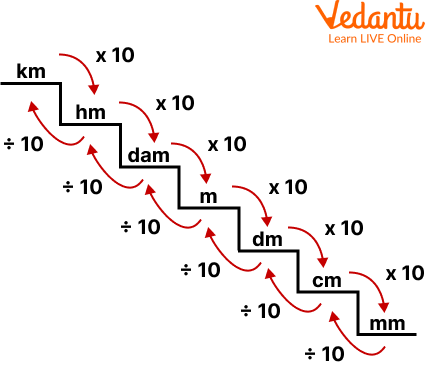
Conversion chart for length
1 cm = 10 mm
1 mm = 0.1 cm
1 m = 100 cm
1 cm = 0.01 m
1 km = 1000 m
1 m = 0.001 km
For Mass:
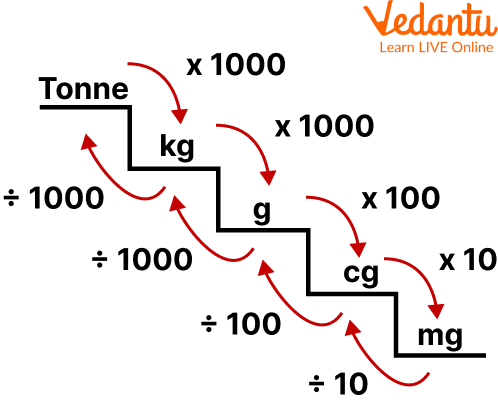
Conversion chart for mass
1 cg = 10 mg
1 mg = 0.1 cg
1 g = 100 cg
1 cg = 0.01 g
1 g = 1000 mg
1 mg = 0.001 g
1 kg = 1000 g
1 g = 0.001 kg
1 tonne = 1000 kg
1 kg = 0.001 tonne
For Capacity:
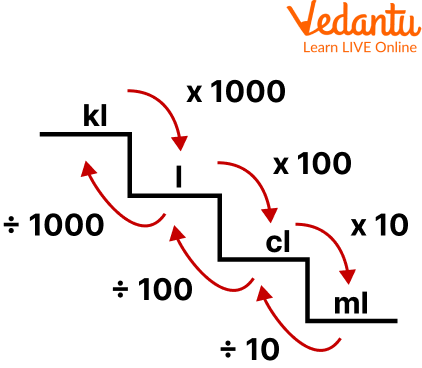
Conversion chart for capacity
1 cl = 10 ml
1 ml = 0.1 cl
1 l = 100 cl
1 cl = 0.01 l
1 l = 1000 ml
1 ml = 0.001 l
1 kl = 1000 l
1 l = 0.001 kl
Solved Examples
Q 1. Convert 2000 l into kl?
Ans: We are given a measurement in the form of litre i.e. $2000l$. As we know that
$1000 l=1 kl$. So we will divide the expression by 1000. So that we will convert them into expressions.
Step2: By simply following the unitary method, we will find the value:
If $1000 l=1 kl$
Then $1 l=\dfrac{1}{1000} kl$
Hence, the value of $2000 l=\dfrac{1 \times 2000}{1000}$
$=2 kl$
Hence the value is $2 kl$
Q 2. Convert 500 metres to kilometres.
Ans: Both metres and kilometres are metric system units of measuring distance. In $1 \mathrm{~m}$, there is $\dfrac{1}{1000} \mathrm{~km}$.
$\Rightarrow 1 \mathrm{~m}=\dfrac{1}{1000} \mathrm{~km}$
$\Rightarrow 500 \mathrm{~m}=\dfrac{500}{1000} \mathrm{~km}$
$\Rightarrow 500 \mathrm{~m}=\dfrac{1}{2} \mathrm{~km}=0.5 \mathrm{~km}$
Therefore, 500 metres equals half a kilometre or $0.5 \mathrm{~km}$.
Q 3: How many centigrams are there in 12 grams?
Ans: Centigrams and grams are the units of the metric system. In 1 gram, there are 100 centigrams.
$\Rightarrow 1 \mathrm{~g}=100 \mathrm{cg}$
$\Rightarrow 12 \mathrm{~g}=12 \times 100 \mathrm{cg}$
$\Rightarrow 12 \mathrm{~g}=1200 \mathrm{cg}$
Therefore, there are 1200 centigrams in 12 grams.
Practice Problems
Q 1. Convert 55 ml into l. (Ans: 0.055 l)
Q 2. Convert 21 kg 46 g into kilograms. (Ans: 21.046 kg)
Summary
As discussed above, The metric system of measurement is the most popular way to determine the height, distance, and other everyday items. The common measurement system that uses decimal values is the metric system. It uses powers of ten for unit conversions. The metric system of units can be used to measure length, weight, area, capacity, speed, distance, time, etc. In the metric system, length is measured in metres, centimetres, and kilometres; weight is measured in kilogrammes, milligrammes, and grammes; capacity is measured in litres, kiloliters, centilitres, and millilitres; and time is measured in hours, minutes, and seconds.
FAQs on Metric Conversion Chart for Length Mass and Capacity Units
1. What is a metric conversion chart?
A metric conversion chart is a table that shows how to convert between different units in the metric system, such as length, mass, and capacity. It is based on powers of 10, which makes conversions simple and systematic.
Common metric units shown in a chart include:
- Length: kilometre (km), metre (m), centimetre (cm), millimetre (mm)
- Mass: kilogram (kg), gram (g), milligram (mg)
- Capacity: litre (L), millilitre (mL)
2. How do you use a metric conversion chart?
To use a metric conversion chart, move the decimal point left or right depending on whether you are converting to a smaller or larger unit.
Steps:
- Identify the starting unit and the target unit.
- Count the number of steps between them on the chart.
- Move the decimal point:
- Right when converting to a smaller unit (multiply).
- Left when converting to a larger unit (divide).
3. What is the order of units in the metric system chart?
The standard order of units in a metric system chart follows prefixes based on powers of 10. For length, the order is:
- Kilometre (km)
- Hectometre (hm)
- Decametre (dam)
- Metre (m)
- Decimetre (dm)
- Centimetre (cm)
- Millimetre (mm)
4. How do you convert between metric units quickly?
You can convert between metric units quickly by using the rule: move the decimal point according to powers of 10.
Quick method:
- Count the number of places between units.
- Move the decimal that many places.
- 1 kg = 1000 g
- 0.75 × 1000 = 750 g
5. What is the formula for metric conversion?
The basic formula for metric conversion is: New Value = Given Value × (conversion factor).
The conversion factor is a power of 10 such as 10, 100, or 1000.
Example: Convert 4 m to mm.
- 1 m = 1000 mm
- 4 × 1000 = 4000 mm
6. How many millimetres are in a metre?
There are 1000 millimetres (mm) in 1 metre (m).
This is because:
- 1 m = 100 cm
- 1 cm = 10 mm
- So, 1 m = 100 × 10 = 1000 mm
7. What is the difference between metric and imperial units?
The main difference is that the metric system is based on powers of 10, while the imperial system uses non-decimal relationships.
Examples:
- Metric: 1 m = 100 cm
- Imperial: 1 foot = 12 inches
8. Can you give an example of converting kilometres to metres?
To convert kilometres to metres, multiply by 1000 because 1 km = 1000 m.
Example:
- Convert 2.8 km to m.
- 2.8 × 1000 = 2800 m
9. Why is the metric system based on powers of 10?
The metric system is based on powers of 10 to make calculations and unit conversions simple and consistent.
Because each unit differs by a factor of 10:
- Multiplying and dividing are easy.
- Decimal movement replaces complex fractions.
- It supports scientific notation and standard measurement.
10. What are common mistakes when using a metric conversion chart?
A common mistake when using a metric conversion chart is moving the decimal point in the wrong direction.
Other frequent errors include:
- Forgetting that smaller units require multiplying.
- Miscounting the number of steps between units.
- Confusing similar units like cm and mm.
