



Step by Step Method with Formula and Solved Examples
What Are Mixed Numbers?
Mixed numbers, also known as mixed fractions, are a combination of whole numbers and a proper fraction. The mixed number is partly a whole number and partly a fraction. The fractional part of a mixed number is always a proper fraction. For example, 534, 712, 723, etc are mixed numbers. Multiplying mixed numbers is similar to multiplying fractions. Here, we will learn the steps to multiply mixed numbers with the like denominators, unlike denominators, and whole numbers.
Parts of Mixed Number
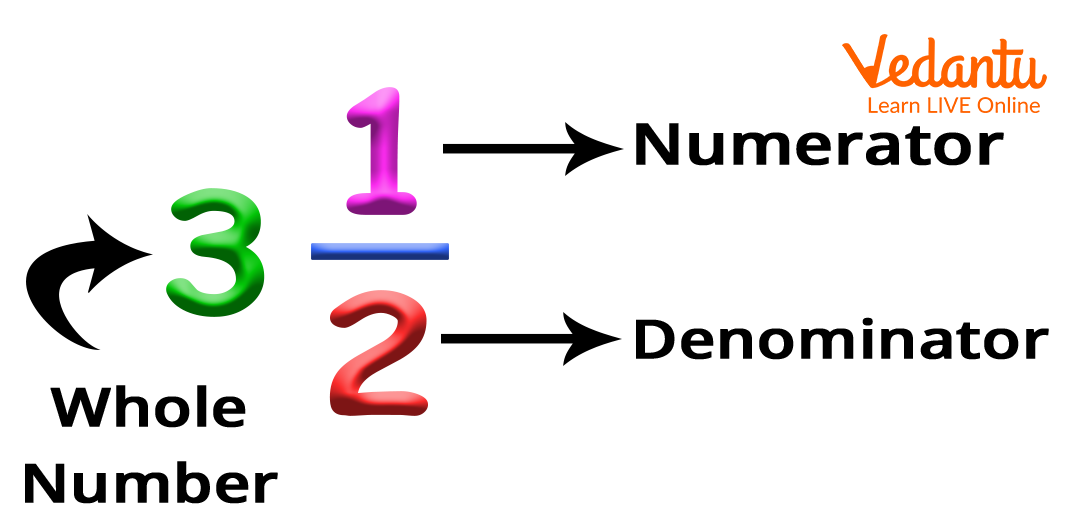
A mixed number is formed by combining three parts namely the whole number, a numerator, and a denominator. Look at the image given to understand the parts of mixed numbers in a better way.
How to Multiply Two Mixed Numbers with Like and Unlike Denominators?
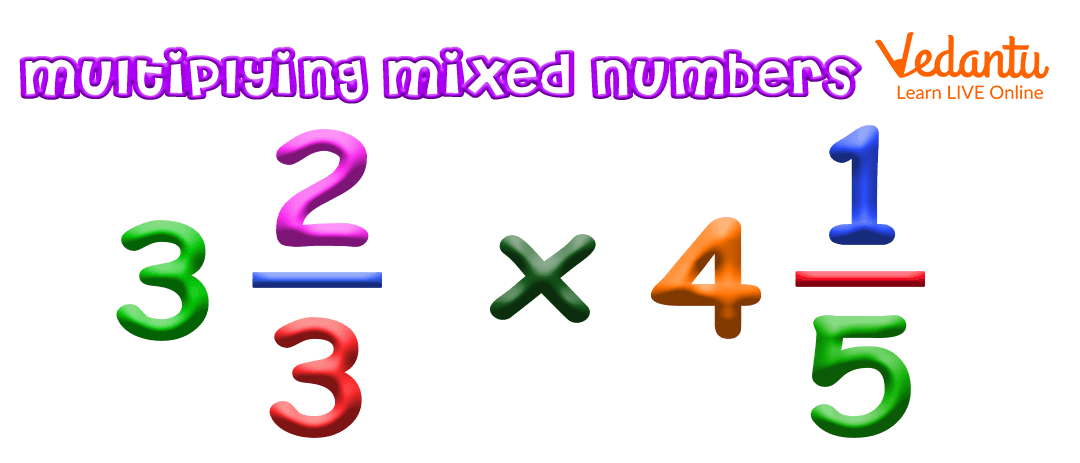
Two fractions with the same denominator are known as the like denominators. Contrarily, two fractions with different denominators are known as unlike denominators. The steps to multiply the mixed fractions remains the same irrespective of the like or unlike denominators. The 4 steps given below describes how to multiply mixed numbers with like and unlike denominators:
Step 1: Convert the given mixed numbers into improper fractions.
Step 2: Multiply first the numerators and and then the denominators of the improper fraction.
Step 3: Simplify the fraction or result obtained in the previous step in lowest terms if possible.
Step 4: Convert the result obtained back to the mixed number.
How to Convert a Mixed Number into an Improper Fraction?
To convert a mixed number into an improper fraction:
Multiply the whole number with the denominator of the proper fraction.
Add the numerator of the proper fraction to the product obtained in step 1.
The denominator of the improper fraction will be the same as the denominator of the proper fraction.
The resulting fraction will be an improper fraction.
Let us understand with an example:
Convert 512 into an improper fraction.
Solution:
Step 1: Multiplying the whole number with the denominator of the proper fraction.
5 2 = 10
Step 2: Adding the numerator of the proper fraction to the product obtained in step 1. Here, the numerator is 1. Accordingly, numerator of the improper fraction will be 10 + 1 = 11
Step 3: The denominator of the improper fraction will stay the same. Accordingly, the denominator will be 2.
Hence, 512 in improper fraction will be 112.
As we have understood how to convert mixed number to an improper fraction, let us now understand multiplying mixed number with an example:
Example on Multiplying Mixed Numbers with Like Denominators
What is 2 27 3 17 ?
Solution:
Step 1: Converting the mixed numbers into improper fractions, we have
2 27 = 2 7 + 27 = 167
3 17 = 3 7 + 17 = 227
Step 2: Multiplying the numerators and denominators of improper fractions obtained in step 1.
167 227 = 35249
Step 3: Converting the final result back into the mixed fraction. Accordingly, 35249 = 7949
Therefore, 2 27 3 17 = 7949
Example on Multiplying Mixed Numbers with Unlike Denominators
What is 1 23 2 34 ?
Solution:
Step 1: Converting the mixed numbers into improper fractions, we have
1 23 = 3 1 + 23 = 53
2 34 = 2 4 + 34 = 114
Step 2: Multiplying the numerators and denominators of improper fractions obtained in step 1.
53 114 = 5512
Step 3: Converting the final result back into the mixed fraction. Accordingly, 5512 = 4712
Therefore, 1 23 2 33 = 4712
How to Multiply Mixed Numbers with the Whole Number?
The steps on multiplying the mixed number with the whole number are discussed below:
Step 1: Convert the whole number into fraction assuming the denominator to be 1.
Step 2: Convert the given mixed numbers into improper fractions.
Step 3: Multiply the numerators and denominators of the fraction.
Step 4: Simplify the result or fraction obtained in the previous step in lowest terms if possible.
Step 5: Convert the result obtained back to the mixed number.
Let us understand with an example:
What is 216 3?
Solution:
Step 1: Converting the whole number into fraction assuming the denominator to be 1. Hence, 3 will be 31
Step 2: Converting the given mixed number into improper fraction gives: 216 = 136
Step 3: Multiplying the numerators and denominators of the fraction gives:
136 31 = 396
Step 4: Simplifying the fraction obtained in the previous step in lowest terms gives:
396 = 39 36 3 = 132
Step 5: Converting the result obtained back to the mixed number gives:
132 = 6 12
Therefore, 216 3 = 6 12
In short, multiplying mixed numbers with fractions is a four-step process. Here, first you have to convert a given mixed number into an improper fraction, multiply the numerator and denominator of the fraction. Simplify the result if possible and convert the result back to the mixed number.
FAQs on How to Multiply Mixed Numbers Easily
1. What does multiplying mixed numbers mean?
Multiplying mixed numbers means finding the product of numbers that contain both a whole number and a fraction. A mixed number has the form a b/c, where a is a whole number and b/c is a proper fraction. To multiply mixed numbers, you usually convert them into improper fractions first and then multiply the fractions. This process ensures accurate calculation and simplifies the steps.
2. How do you multiply mixed numbers step by step?
To multiply mixed numbers, convert them to improper fractions and then multiply normally. Follow these steps:
- Convert each mixed number to an improper fraction.
- Multiply the numerators together.
- Multiply the denominators together.
- Simplify the fraction if possible.
- Convert back to a mixed number if required.
Example: 1 1/2 × 2 1/3 = 3/2 × 7/3 = 21/6 = 7/2 = 3 1/2.
3. What is the formula for multiplying mixed numbers?
The formula for multiplying mixed numbers is to convert each into an improper fraction using (whole × denominator + numerator) / denominator, then multiply the fractions. In general:
- If a b/c = (a × c + b)/c
- Then multiply: (a × c + b)/c × (d × f + e)/f
Finally, simplify the result to its lowest terms.
4. Can you multiply mixed numbers without converting to improper fractions?
Yes, you can multiply mixed numbers directly, but converting to improper fractions is usually easier and less error-prone. The alternative method involves:
- Using the distributive property.
- Multiplying each part separately.
However, this method is longer and increases the chance of mistakes, so the standard method is to convert to improper fractions first.
5. How do you simplify when multiplying mixed numbers?
To simplify when multiplying mixed numbers, reduce the fractions before or after multiplying. You can:
- Cross-cancel common factors between numerators and denominators.
- Reduce the final fraction to its lowest terms.
Example: 2 1/4 × 3/5 = 9/4 × 3/5 = 27/20 = 1 7/20.
6. What is an example of multiplying mixed numbers?
An example of multiplying mixed numbers is 2 2/3 × 1 1/4 = 3 1/3. Here is the working:
- Convert: 2 2/3 = 8/3 and 1 1/4 = 5/4
- Multiply: 8/3 × 5/4 = 40/12
- Simplify: 40/12 = 10/3
- Convert: 10/3 = 3 1/3
7. Why do you convert mixed numbers to improper fractions before multiplying?
You convert mixed numbers to improper fractions because fractions are easier to multiply directly. Multiplication rules apply clearly to numerators and denominators, which avoids confusion. Converting first reduces mistakes and makes simplification straightforward.
8. What are common mistakes when multiplying mixed numbers?
Common mistakes when multiplying mixed numbers include forgetting to convert to improper fractions and not simplifying correctly. Other errors include:
- Multiplying whole numbers and fractions separately without using correct rules.
- Forgetting to simplify the final answer.
- Making arithmetic errors in multiplication.
Always check conversions and reduce the final product.
9. Do you need a common denominator to multiply mixed numbers?
No, you do not need a common denominator to multiply mixed numbers. Unlike addition or subtraction, multiplication only requires multiplying the numerators together and the denominators together. This makes multiplying fractions and mixed numbers simpler than adding them.
10. How do you multiply a mixed number by a whole number?
To multiply a mixed number by a whole number, convert the mixed number to an improper fraction and write the whole number as a fraction over 1. Steps:
- Convert: 3 1/2 = 7/2
- Write whole number: 4 = 4/1
- Multiply: 7/2 × 4/1 = 28/2
- Simplify: 28/2 = 14
So, 3 1/2 × 4 = 14.
