



Definition of Measure in Math with Formulas and Examples
Is milk the secret of your energy? Then, how many glasses of milk do you drink in a day? Two glasses, one in the morning and one at night. Good, that's like a champion.
Wait, what are you saying? You drink milk reluctantly. And, you are annoyed as we ask a question related to milk. My dear child, here are two points you have to remember:
Milk is good for your health.
‘Two glass’ is the “measure” of milk.
The question we have asked is to tell you what is called ‘measure’? To know more, read this complete article.
Definition of Measure
In general, the measure is the characteristic of any object, person, or activity in words, symbols, or units. 'Measure' is to find the height, weight, length, volume, and other parameters of any object.
For example: How old are you? Your answer probably is 6 or 7 years.
Here, the question is about your age. The measure is the characteristics that we obtain, here we obtain age. So, the measure is ‘age’.
To measure any characteristic, it is not necessary to have a defined unit.
For example: How much do you walk today? Two rounds of a park. So, here walking distance can be measured as two rounds of the park, which is not a unit in any defined format. But it is self-explanatory and used in day-to-day life.
A process to understand the characteristics of any object, person, or activity defined by using any standard units, symbols, or standard words is called ‘measure’.
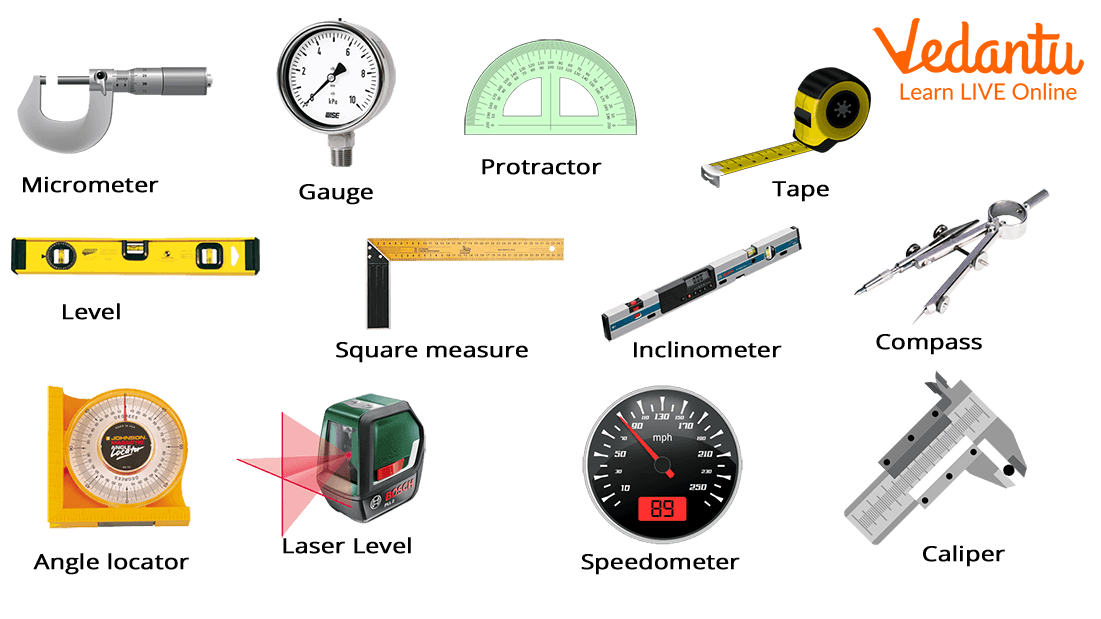
Measurement Devices
Factors of ‘Measure’
There are four factors to ‘measure’ any object, which are the following:
Object, Person, or Activity: For which or whom ‘measure’ is required.
For example:
What is the length of your pencil box? — Pencil box measure is required — An object.
What is the weight of your best friend? — Best friend measure is required — A person.
How much time does your mother take to make your favourite dish? — Favourite dish measure is required — An activity.
Characteristics of Object, Person, or Activity: It tells which characteristics of an object, person, or activity are to be ‘measured’.
For example:
What is the length of your pencil box? — Length measure is required.
What is the weight of your best friend? — Weight measure is required.
How much time does your mother take to make your favourite dish? — Time measure is required.
Tools and Devices: There are certain tools and devices required to ‘measure’ any characteristic of an Object, Person, or Activity.
For example:
What is the length of your pencil box? — Ruler is required.
What is the weight of your best friend? — Weight machine is required.
How much time does your mother take to make your favourite dish? — Stopwatch is required.
A Person: To ‘measure’ any characteristics of any object, person, or activity, a person is required. Though many devices are nowadays available to measure different activities, these devices are also operated by a person. Isn’t it?
Use of ‘Measure’ in Education
It is a well-defined process through which we can measure the utility of different factors of educational processes and the utility of the concerned person related to any process. By ‘measure’, we can find the intelligence, aptitude level, attitude, area of interest, and many other factors of students using a set of standard and non-standard predefined units.
How to ‘Measure’ in Education?
There are a few steps that are used to ‘measure’ in education, which are the following:
To define the measuring traits and objectives.
To select the suitable measurement method or tool.
Use the measurement tools and methods aptly.
To analyse results and records.
Conclusion
'Measure' is a very important term in Mathematics. It is used to evaluate the performance of any object, person, or activity from a different perspective. There are various factors used to measure. Also, ‘measure' is widely used in the field of Education. Nowadays, artificial intelligence (AI) is widely used to evaluate the performance of students. AI also helps to increase the reasoning ability of children.
FAQs on What Is Measure in Mathematics
1. What is measure in mathematics?
In mathematics, measure is a way of assigning a numerical value to describe the size, length, area, volume, or probability of a set or object. It tells us how big or how much of something there is.
- Examples include length (measured in meters), area (square units), and volume (cubic units).
- In advanced mathematics, measure theory generalizes these ideas to more complex sets.
2. What is a measure of an angle?
The measure of an angle is the amount of rotation between two rays, usually expressed in degrees or radians. It tells how wide an angle is.
- A full turn equals 360° or 2π radians.
- A right angle measures 90°.
- Example: If an angle measures 45°, it is half of a right angle.
3. What is measure in geometry?
In geometry, measure refers to the numerical value of geometric quantities like length, area, volume, or angle. It helps describe the size or extent of shapes.
- Line segments have length.
- Polygons have area.
- Solids have volume.
4. What is a measurable set?
A measurable set is a set for which a consistent numerical measure (such as length, area, or probability) can be assigned. It follows the rules of measure theory.
- If a set has length 5 units, it is measurable.
- In probability, measurable sets are called events.
5. What is the difference between length and measure?
The length is a specific type of measure, while measure is a broader concept that includes length, area, volume, and more.
- Length measures one-dimensional distance.
- Area measures two-dimensional space.
- Volume measures three-dimensional space.
6. How do you measure the area of a shape?
To measure area, use the formula that matches the shape and substitute the correct dimensions. Area is measured in square units.
- Rectangle: Area = length × width
- Triangle: Area = ½ × base × height
- Circle: Area = πr²
7. What is measure theory in mathematics?
Measure theory is a branch of mathematics that studies how to systematically assign a measure to sets, generalizing ideas of length, area, and volume. It forms the foundation of modern probability and integration.
- It defines properties like non-negativity and countable additivity.
- It is used in defining the Lebesgue integral.
8. What are the properties of a measure?
A mathematical measure satisfies three main properties: non-negativity, null empty set, and countable additivity.
- Non-negativity: Measure is always ≥ 0.
- Empty set has measure 0.
- Countable additivity: The measure of disjoint sets equals the sum of their measures.
9. What units are used to measure length, area, and volume?
Length, area, and volume are measured using different units based on dimension.
- Length: meters (m), centimeters (cm)
- Area: square meters (m²), square centimeters
- Volume: cubic meters (m³), liters
10. Can you give an example of measure in real life?
A real-life example of measure is calculating the area of a room to determine how much flooring is needed. If a room is 8 meters long and 5 meters wide, its area is 40 m².
- This helps estimate material cost.
- Other examples include measuring distance traveled or water volume in a tank.
