



Download FREE PDF of NCERT Solutions for Class 11 Geography Chapter 5 Natural Vegetation
1. Choose the right answer from the four alternatives given below.
(i) Sandalwood is an example of:
(a) Evergreen forest
(b) Deciduous forest
(c) Deltaic forest
(d) Thorny forest
Answer: (b)Deciduous forests
(ii) Which one of the following was the purpose of Project Tiger?
(a) to kill tigers
(b) to put tigers in the Zoo
(c) to protect tigers from illegal hunting
(d) to make films on tigers
Answer: (c) To protect tigers from illegal hunting
(iii) In which one of the following states is the Nandadevi Biosphere reserve situated?
(a) Bihar
(b) Uttar Pradesh
(c) Uttarakhand
(d) Odisha
Answer: (c) Uttarakhand
(iv) How many of the Biosphere reserves from India are recognised by the UNESCO?
(a) One
(b) Two
(c) Twelve
(d) Four
Answer: (d) Four
(v) Which one of the following proportion of area of the country was targeted to be under forest in Forest Policy of India?
(a) 33
(b) 44
(c) 55
(d) 22
Answer: (a) 33
2. Answer the following questions in about 30 words.
(i) What is natural vegetation? Under what climatic conditions are tropical evergreen forests develop?
Answer: Natural vegetation refers to plant life that grows naturally in a region without significant human interference and adapts to the local climate and soil conditions over time.
Tropical evergreen forests develop in hot, humid areas that receive more than 200 cm of annual rainfall and have average temperatures above 22°C. In India, these forests are mainly found in the Western Ghats, the North-Eastern states, and the Andaman and Nicobar Islands.
(ii) What do you understand by social forestry?
Answer: Social forestry is the practice of managing, protecting, and planting trees on community lands and barren areas to meet environmental, social, and rural development needs. It helps improve ecological balance and provides resources such as fuelwood and fodder. Social forestry is broadly classified into urban forestry, rural forestry, and farm forestry.
(iii) Define Biosphere reserves?
Answer: Biosphere Reserves are large protected areas that conserve unique ecosystems, biodiversity, and natural habitats. Recognised under UNESCO’s Man and Biosphere (MAB) Programme, they promote conservation, sustainable development, and scientific research while maintaining a balance between humans and the environment.
(iv) What is the difference between forest area and forest cover?
Answer: Forest area refers to land officially recorded as forest by government authorities, regardless of whether trees are present. Forest cover, on the other hand, represents the actual area covered by forests and tree canopies. Forest area is determined through official land records, whereas forest cover is assessed using satellite imagery and aerial surveys.
3. Answer the following questions in not more than 150 words.
(i) What steps have been taken up to conserve forests?
Answer: Several measures have been introduced to conserve forests and maintain ecological balance. One of the most important initiatives is social forestry, which focuses on afforestation and forest protection to support environmental and rural development. It includes:
Urban Forestry: Planting and managing trees in urban areas such as parks, roadsides, green belts, and industrial zones.
Rural Forestry: Encouraging tree plantation in rural regions through agro-forestry and community-based forestry programmes.
Farm Forestry: Promoting the cultivation of trees alongside crops to produce timber, fuelwood, fodder, and fruits.
Another important measure is community forestry, where trees are planted and managed on community lands such as village commons, canal banks, roadsides, and school premises.
In addition, farm forestry encourages farmers to grow trees on their private lands, with support from state forest departments through the distribution of free seedlings. These initiatives help increase forest cover and ensure the sustainable use of forest resources.
(ii) How can people’s participation be effective in conserving forests and wildlife?
Answer:
People’s participation plays a crucial role in the conservation of forests and wildlife.
Since human activities such as deforestation, illegal hunting, and poaching are major threats to biodiversity, public awareness and cooperation are essential for protecting natural resources.
To safeguard wildlife, the Government of India enacted the Wildlife Protection Act, 1972, which prohibits hunting and provides legal protection to endangered species.
The Act also supports the establishment and management of protected areas such as national parks and wildlife sanctuaries.
It was further strengthened by amendments that imposed stricter penalties and improved conservation efforts.
While government policies provide the framework for protection, their success depends largely on active public involvement.
By participating in conservation programmes, protecting natural habitats, and promoting sustainable practices, people can significantly help preserve forests and wildlife for future generations.
Project/Activity
1. On the outline map of India, mark and label the following.
(i) Areas having Mangrove forests.
(ii) Biosphere reserves of Nanda Devi, Sunderbans, Gulf of Mannar and Nilgiri.
(iii) Mark the location of Forest Survey of India Head Quarter.
Answer:
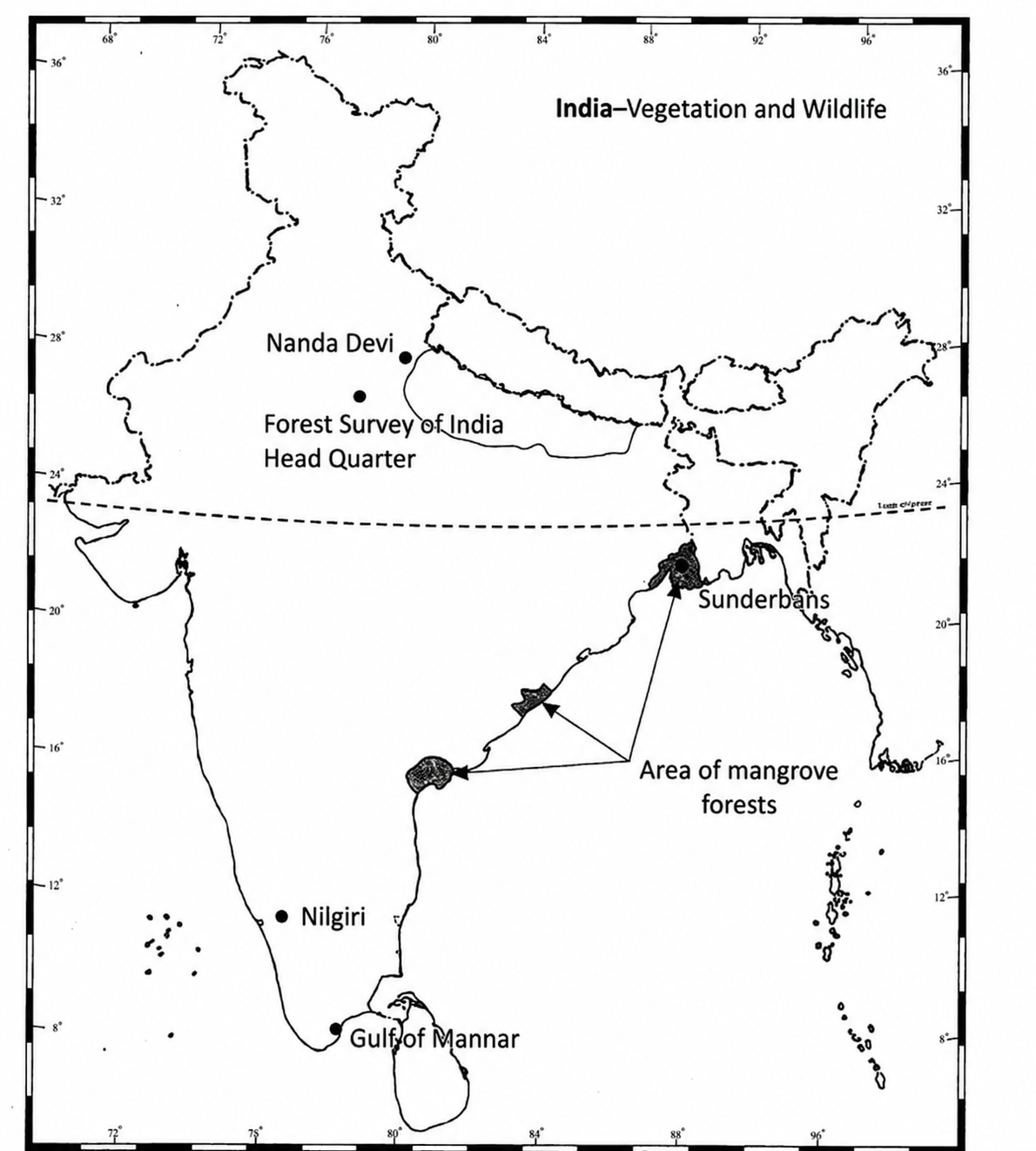
2. List the trees, bush and shrub species found around your school. Write their local names and their uses.
Answer: Students should use maps, atlases, local observations, and other relevant resources to complete these activity-based questions independently and develop a better understanding of natural vegetation and forest resources.
Key Takeaways from Class 11 Geography Chapter 5 Natural Vegetation
Grasping the basics of Natural Vegetation helps students build a strong foundation for advanced Geography topics. Focusing on forest types, their distribution, and the factors affecting vegetation growth makes learning more relevant and effective for board exams.
Make sure to cover key areas like tropical evergreen and deciduous forests, mangroves, wildlife conservation, and biosphere reserves. Regularly reviewing NCERT solutions for Class 11 Geography India Physical Environment Chapter 5 increases understanding and boosts confidence for the upcoming 2026 exams.
Practice answering questions in your own words, and focus on conceptual clarity. This habit not only sharpens your knowledge but also helps you excel in both written and objective questions in your assessments.
CBSE Class 11 Geography India Physical Environment Chapter 5 Study Materials
Explore More NCERT Solutions for Class 11 Geography Chapters
Related Study Material for Class 11 Geography
FAQs on NCERT Solutions for Class 11 Geography India Physical Environment Chapter 5 Natural Vegetation 2026-27
1. What is natural vegetation from Class 11 Geography Chapter 5?
Natural vegetation refers to plant communities that grow naturally in an area without human interference and adapt to the local climate and soil conditions.
2. What are the major types of natural vegetation found in India?
India has five major types of natural vegetation: Tropical Evergreen Forests, Tropical Deciduous Forests, Tropical Thorn Forests, Mountain Forests, and Mangrove Forests.
3. Why are mangrove forests important from the NCERT Solutions Class 11 Geography Chapter 5?
Mangrove forests protect coastlines from erosion, support marine ecosystems, and act as natural barriers against cyclones and tidal waves.
4. Which factors affect the distribution of natural vegetation in India?
Climate, rainfall, temperature, soil type, altitude, and relief features are the key factors influencing natural vegetation.
5. Why is forest conservation important, NCERT Solutions Class 11 Geography Chapter 5 Natural Vegetation?
Forest conservation helps maintain ecological balance, preserve biodiversity, prevent soil erosion, and regulate the climate.
6. Why is Geography important for Class 11 students?
Geography helps students understand the relationships among humans, the environment, natural resources, and the physical processes that shape the Earth.
7. How can maps and diagrams improve Geography learning?
Maps and diagrams make geographical concepts easier to understand, improve spatial awareness, and help students perform better in examinations.
8. Why should students refer to NCERT Solutions for Class 11 Geography?
Vedantu’s NCERT Solutions provide accurate answers, clear explanations, and step-by-step guidance based on the latest CBSE syllabus.
9. Are NCERT Solutions enough for CBSE Class 11 Geography exam preparation?
Yes, NCERT Solutions cover all textbook questions and important concepts, making them an essential resource for exam preparation and revision.
10. How do NCERT Solutions for Class 11 Geography Chapter 5 Natural Vegetation help students?
These solutions simplify complex topics, improve conceptual understanding, strengthen answer-writing skills, and help students prepare effectively for exams.
