



Exercise-wise Step-by-Step Answers for Measuring Length (Class 4 Maths)
NCERT Textbook Page 80 – Let us Observe
Question 1.
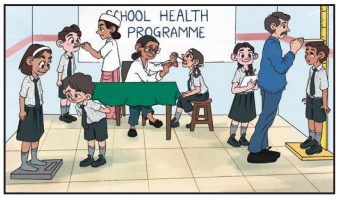
Look at the picture. What are the students measuring? Put a tick mark (/) if you find it being measured.
(a) Length
(b) Height
(c) Weight
(d) Depth
(e) Breadth
(f) Temperature
Solution:
(a) Length
(b) Height ✓
(c) Weight ✓
(d) Depth
(e) Breadth
(f) Temperature ✓
The students in the picture are measuring height, weight and temperature. So, the correct options are (b), (c) and (f).
Question 2.
What is being used to measure the height? What other tools can be used to measure height?
Solution:
The students measured the height using a scale. Other tools that can be used to measure height include a tape and a metre stick.
Question 3.
Recall in Grade 3 you studied that lengths are measured in metres. Check and fill in the blanks whether the following are correct/ incorrect for your classroom.
(a) The height of most of the students in my grade is more than a metre.
(b) The length of my arm is less than a metre.
(c) The height of the door of the grade is less than a metre.
(d) The breadth of the blackboard is more than a metre.
Solution: (a) Most students are taller than one metre, so the statement is true.
(b) The average length of a student’s arm is usually less than one metre, so this statement is also true.
(c) Classroom doors are generally about two metres or taller, so the statement is false.
(d) Blackboards are usually wider than one metre, so the statement is true.
NCERT Textbook Pages 81-82 – Let Us Do
Use your ropes to carry out the following activities. You can use a combination of ropes if
needed.
Solution:
Students should do it by themselves.
NCERT Textbook Page 83 Let Us Think: Guess the Length
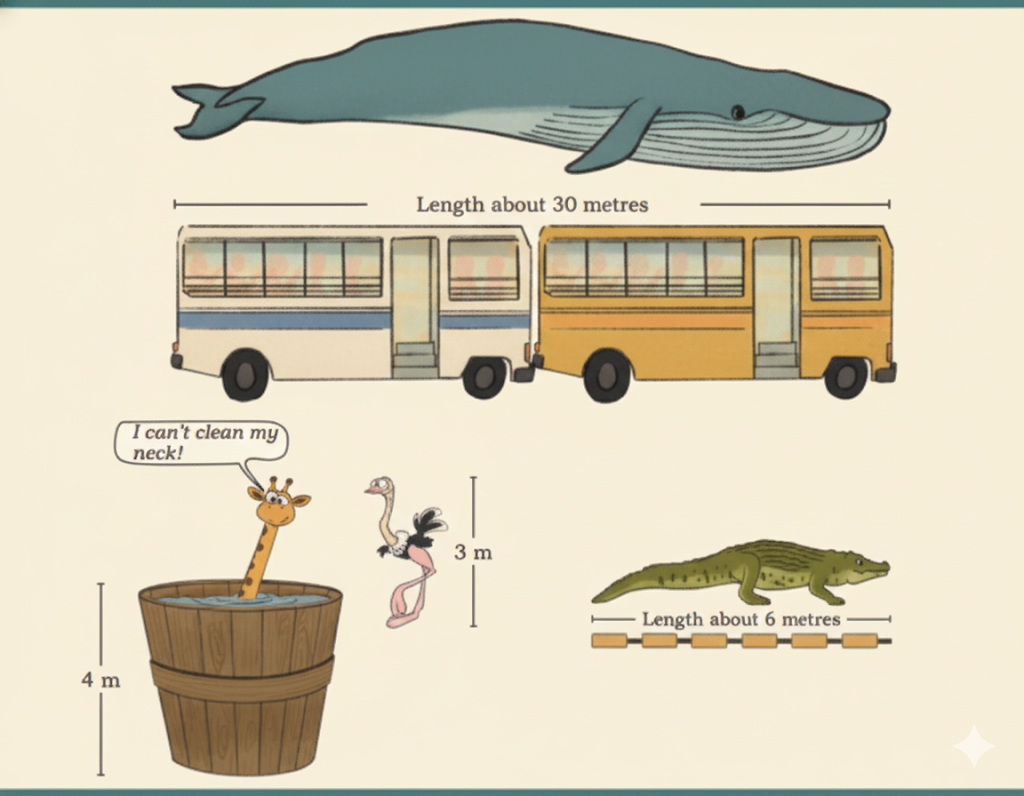
Look at all the pictures carefully and answer the questions.
Question 1.
What is the length of one bus in metres? What is the length of one cricket bat in metres?
Solution:
We are given that the total length of two buses is 30 metres.
So, the length of one bus is $\dfrac{30}{2}= 15$ metres.
We are also told that the total length of six cricket bats is 6 metres.
So, the length of one cricket bat is $\dfrac{6}{1}= 1$ metre.
Question 2.
How many buses would be equal to the length of two blue whales?
Solution: In the given picture, one blue whale is equal in length to two buses.
So, the length of two blue whales is equal to (2 x 2 = 4) buses.
Question 3.
How many cricket bats will be needed to measure one whale?
Solution: In the given pictures, the whale is 30 metres long.
From Question 1, the length of one cricket bat is 1 metre.
So, the number of cricket bats needed to measure the whale is (1 $$\times 30$$ = 30) bats.
Question 4.
If two ostriches stand one above another, their height will be equal to the height/length of.
Solution:
The height of one ostrich is 3 m.
So, the height of two ostriches is ($3 \text{ m} + 3 \text{ m} = 6 \text{ m}$).
From the given picture, the length of the crocodile is also 6 m.
Therefore, the height of two ostriches is equal to the length of one crocodile.
Question 5.
How many crocodiles will be equal to the length of a blue whale? ’
Solution:
The lengths of a crocodile and a blue whale are given as 6 metres and 30 metres, respectively.
Number of crocodiles = $\dfrac{\text { Length of Blue Whale }}{\text { Length of One Crocodile }}=\dfrac{30}{6}$
= 5
Hence, 5 crocodiles will be equal to the length of one blue whale.
NCERT Textbook Pages 85-89 Let Us Do
Question 1.
Measure each object using a scale.
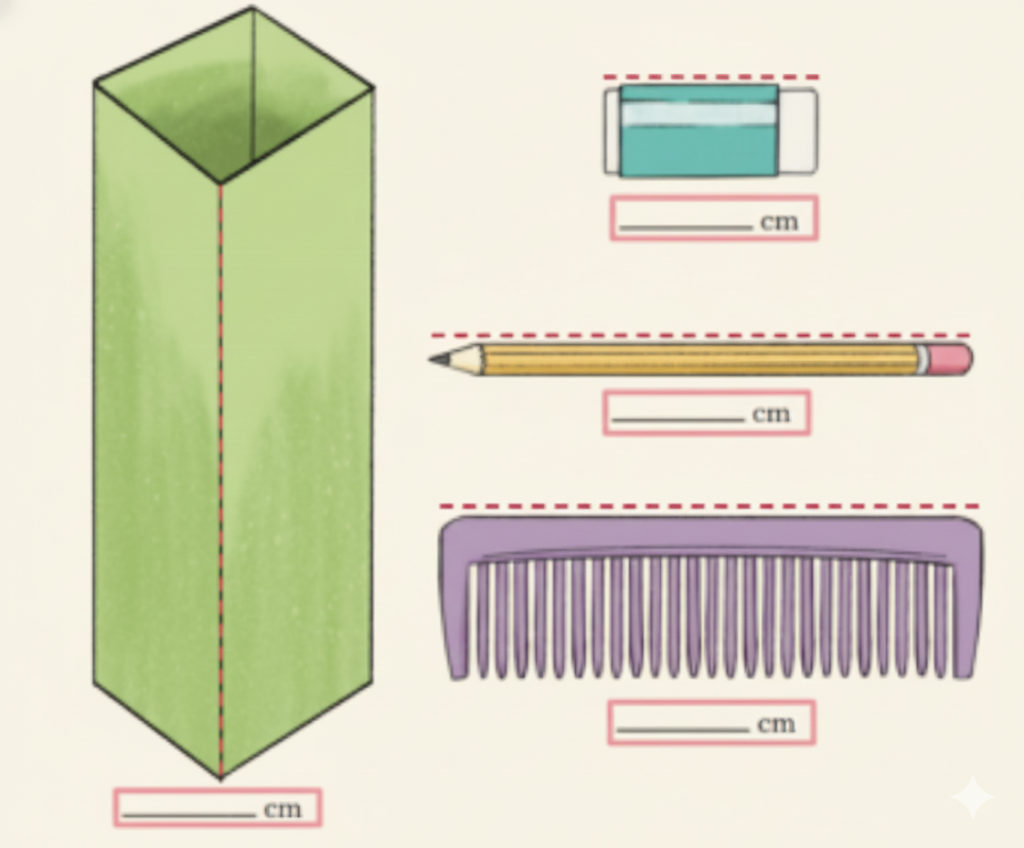
Write the names of the objects in increasing order of length.

Solution:
Students should do it by themselves.
Question 2.
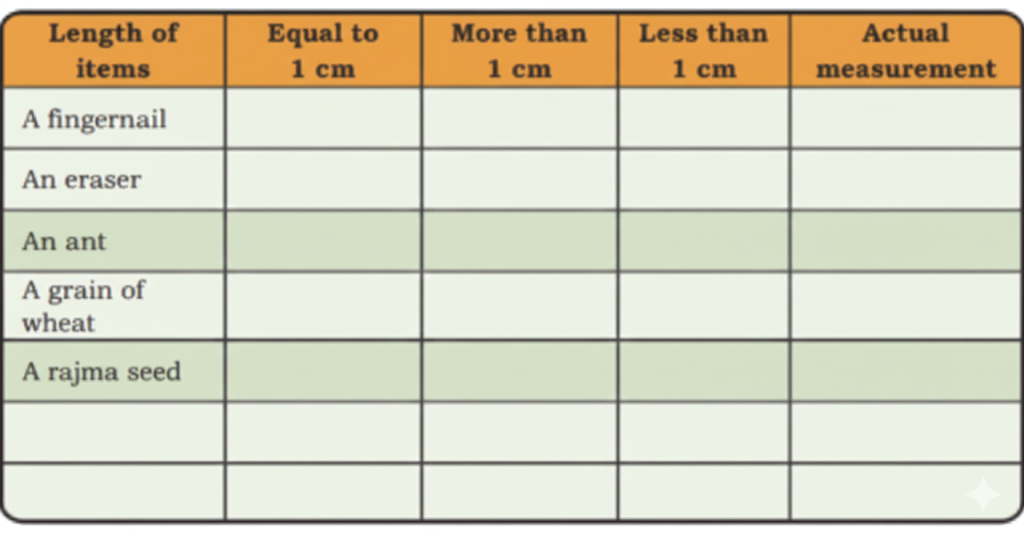
Estimate the lengths of the following and compare your responses with your friends, in the grade . Write some examples of things that can be lesser than or equal to 1 cm in length. Verify by measuring.
Solution:
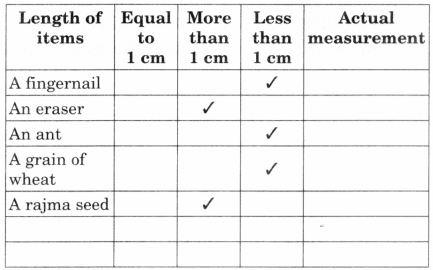
Students should do it by themselves.
Question 3.
Take three toy cars and find out how far each one can go. You can use a small wooden ramp, or you might like to make a ramp using any material that you have.
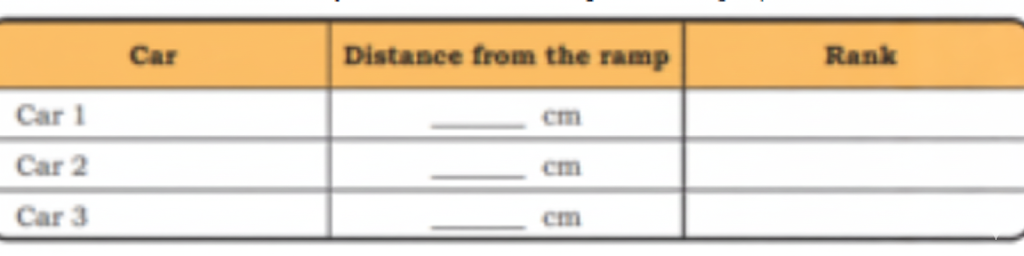
Solution:
Students should do it by themselves.
Question 4.
Find the longest and the shortest route in this treasure hunt. You can go around the obstacles but cannot jump over them. You can only walk on the yellow tiles and not on the grass. Can you find the length of your route in centimetres? Look for the 1 cm clue in the map.
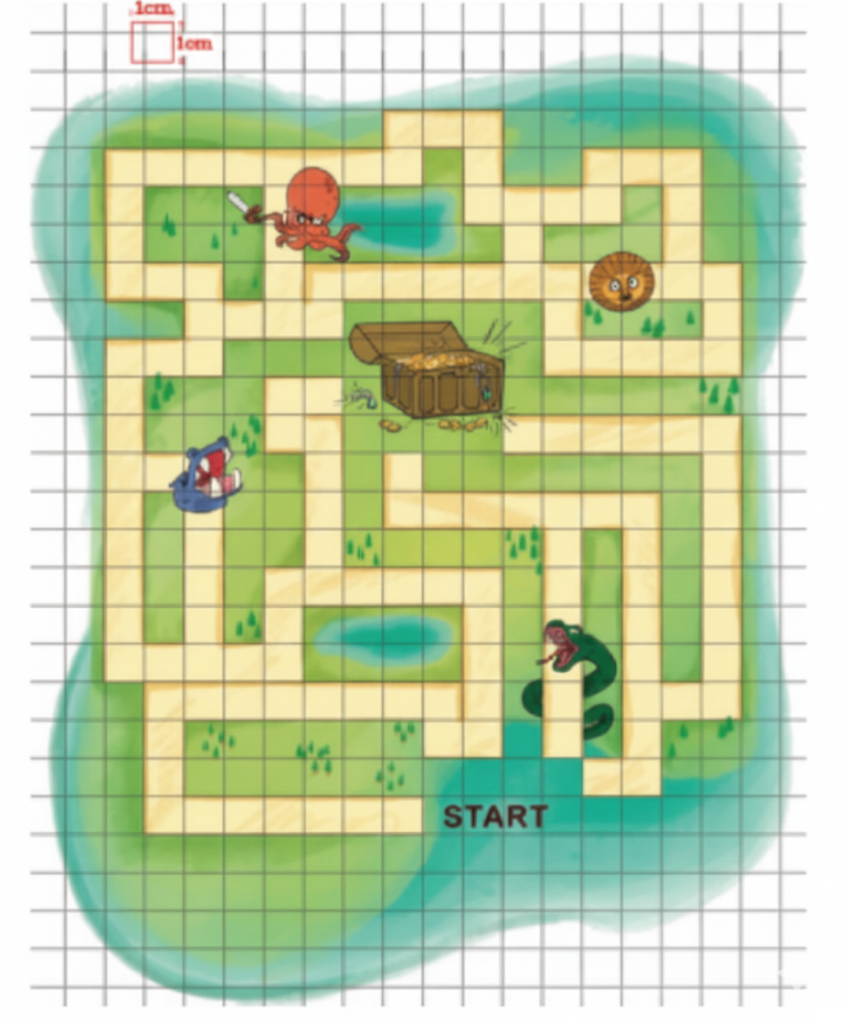
Solution:
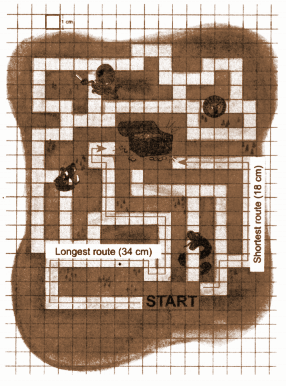
Question 5.
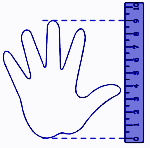
Trace your hand on a piece of paper. Measure it using the scale.
Length of my hand = ________ cm
Solution:
Students should do it by themselves.
Question 6.
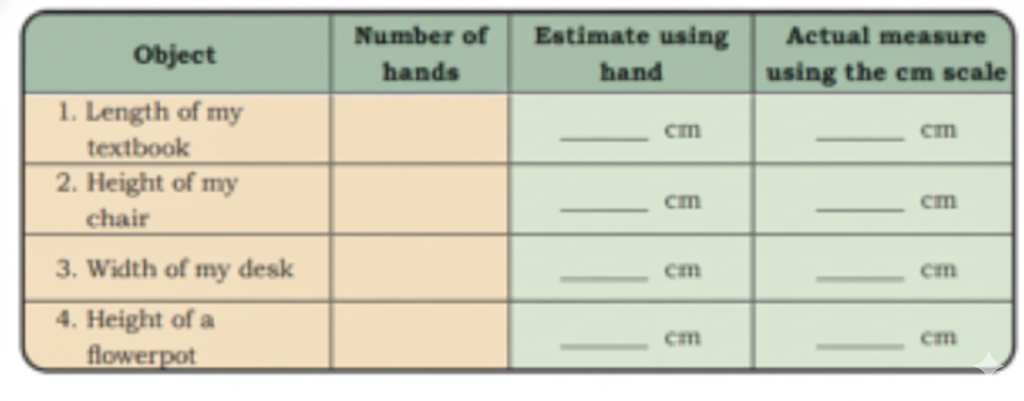
Use your hand to estimate the measurement of any object. Convert into centimetres. Verify using the scale.
Solution:
Students should do it by themselves.
Question 7.
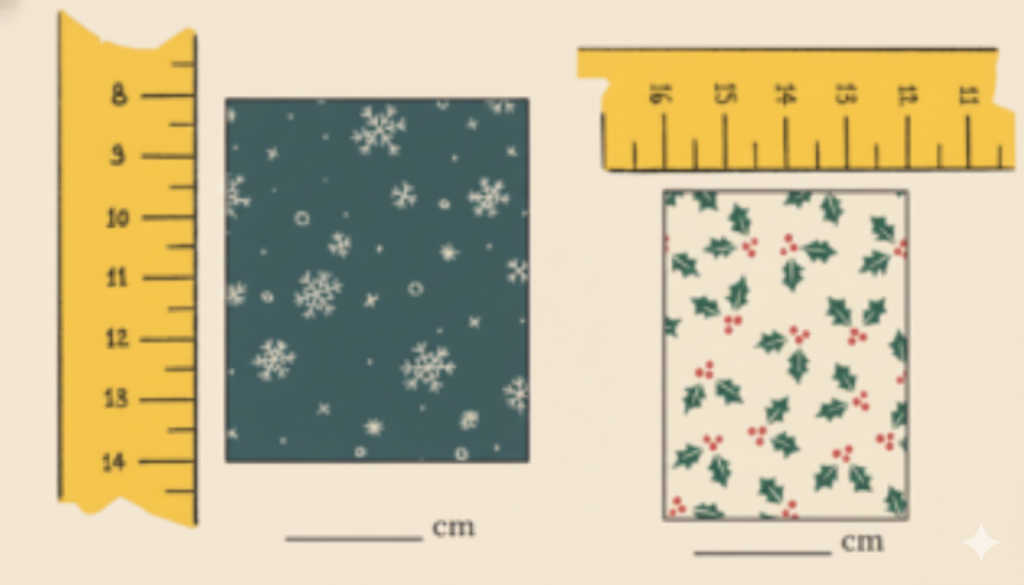
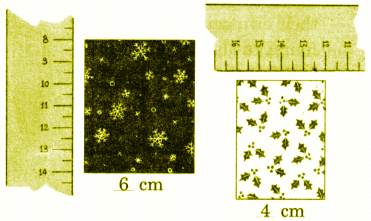
Ashwin’s scale is broken. Can you help him to measure using this scale?
Solution:
Question 8.
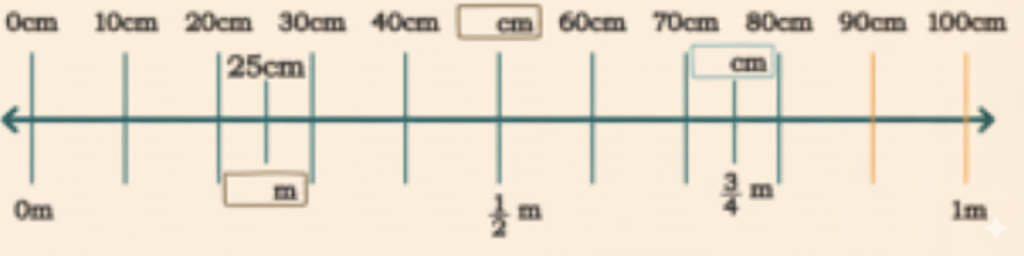
Fill the blanks on the number line below appropriately.
Solution:
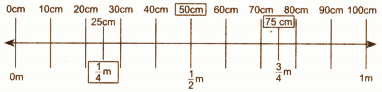
To convert cm to m, we must divide the centimetres by 100. Also, to convert m to cm, we multiply the meters by 100.
In the picture, we have given 25 cm, and we have to write this in m.
25 cm = \(\dfrac{25}{100}\) m = \(\dfrac{1}{4}\) m
Now, convert \(\dfrac{1}{2}\) m into cm.
\(\dfrac{1}{2}\) m = \(\dfrac{1}{2}\) × 100 cm = 50 cm
Now, convert \(\dfrac{3}{4}\) m into cm.
\(\dfrac{3}{4}\) m = \(\dfrac{3}{4}\) × 100 cm = 75 cm
Question 9.
The length of a board is 2 metres. Sonu has a decorative border sticker which is 20 cm long. How many such stickers are needed to cover the length of the board completely?

Solution:
Length of the board = 2 metres
Length of one decorative sticker = 20 cm
Since 1 metre = 100 cm,
2m = 2 × 100 cm – 200 cm
Required number of stickers needed to cover the length of the board = \(\dfrac{200 \mathrm{~cm}}{20 \mathrm{~cm}}\) cm = 10
Hence, 10 stickers are needed to cover the board completely.
NCERT Textbook Page 89 – Metres and Centimetres
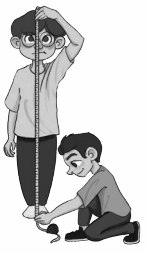
Ramu and Shamu are using measuring tape to measure their own height.
Ramu reads his height from the tape as 120 cm and Shamu reads it as 1 m 20 cm. Who is correct?
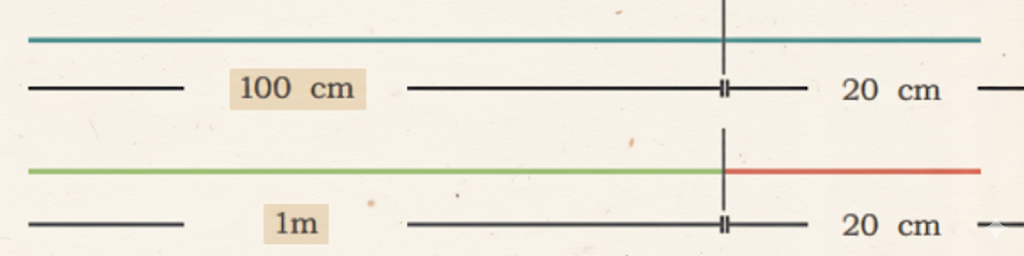
Pinki says both are correct and draws this.
Solution:
Ramu’s height is 120 cm.
Shamu’s height is 1 m 20 cm.
Since 1 metre equals 100 cm, we convert Shamu’s height into centimetres:
$(1 \text{ m } 20 \text{ cm} = 100 \text{ cm} + 20 \text{ cm} = 120 \text{ cm})$.
Both measurements are equal.
So, Pinki is correct because Ramu and Shamu have given the same height using different units.
NCERT Textbook Page 90 – Let Us Do
Question 1.
The Village Sarpanch got the depth of some wells in his village measured by two different people.
(a) Fill in the blanks such that the depths are the same.
i) 2 m = 200 cm
ii) __ m = 400 cm
iii) 6 m = ____cm
iv) __ m = 800m
Solution:
(i) 2 m = 2 × 100 cm = 200 cm
(ii) 4 m = 4 × 100 cm = 400 cm
(iii) 6 m = 6 × 100 cm = 600 cm
(iv) 8 m = 8 × 100 cm = 800 cm
(b) Identify the wells with the same depth and match them.
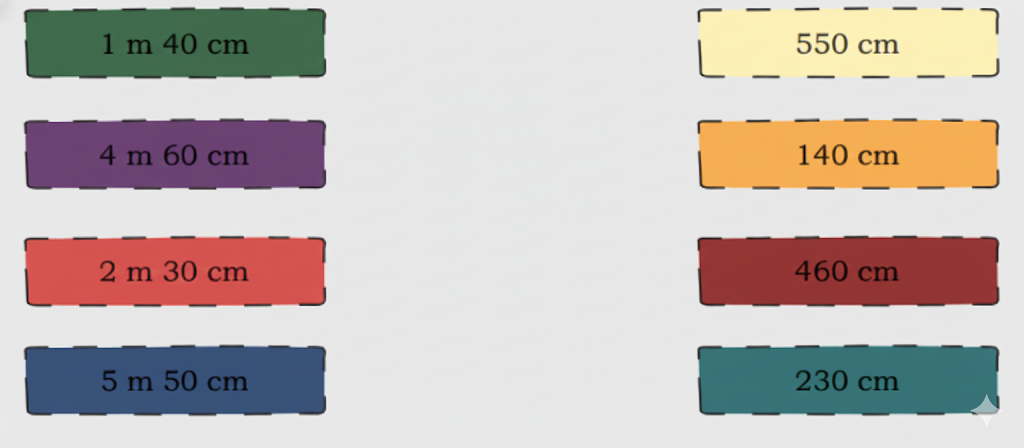
Solution:
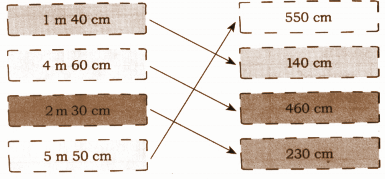
NCERT Textbook Pages 90-91 – Let Us Explore
Activity: Students will measure their height using a measuring tape. Make a table in your notebook and complete it.
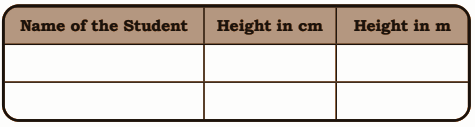
Answer the following questions.
1. Height of the tallest child is ________
2. Height of the shortest child is ________
3. Number of children who are more than 1 m tall ________.
4. Number of children who are shorter than 1 m
Solution:
Students should do it by themselves.
NCERT Textbook Page 91 – Fencing and Lacing
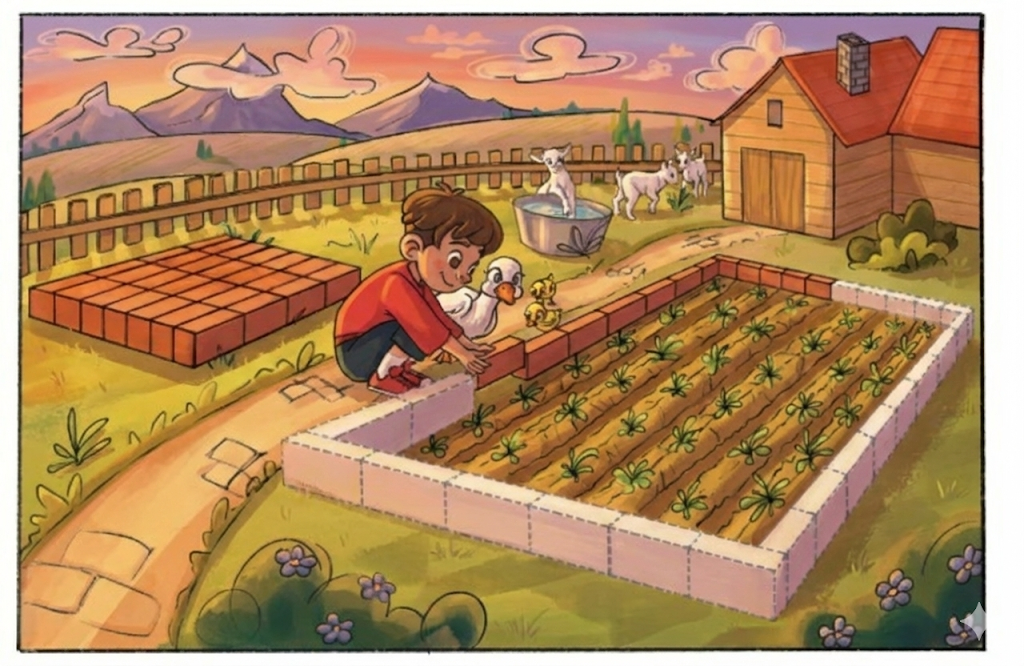
Bhola is making a boundary with bricks for his vegetable garden. Colour the bricks on the boundary. How many bricks will he need to make the boundary?
Solution:
Another 21 bricks are required to complete the boundary.
NCERT Textbook Pages 92-94 Let Us Do
Question 1.
Bhola made the boundary of his gardens in the following ways. Circle the boundary that is longest.
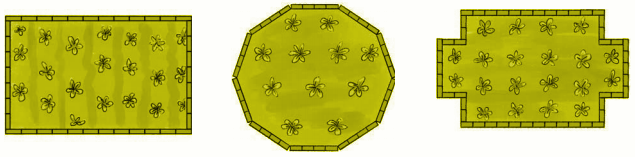
Solution:
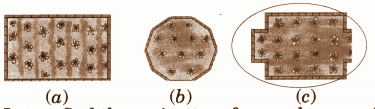
Among the given pictures, image (e) has the longest boundary, using 50 bricks.
Question 2.
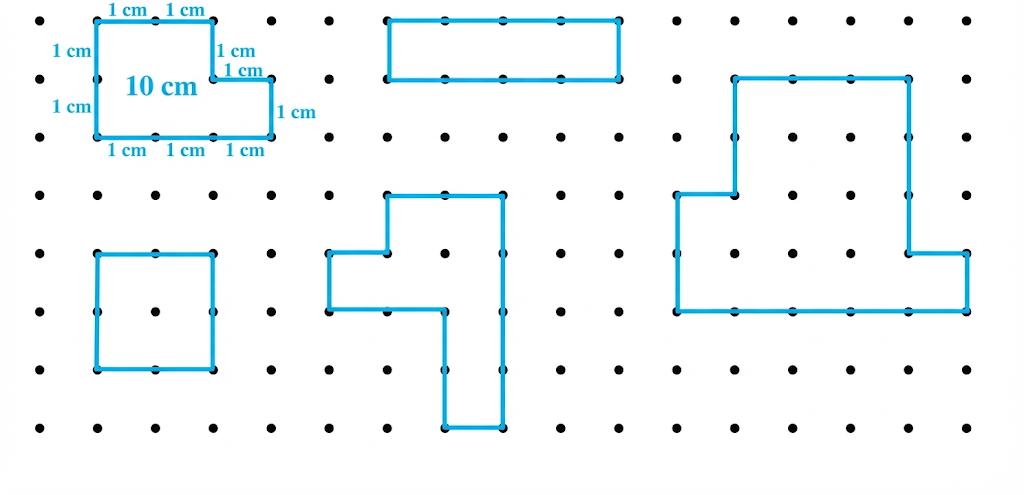
Let us find the perimeter of some shapes using the dot grid. One is done for you.
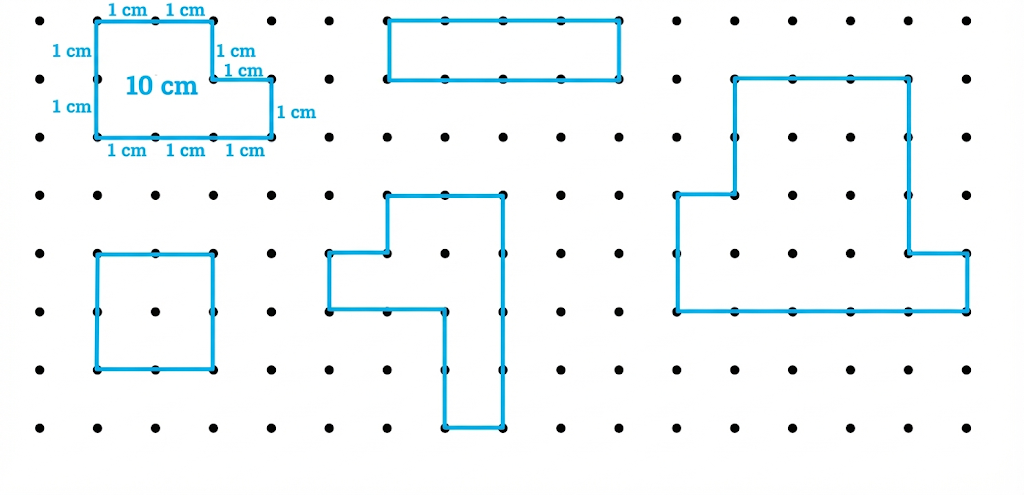
(a) Colour the boundary with the longest length in blue.
(b) Colour the boundary with the shortest length in green.
(c) Tick the shapes with the same length.
Solution:
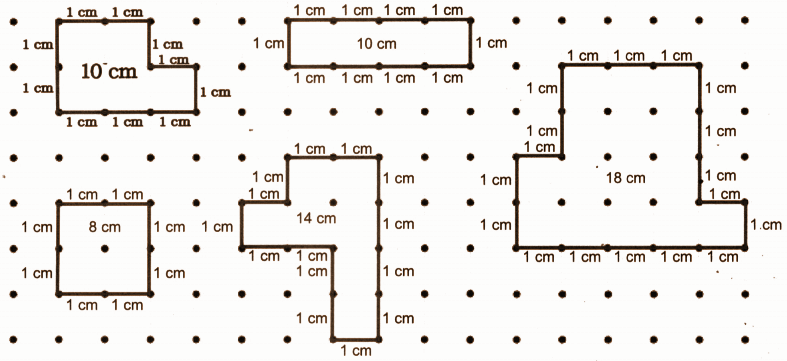
(a) – (c) Students should do it by themselves.
Question 3.
Do any of the following shapes have the same perimeter? Tick them
Solution:
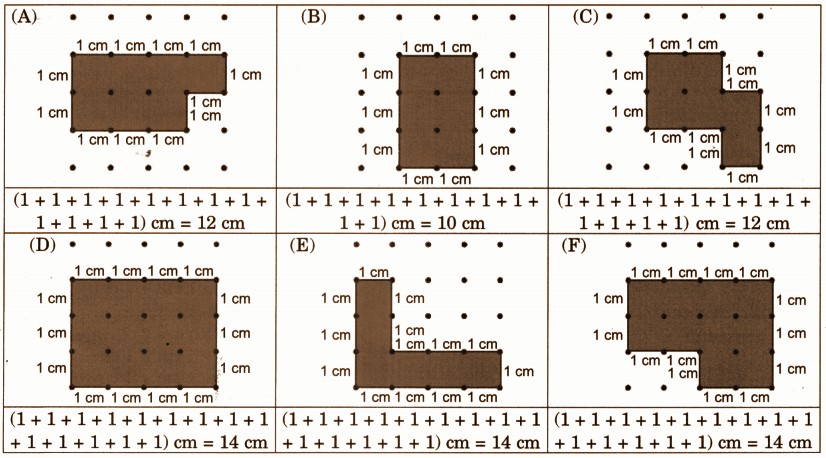
We can see that figures A and C have the same perimeter. Also, figures D, E and F have the same perimeter.
Question 4.
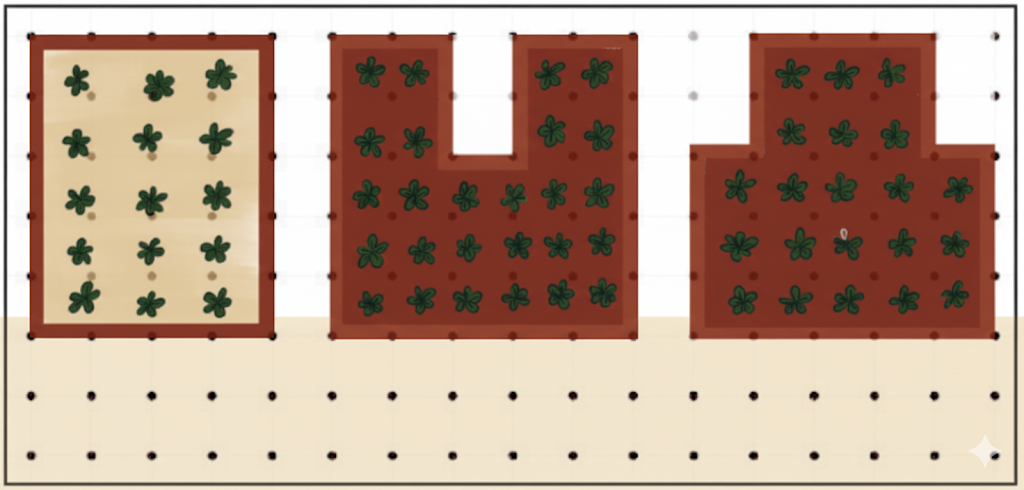
Tick the garden with the minimum perimeter.
Solution:
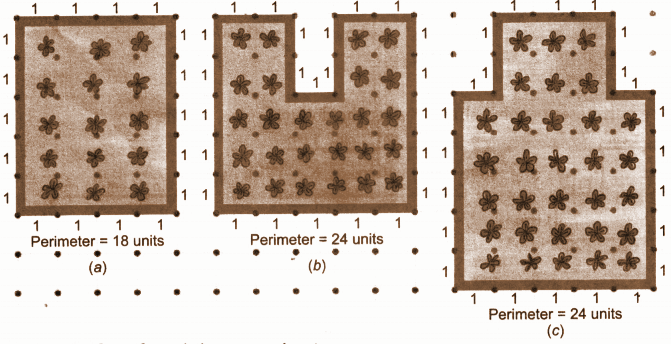
Garden (a) has the minimum perimeter.
Question 5.
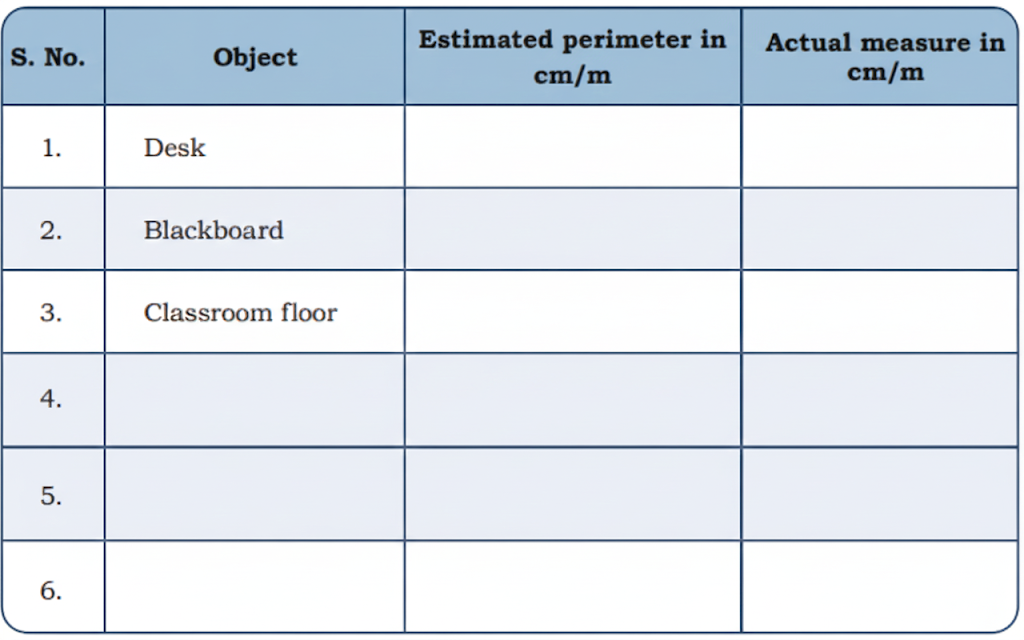
Estimate and measure the perimeter of shapes around you using a scale and write in the space given below.
Solution:
Students should do it by themselves.
Question 6.
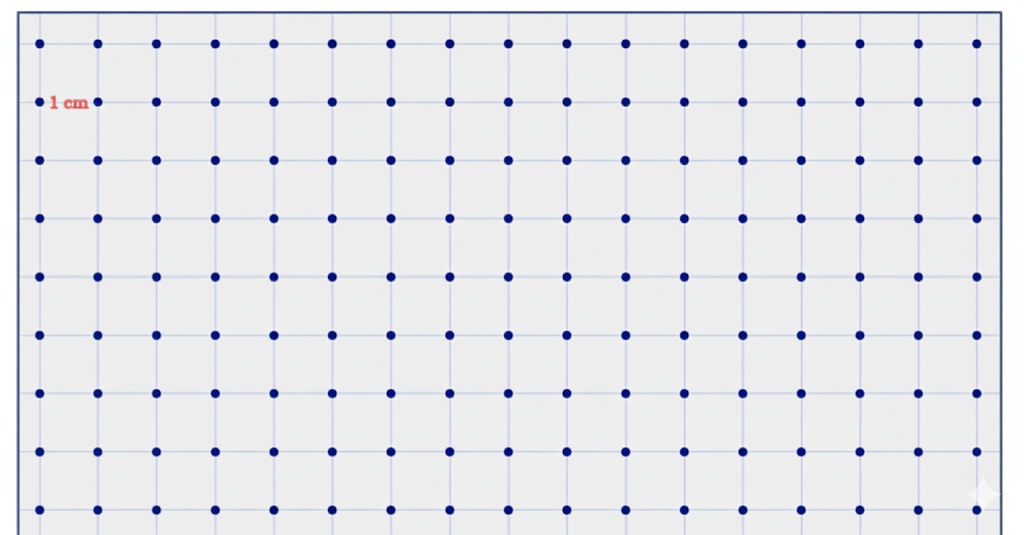
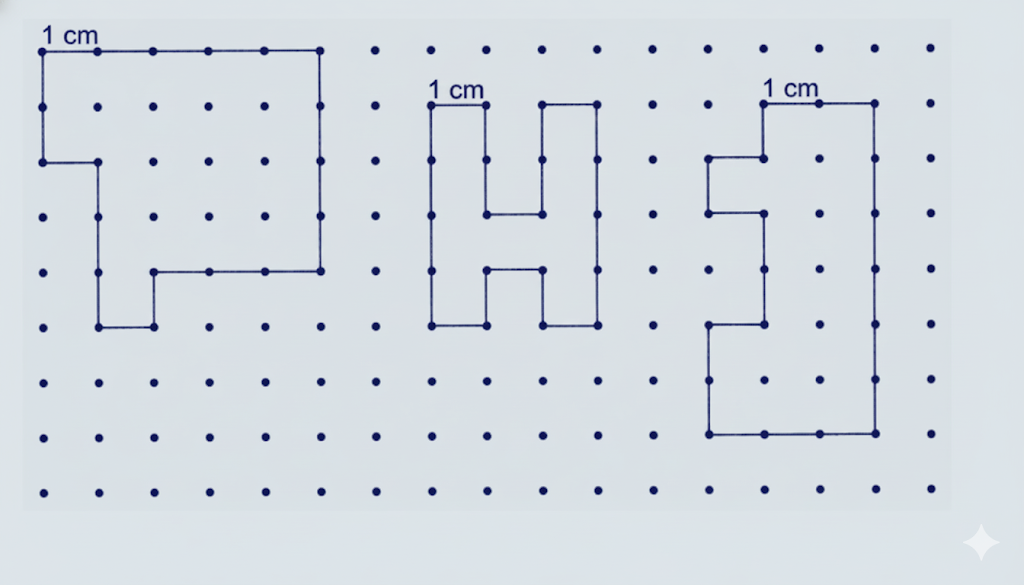
Draw three different shapes with perimeter of 20 cm.
Solution:
20 cm
NCERT Solutions Class 4 Maths Chapter 6 Measuring Length (2026-27)
In Class 4 Maths Chapter 6, students explore **measuring length** using metres and centimetres. These NCERT Solutions for **Class 4 Maths Chapter 6 Measuring Length** (2026-27) explain each activity step by step so you can connect real-life examples like buses, whales and classrooms with numbers.
With clearly explained conversions between **metres and centimetres** and fun tasks on perimeter, these NCERT Class 4 Maths solutions make practice easy. Focus on reading scales correctly, counting centimetre blocks and estimating before measuring to build strong number sense for length-based questions.
While revising this chapter, regularly redo tables like long jump, toy car distance and garden fencing. Such **exercise-based practice** strengthens concepts of **length and perimeter**, helping you score full marks in measurement questions in your school exams.
FAQs on NCERT Solutions For Class 4 Maths Chapter 6 Measuring Length - 2026-27 Free PDF Download (Login Required)
1. What is the easiest way to master measuring length in Class 4 Maths?
The most effective way to master measuring length in Class 4 Maths is by practising NCERT Solutions Class 4 Maths Chapter 6 step by step.
- Consistently solve exercise-wise questions for better understanding.
- Use key formulae and diagrams provided in the solutions for clarity.
- Revise with short notes and chapter summary to help with quick recall before the exam.
2. Are NCERT Solutions enough for Class 4 Maths exams?
NCERT Solutions for Class 4 Maths are usually sufficient for most CBSE school exams.
- They cover all intext and back exercise questions as per the CBSE 2026–27 syllabus.
- Regular practice helps students understand key concepts and definitions thoroughly.
- Use them along with exemplar and revision notes for additional practice.
3. How to write stepwise NCERT answers to score full marks?
To score full marks, always write clear and stepwise solutions for each problem in Class 4 Maths Chapter 6.
- Start with the formula or method used.
- Show all calculation steps neatly.
- Draw diagrams wherever required and label them properly.
- Highlight the final answer.
- Follow the CBSE marking scheme to include all required parts of the answer.
4. Are diagrams or definitions mandatory in answers?
Including diagrams and definitions wherever asked is essential for full marks in most CBSE Class 4 Maths questions.
- Neat, well-labelled diagrams help explain measurement problems clearly.
- Definitions of terms like centimetre, metre, length show your understanding to the examiner.
5. How can I structure long answers for better marks in measuring length chapter?
To structure long answers in Measuring Length Class 4 for maximum marks:
- Start with a brief introduction or definition if needed.
- Write stepwise working for every calculation.
- Insert diagrams with proper labels if relevant.
- Conclude with the final answer and units (cm, m, etc.).
- Follow the marking scheme for pointwise explanation.
6. Where can I download the NCERT Solutions Class 4 Maths Chapter 6 PDF?
You can download the Class 4 Maths Chapter 6 solutions PDF for free from trusted educational platforms.
- Look for a "Free PDF Download" option on the solution page.
- Use the PDF for offline study and quick revision before exams.
7. Which questions are most important from Class 4 Maths Chapter 6 for exams?
The most important questions from Class 4 Maths Chapter 6 Measuring Length are:
- Problems on converting units (cm to m, m to cm).
- Sum and difference of lengths.
- Application of measurement in real-life scenarios.
- Drawing and labelling diagrams for measurement activities.
8. How does practicing step-by-step NCERT solutions help in exams?
Practising stepwise NCERT Solutions helps in scoring higher marks as it:
- Ensures you follow the correct method for each question.
- Helps avoid common mistakes in calculations and diagrams.
- Makes your answers easy to check for examiners following the CBSE marking scheme.
9. What are the key formulae and definitions in Measuring Length Class 4?
The key formulae and definitions in NCERT Solutions for Class 4 Maths Chapter 6 include:
- 1 metre (m) = 100 centimetres (cm)
- Length: Measurement of something from end to end.
- Centimetre, metre, kilometre: Units of length measurement.
10. Do examiners award partial marks for correct steps even if the final answer is wrong?
Yes, in CBSE exams, examiners often give partial marks for correct methods and steps even if the final answer is wrong.
- Writing stepwise solutions in Class 4 Maths Chapter 6 helps secure marks for your approach.
- Always show all working clearly, even if you are unsure about the final answer.
11. How to learn diagrams for Class 4 Maths Chapter 6?
To learn diagrams for Class 4 Maths Chapter 6 Measuring Length:
- Practice drawing and labelling measuring instruments (scale, tape, etc.).
- Refer to stepwise solutions with diagrams in the NCERT solutions.
- Maintain neatness and correct labels to earn easy marks in exams.
12. What is covered in NCERT Solutions Class 4 Maths Chapter 6 Measuring Length?
The Class 4 Maths Chapter 6 NCERT Solutions cover:
- Stepwise solutions to all intext and back exercise questions.
- Key definitions, measurement units, and conversion problems.
- Diagram drawn questions and application-based questions.
- Summary and formulae for revision aligned with the CBSE 2026–27 syllabus.
