




How to Write Full Marks Answers for Class 5 English Chapter 7 Santoor Gilli Danda
Let us Think (Page 80)
A. Answer the following questions.
Question 1. Which game does the poem mention? What are the things needed to play this game?
Answer: The poem talks about the traditional game “Gilli Danda.” This game is played using a long stick called a danda and a short wooden piece known as a gilli.
Question 2. According to the poem, how do the players feel while playing Gilli Danda?
Answer: While playing Gilli Danda, the children experience pure happiness, a sense of freedom, and enjoy the game thoroughly.
Question 3. What happens to the tiny gilli when the stick strikes it?
Answer: When the danda hits the gilli, it shoots upward and soars into the air.
Question 4. Which lines tell us that the children are playing the game outside?
Answer: The lines “The small gilli, up high it flies, underneath the bright blue skies. Laughing, playing, having fun, under the golden rays of the sun!” suggest that the children are outdoors enjoying the game in the open air.
Question 5. What is the meaning of the line “our game is so sound”?
Answer: It suggests that their game is full of joy, energy, and excitement.
Question 6. Which word in the poem shows ‘happiness’?
Answer: The word “joy” expresses a feeling of happiness.
B. Think and discuss
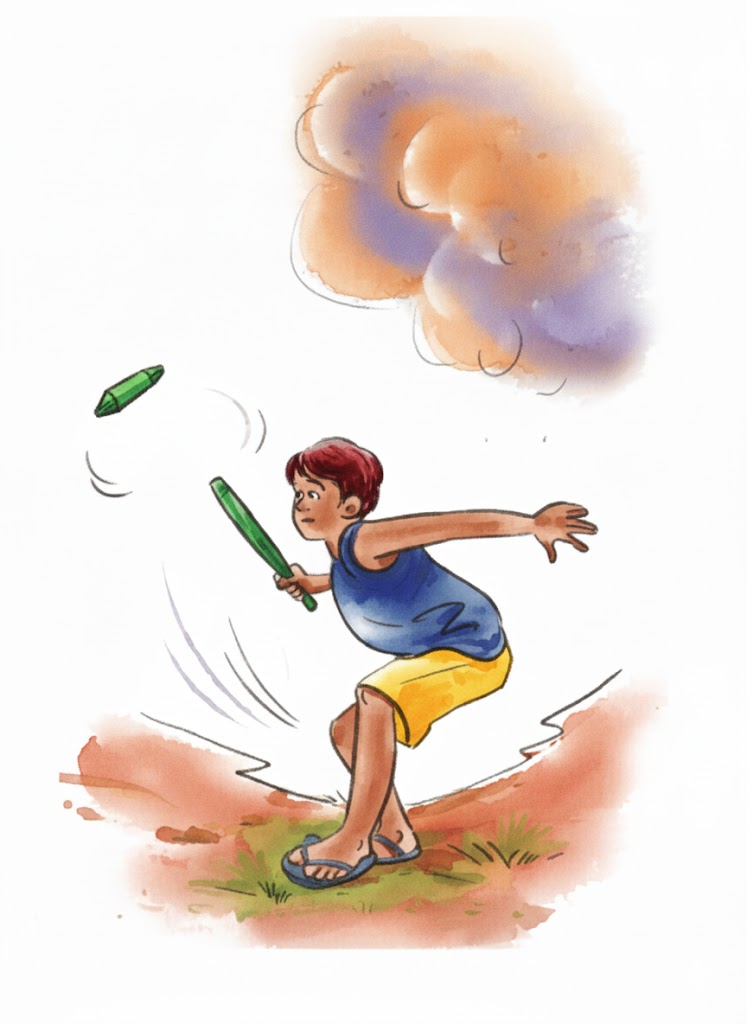
Question 1. Do you enjoy playing outdoors? Why or why not?
Answer: Yes, I like playing outside because it is enjoyable, good for my health, and lets me spend time with my friends.
Question 2. Name five outdoor games that you enjoy playing with your friends.
Answer: Games like Gilli Danda, cricket, football, kho-kho, and badminton.
Question 3. Imagine you are the small gilli. What would you see while flying up in the sky?
Answer: If I were the gilli, I would see the bright sky above, the sun and clouds, birds soaring around me, and my friends watching me from below.
Let us Learn (Pages 81-83)
Sameer was unhappy because he was unable to find his drawing book. He decided to redo his work
Both ‘un-’ and ‘re-’ are prefixes. When we add a prefix at the beginning of a word it changes that word’s meaning. Each prefix has a different function
Un + happy – unhappy (not happy)
Re + draw – redraw (draw again)
Look at the meaning of the following prefixes.
Un : not
Re : again
A. Add correct prefixes to the following words to create new words. Write the new word along with its meaning in the space given below.
Answer:
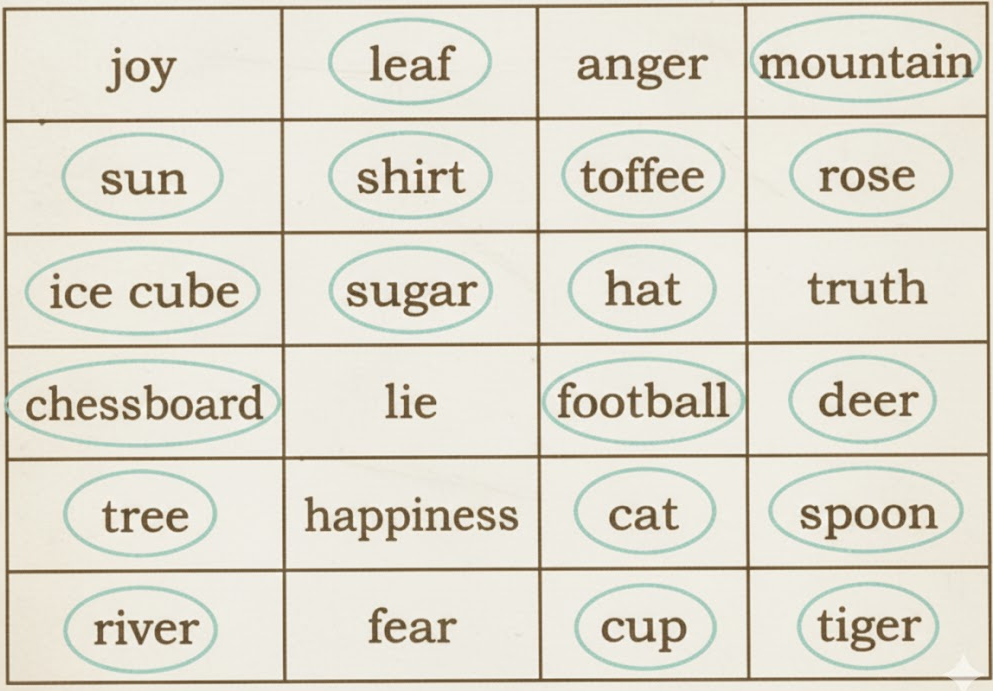
B. In the following table, encircle the nouns that you can see, taste, touch, or smell.
The words that you have NOT encircled are abstract nouns. The word ‘abstract’ refers to something that has no physical shape. For example, ‘sadness’ is an abstract noun.
‘Happiness’ and ‘rose’ are both nouns, but you can touch, see, and smell a rose.
However, you cannot touch happiness. It is a feeling.
Feelings, thoughts, ideas, etc., are all abstract nouns as they cannot be touched, smelt, or seen.
Can you think of a few more abstract nouns? Write them in your notebook and share them with the class.
Answer:
Note to the Teacher
Begin by explaining abstract nouns using simple, everyday examples.
You may also include examples from the learners’ first language (L1) to help them understand the link between abstract nouns and adjectives.
Guide students in recognising how abstract nouns differ from adjectives and show them clear ways to identify each.
Possessive pronouns indicate ownership or relationship between people and things.
For example:
The book on the table is mine.
The red handbag is hers.
There is a new cycle near the gate, is it yours?
C. Fill in the blanks with the most suitable word from the list below.
theirs, mine, yours, his, hers, ours
Question 1. These crayons belong to me. These are ……….. .
Answer: mine
Question 2. The toy train belongs to Mudit. The toy train is …….. .
Answer: his
Question 3. The house with the red roof belongs to my cousins. The house is ……. .
Answer: theirs
Question 4. The little girl has bought a set of bowls to play Jal Tarang. The bowls belong to her. The bowls are ………
Answer: hers
Question 5. We have a cow with large brown eyes. The cow is ……. .
Answer: ours
Question 6. You should take better care of your things. After all, they belong to you. The things are ……….. .
Answer: yours
Did you Know?
Gull Danda is known as tip-cat in English.
Let us Speak (Page 84)
Gill Danda is a fun outdoor game.
It is played with two sticks—one short (gilli) and one long (danda).
One of the players hits the gilli with the danda to make it fly in the air.
Other players try to catch the gilli.
Think of a game played in groups. Share the information with your classmates.
You may include the following information:
The name of the game.
Whether it is an indoor or outdoor game.
Number of players needed.
Material required for the game.
Rules of the game along with safety instructions.
Answer:
Sample Answers: Children often enjoy playing a variety of group games. Some of them are:
Hide and Seek: This outdoor game involves at least two players. One child, known as the seeker, closes their eyes and counts while the others find hiding spots. No equipment is needed to play this game.
Rope Jumping: This outdoor activity can be played alone or with others. Children jump over a rope that is swung continuously under their feet and above their heads.
Hopscotch: This outdoor game uses a grid drawn on the ground, usually with numbered squares. A player throws a small object, such as a stone or coin, into the first square and then hops through the grid, avoiding the square with the marker. They hop on one foot or both, depending on the layout. After reaching the end, they turn back, pick up the marker, and continue the game by throwing it into the next square. A turn ends if the player steps on a line, loses balance, or throws the marker into the wrong square. The child who completes all squares first wins.
Cricket: This outdoor game is played between two teams of eleven players each. The game requires equipment like a bat, ball, wickets, gloves, helmets, and pads. It is played on a large field with a central pitch where the bowler delivers the ball and the batsman attempts to score runs by hitting it.
Football: This outdoor sport also involves two teams of eleven players. Players use their feet, head, or body—except their hands—to move the ball and attempt to score goals. Only the goalkeeper can touch the ball with their hands, and only within the penalty area. The team with the higher number of goals wins.
Ludo: This indoor board game is played by two to four players. Each player has four tokens that must travel around the board and reach the home area. Movement depends on rolls of the dice. The first player to bring all their tokens home wins.
Chess: This is an indoor strategy game played by two players on a board with 64 squares. Each player begins with 16 pieces, including a king, queen, rooks, bishops, knights, and pawns. The aim is to checkmate the opponent’s king—putting it in a position where it cannot escape. Chess requires planning, logical thinking, and strategy.
Let us Listen (Page 84)
Listen to the teacher and respond with a matching action.
Question 1. “Swing and hit”: Pretend to swing an invisible danda.
Answer: Students should do it by themselves.
Question 2. “Watch it go!”: Raise your arms as if you have just hit the gilli and you are watching it fly.
Answer: Students should do it by themselves.
Question 3. “Laughing, playing”: Giggle or clap hands.
Answer: Students should do it by themselves.
Question 4. “Shade your eyes from the sun”: Keep your hands above your eyebrows.
Answer: Students should do it by themselves.
Let us Write (Pages 85-87)
A. Find the meanings of the following words using a dictionary.
Quit
Gather
Swing
Underneath
Golden
Now, use each word in a sentence of your own.
Answer:
Quit – to stop doing an activity
I will not quit until my homework is complete.
Gather – to come together in one place
We gather in the playground every evening.
Swing – to move back and forth or to strike something
He swings the bat to hit the ball.
Underneath – directly below
The cat is resting underneath the table.
Golden – having the colour or shine of gold
The fields looked golden in the sunlight.
Note to the Teacher
Show learners how to use a dictionary to look up word meanings.
Encourage them to work with a partner to find the meanings of the listed words.
Continue giving similar practice activities from time to time to strengthen their vocabulary skills.
B. Rearrange the following to form a question and write them in your notebook. Remember to put a question mark at the end.
are cows where the
is your house which
it time is what
the blue why sky is
the many are how birds on tree
you my when return will book
walk you to do school
a can fly kite you
Answer:
Where are the cows?
Which is your house?
What time is it?
Why is the sky blue?
How many birds are on the tree?
When will you return my book?
Do you walk to school?
Can you fly a kite?
C. The word ‘gilli’ has double T in it. Similarly, the words ‘millet’ and ‘bullock’ have double ‘l’.
Now write three words having each of the double letters given below.
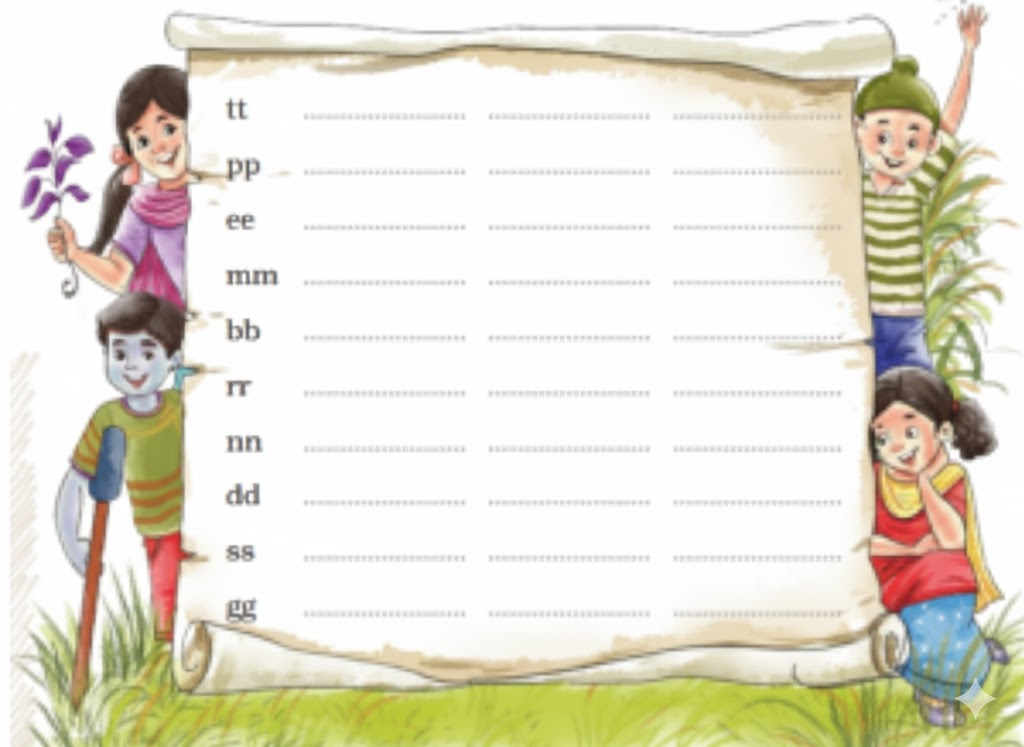
Answer:

Note to the Teacher
At first, children may think only of nouns. Encourage them to also suggest adjectives, verbs, and adverbs as they build their vocabulary.
D. Circle the word that is different in meaning from the underlined word.
Question 1. Miibi went to the market and bought an expensive toy.
precious costly cheap
Answer: cheap
Question 2. Anju and Farida forgot to buy popcorn and juice for the picnic.
remembered revised ignored
Answer: revised
Question 3. The moon continued to count the stars night after night.
stopped began started
Answer: stopped
Question 4. I always complete my homework on time.
often never sometimes
Answer: never
Question 5. There was excitement in the shop among the toys.
interest enjoyment boredom
Answer: boredom
Question 6. Badal nervously told his mother about the dog he found on his way home.
sadly joyfully confidently
Answer: confidently
Question 7. Everyone liked the vibrant colours of the bangles.
dull bright shiny
Answer: dull
Question 8. The fort is known for its unique style of construction.
different unusual common
Answer: common
Let us Do (Pages 88-89)
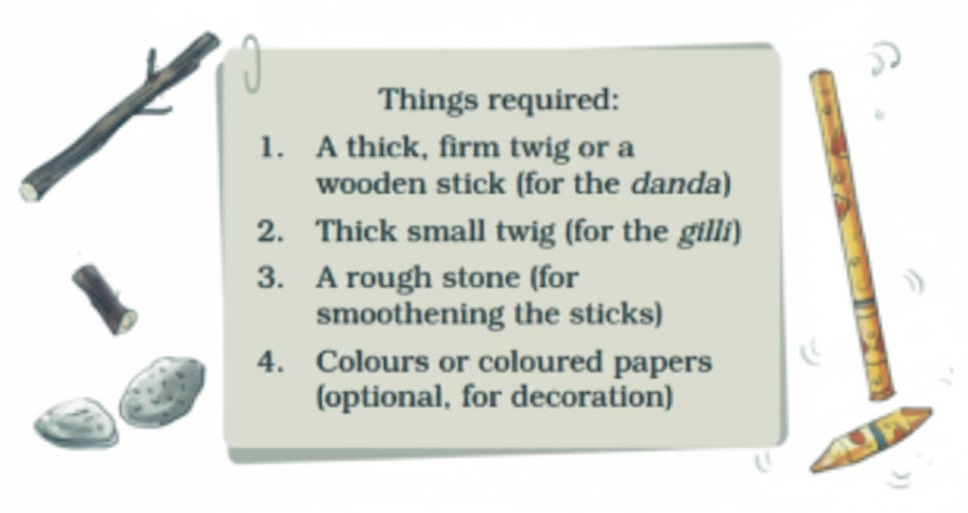
Steps
For the Danda (stick)
1. Choose a Stick
Pick a sturdy twig or an old wooden stick that is strong enough to use.
2. Make It Smooth
Rub the stick with a rough stone to even out the surface.
3. Decorate (Optional)
You can paint the danda or wrap it with coloured paper to make it look nice.
For the Gilli (small wooden peg)
1. Select a Small Piece of Wood
Find a short twig or a small leftover wooden piece about 3–4 inches long.
2. Shape the Tips
Sharpen both ends of the gilli using a rough stone so it gets the right shape.
3. Smooth the Surface
Rub the gilli with a stone to make it even and smooth.
4. Decorate (Optional)
Paint or colour the gilli if you want to make it more attractive.
Final Touch
Test the gilli and danda to ensure they are easy to handle and are sturdy.
Note to the Teacher
Ensure that safety measures are in place for this activity.
Just for Fun (Pages 89-90)
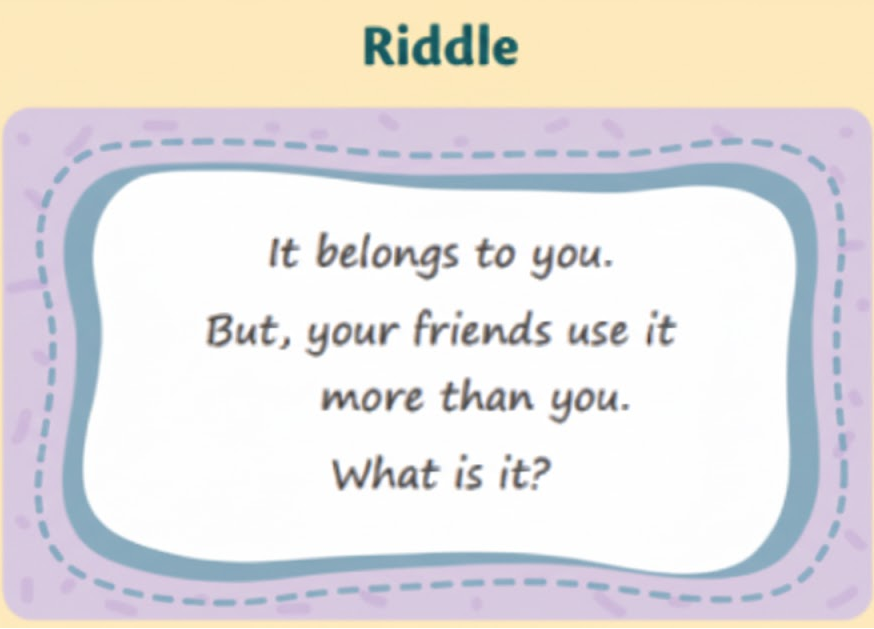
Answer: Your name
B. Spellathon
How many words of three or more letters can you make from the letters shown in the following wheel?
Rule: One letter can be used as many times as it appears in the wheel.
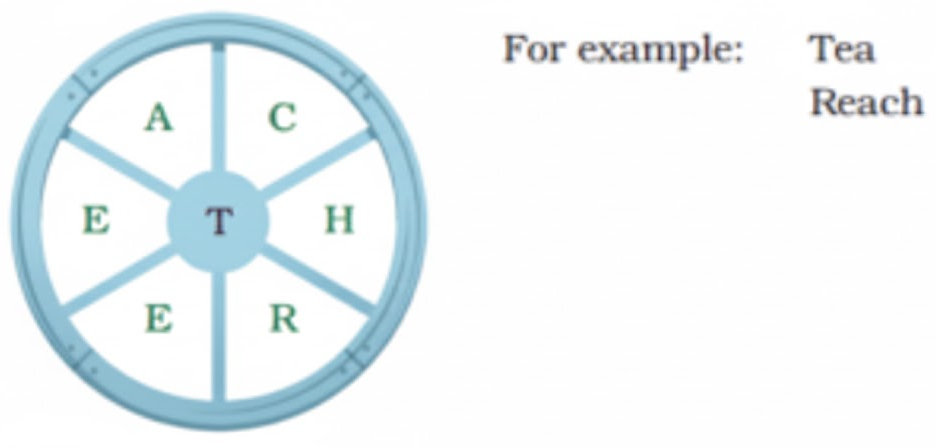
Can you make a seven-letter word using all the letters in the wheel?
Now, create a letter wheel similar to the above.

Answer: Teacher
Mastering Class 5 English Chapter 7 Gilli Danda
Understanding Class 5 English Chapter 7 Santoor Gilli Danda helps students improve their language skills and learn about traditional Indian games. Practicing these questions builds reading, writing, and comprehension—making you better prepared for exams.
Our NCERT Solutions for Class 5 English Chapter 7 Gilli Danda 2026-27 are explained in easy language, ensuring children grasp every key point. Focus on important terms and sentence formation to boost your confidence in English.
To score higher, revise the definitions, practice writing your own sentences, and enjoy the hands-on activities from the textbook. Smart preparation with these stepwise answers brings clarity and fun to your learning journey.
FAQs on NCERT Solutions For Class 5 English Chapter 7 Gilli Danda - 2026-27 Free PDF Download (Sign-in Required)
1. What are NCERT Solutions for Class 5 English Chapter 7 Santoor Gilli Danda?
NCERT Solutions for Class 5 English Chapter 7 Santoor Gilli Danda provide stepwise, exam-oriented answers to all textbook exercises so students can prepare effectively for CBSE exams.
Key features include:
- Answers to all questions from the chapter
- Stepwise solutions aligned with the CBSE 2026–27 syllabus
- Easy-to-understand explanations
- Useful tips for scoring full marks
- Downloadable PDF for offline study
These solutions help clarify concepts and improve answer writing skills.
2. How do NCERT Solutions for Class 5 English Chapter 7 help you score full marks?
NCERT Solutions for Class 5 English Chapter 7 help students score full marks by providing accurate, CBSE-pattern answers and key exam strategies.
They help by:
- Covering each step required for maximum marks
- Using key words and phrases expected by CBSE examiners
- Highlighting important chapter points and definitions
- Giving answer-writing tips to increase presentation quality
- Offering practice material for revision
This ensures students are well-prepared for all types of questions in school and final exams.
3. What is covered in Class 5 English Chapter 7 Santoor Gilli Danda?
Class 5 English Chapter 7 Santoor Gilli Danda covers the story, main events, and important values related to traditional Indian games.
Chapter highlights include:
- Introduction to the game Gilli Danda
- Storyline, characters, and lesson theme
- Moral values such as teamwork, honesty, and respect for tradition
- New vocabulary and relevant grammar exercises
The chapter also builds reading comprehension and creative writing skills.
4. How should I write stepwise NCERT answers for Class 5 English to score better?
To write stepwise NCERT answers for Class 5 English and score better:
- Read the question carefully and understand what is asked
- Begin with a direct answer, followed by supporting details
- Use key vocabulary from the textbook
- Structure your answer in points or short paragraphs
- Highlight important words or phrases
- Check grammar and spelling before submitting
Presenting answers clearly and neatly increases your chance for full marks.
5. Are diagrams or definitions mandatory in Santoor Gilli Danda answers?
Diagrams are generally not required for Santoor Gilli Danda in Class 5 English, but definitions and key terms should be included wherever asked.
For best marks:
- Write clear, textbook-style definitions when questions ask for them
- Use diagrams only if the question or exercise instructs
- Label any provided pictures or activities neatly
Following CBSE marking scheme ensures no marks are lost due to missing definitions or labels.
6. Where can I download the Class 5 English Chapter 7 Santoor Gilli Danda PDF solutions?
You can download the Class 5 English Chapter 7 Santoor Gilli Danda NCERT Solutions PDF from reliable educational websites offering CBSE content.
Benefits of the PDF version:
- Easy offline study and revision
- Printable for quick access
- Includes stepwise and exercise-wise answers
Look for the ‘Free PDF Download’ button or link on the solutions page.
7. Which questions from Santoor Gilli Danda are important for exams?
The most important questions from Santoor Gilli Danda for Class 5 English exams typically include:
- Short answer questions on the story or theme
- Definition-based questions related to vocabulary
- Questions asking for moral or lesson learned
- Creative writing exercises based on the chapter
- Back exercise and intext questions found in the NCERT textbook
Practicing these with NCERT Solutions prepares you well for exams.
8. How do I structure long answers in Class 5 English for high marks?
To structure long answers in Class 5 English and maximise marks:
- Start with a clear introduction stating the main idea
- Explain with 2–3 supporting points or examples
- Use paragraphs or bullets for clarity
- Conclude by summarising your answer
- Include key words from the question or textbook
This structured approach matches the CBSE evaluation scheme and helps you score better.
9. What are common mistakes to avoid while writing NCERT Solutions answers for English Chapter 7?
Common mistakes to avoid while writing NCERT Solutions answers for English Chapter 7 include:
- Skipping important points or key words
- Writing answers that are too short or too long
- Making spelling or grammatical errors
- Not following the stepwise format suggested in solutions
- Ignoring CBSE marking scheme requirements
Review your answers against these points to prevent losing easy marks.
10. Are NCERT Solutions enough for Class 5 English exams?
NCERT Solutions are usually sufficient for Class 5 English exams as they are aligned to your syllabus, cover all textbook questions, and match the CBSE exam pattern.
- They help build answer writing practice
- Ensure strong conceptual clarity
- Allow focused revision close to exams
For extra practice, use exemplar questions, sample papers, or revision notes along with NCERT Solutions.
