




Stepwise Answers & Exam Tips for NCERT Class 5 EVS Chapter 9
Write (Pages 147-148)
Question.
Try to remember the time you were in Grades 3 and 4. Think and write about the changes that you have noticed in yourself and your friends, in your school, and in your environment.
Answer:
Write (Pages 148-149)
Question 1.
Can you think of something that takes a really long time to change, maybe over years?
Answer:
Mountains, rivers, and forests change very gradually over long periods. People also age slowly throughout their lives. Even the growth or expansion of a city takes a long time to happen.
Question 2.
What about something that changes within just a few years?
Answer: A child grows with time, and a new building comes up step by step. In the same way, a small sapling can become a young tree within just 2–3 years.
Question 3.
Are there changes that happen every year, again and again?
Answer: Yes, some changes repeat every year. For example, flowers blossom in spring, and trees drop their leaves in autumn. Many birds migrate from cold places to warmer regions in winter. Rivers become full during the rainy season, and snowfall occurs when winter arrives.
Question 4.
Can you name something that changes in just a few minutes or even seconds?
Answer: Weather, clouds moving across the sky, a balloon bursting, lightning flashing during a storm, and switching a light on or off are all examples of changes that take place within minutes or even seconds.
Intext (Page 149)
Question.
What causes day and night?
Answer:
Day and night occur because the Earth spins on its axis. When a region of the Earth turns toward the Sun, it experiences daylight, and when it turns away, that area has night.
Activity 1 (Page 150)
To demonstrate day and night using torchlight and globe.
Students should do it by themselves.
Intext (Page 150)
Question.
Did you notice how the light made day on one side of the globe and night on the other?

Answer:
Yes, I observed that the part of the globe facing the torch was bright, showing daytime. The side turned away from the light was dark, representing night. This simple activity clearly shows how the Earth’s rotation causes day and night.
Find Out (Page 151)
Question.
Study the globe and write in the space given below, when it is day time in India, which countries will have night?
Answer:
When it is day in India, our side of the Earth is facing the Sun. At that same moment, countries such as the United States, Brazil, and Canada have night because they lie on the opposite side of the Earth and are not receiving sunlight.
Intext (Pages 153-154)
Question.
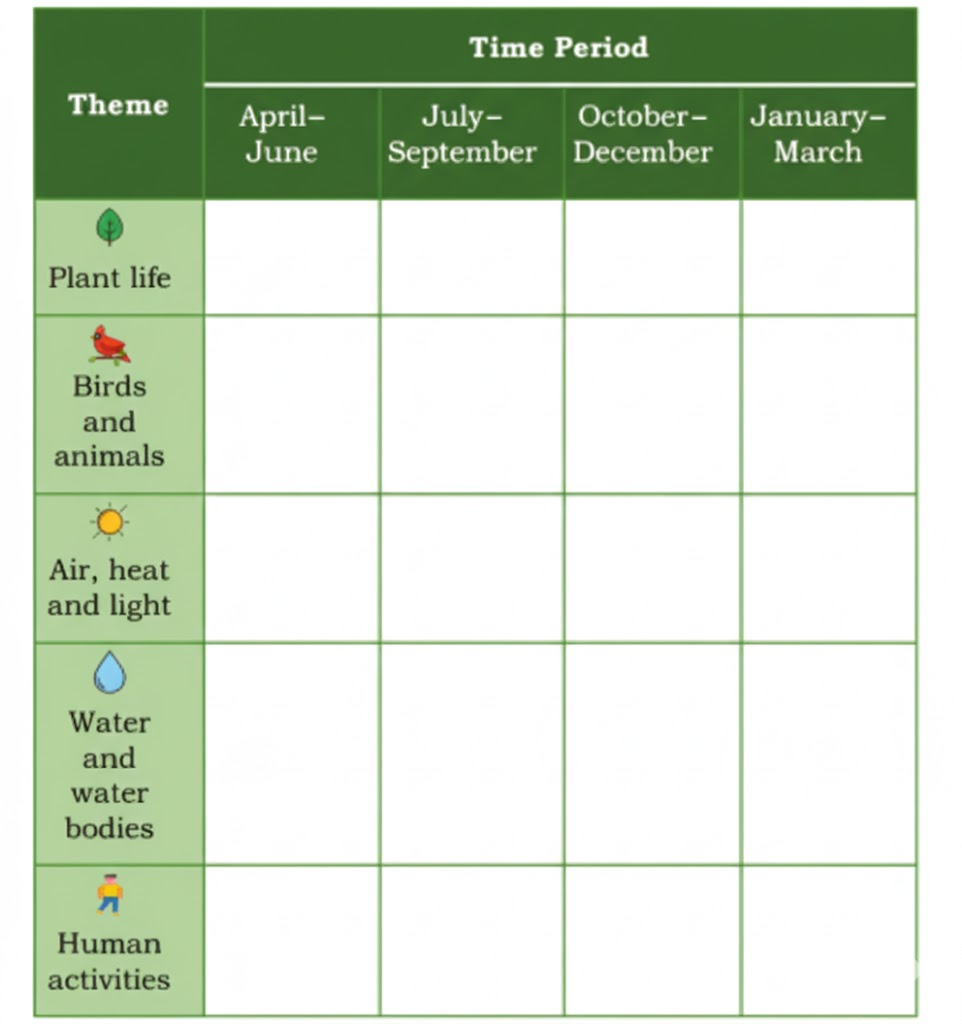
Fill the chart with the changes observed across different time periods during the year.
Chart Template
Answer:
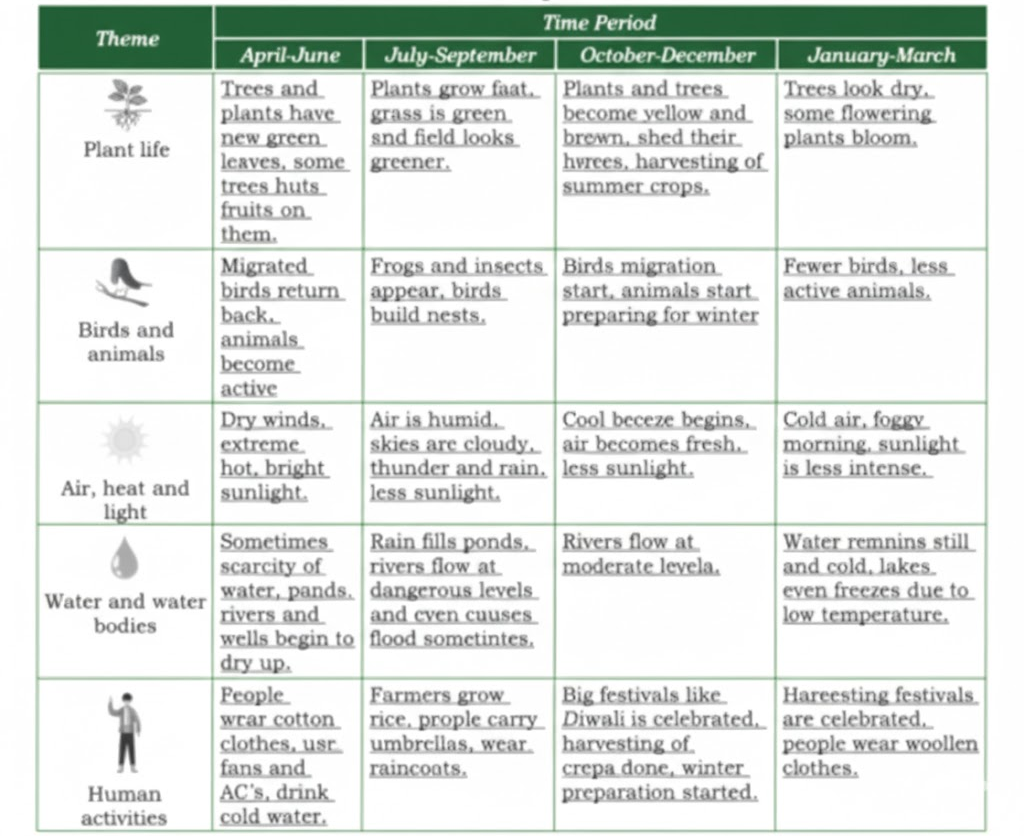
Intext (Page 155)
Question.
What are the seasons called in your region?
Answer:
(Answers may differ)
In my area, the seasons are known by the following names:
Spring: Basant
Summer: Garmi
Monsoon: Barsaat
Autumn: Patjhad
Pre-winter: Hemant
Winter: Jaada
Intext (Page 156)
Question.
Do you know how many seasons we have in India?
Answer:
In India, we observe six different seasons, each based on the natural changes that occur every few months.
Write (Page 157)
Question.
How do you feel when the season changes? Would you prefer one season to continue throughout the year? Give the reasons for your answer.
Answer:
I feel happy and excited whenever the seasons change. I enjoy different activities in each season—like eating mangoes in summer or enjoying the cool air in winter. I also love playing in the rain during the monsoon.
I would not want the same season to stay all year. If only one season existed, many natural processes would stop. Crops might not grow properly, and birds would not migrate. Every season has its own importance and charm. Seasonal changes add variety, balance, and beauty to both nature and our lives.
Discuss (Page 157)
Question.
Winter in Kerala is different from winter in Kashmir valley. Monsoon in Assam is different from Rajasthan. Why do you think it is so?
Answer:
Different parts of India experience different types of climate because of variations in landforms, altitude, and location. This is why the same season can feel very different from one region to another. Kerala stays warm in winter as it is close to the sea, while Kashmir, located in the mountains, receives snowfall. Assam gets heavy rainfall because of its hills and dense forests, whereas Rajasthan receives very little rain since it is a desert region.
Intext (Page 157)
Question.
In India, we have many songs associated with seasons. Do you know any? Find out some songs.
Answer:
Students should do it by themselves.
Intext (Page 157)
Question.
With the help of your teacher and elders, name the crops that grow in summer and winter in your region.
Answer:
Intext (Page 158)
Question.
Many of our festivals are connected with seasons. See if you can match these festivals to the season they are celebrated in!
Answer:
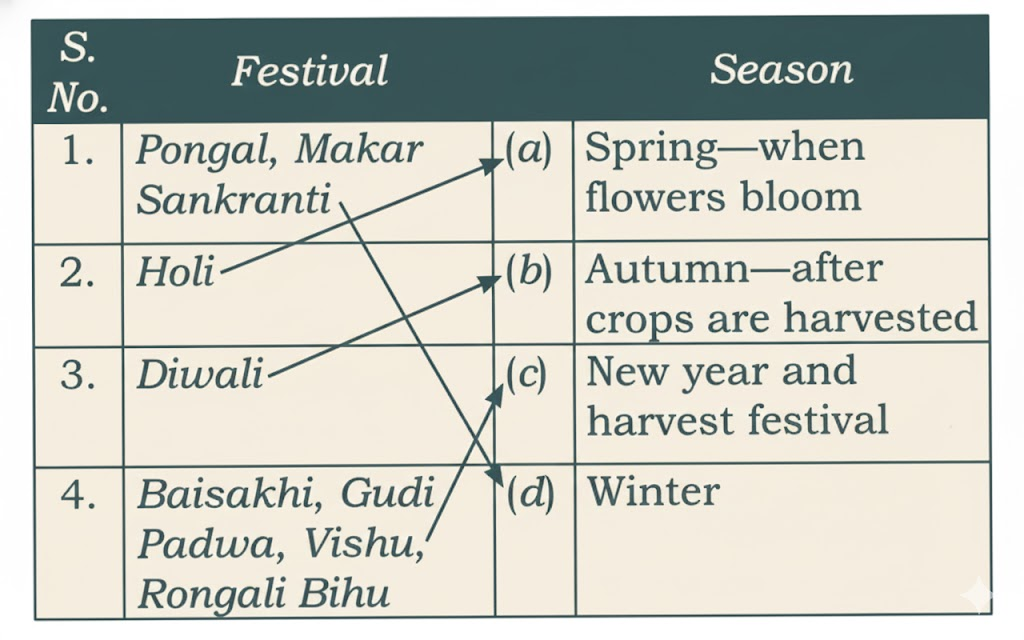
Let Us Reflect (Pages 159-160)
Question 1.
Narrate your experiences about the season changes.
Answer:
(Answers may differ)
I enjoy observing how nature changes from one season to another. In summer, the heat makes me prefer cotton clothes, and I stay refreshed by drinking cold water and eating mangoes.
During the monsoon, I carry an umbrella when I step outside and have fun splashing in puddles with my friends. In autumn, the weather becomes pleasant, and I notice some trees shedding their leaves. Festivals like Dussehra and Diwali make this time even more cheerful.
In winter, I wear warm woollen clothes and love spending time in the sunlight during the day. Each season brings something new, enjoyable, and refreshing.
Question 2.
Ask your family members and write about seasons. Do you find any major differences in the patterns or changing seasons? What could be possible reasons for these differences?
Answer:
I talked to my parents about how seasons used to be. They shared that, in their childhood, summers were milder and winters stayed for a longer time. It also rained more regularly during the monsoon.
However, today the situation has changed. Summers have become extremely hot, with temperatures rising every year. Winters are shorter and not as cold as they once were. Rainfall is also irregular, which affects crop growth.
This change in seasonal patterns is mainly due to large-scale cutting of trees, increasing pollution, and global warming.
Question 3.
Seasons have local names. Find out and write the seasons mentioned below are called in your region, and your local language.
(a) Spring: ……….
(b) Summer: ………..
(c) Monsoon: ………..
(d) Autumn: ……….
(e) Pre-winter: ………..
(f) Winter: ………..
Answer:
(Answers may differ)
(a) Spring : Basant
(b) Summer Garmi
(c) Monsoon : Barsaat
(d) Autumn : Patjhad
(e) Pre-winter : Hemant
(f) Winter : Jaada
Question 4.
Fill the table below based on your observations and experiences.
Answer:
Question 5.
Share your experience of seasons’ journaling.
Answer:
(Answers may differ)
I really liked doing the seasons journaling activity. It helped me notice how plants, animals, and people behave differently in each season. I observed fresh flowers appearing in spring, strong rainfall during the monsoon, and chilly, foggy mornings in winter. Recording these changes through writing and drawing made me feel closer to nature. I also enjoyed sharing my observations with my classmates.
Question 6.
Make a comparative drawing of the three major seasons.
Answer:
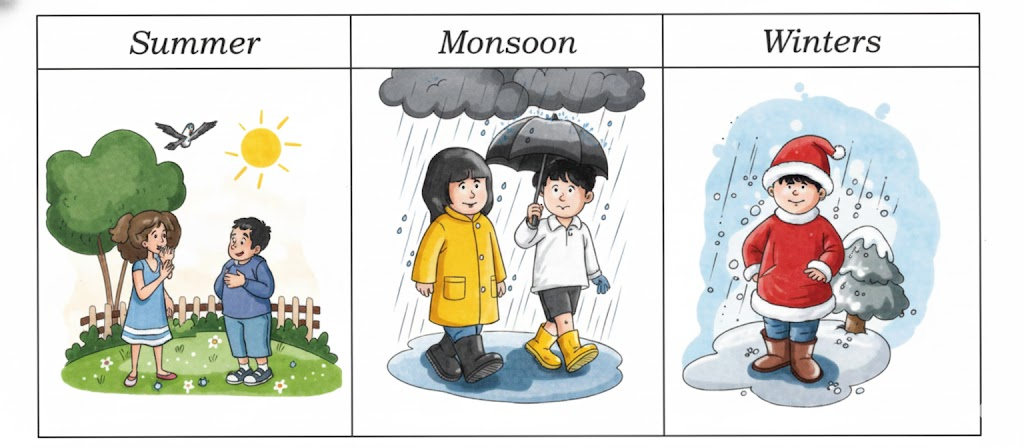
Rhythms of Nature: Class 5 EVS Chapter 9
Understanding the rhythms of nature is key to scoring well in NCERT Class 5 Our Wondrous World Chapter 9. Focusing on seasonal changes and daily cycles helps students relate science concepts to daily life and boosts retention for exams.
This chapter explores day and night, seasons, and life’s changes through stories and hands-on activities. Using these NCERT-based concepts, students can strengthen their observation skills and develop a deeper understanding of their environment.
Practice answering all exercise questions and keep a nature journal. Reviewing patterns in nature and seasonal festivals will help you excel in your EVS exam and make your learning interesting and practical!
FAQs on NCERT Solutions For Class 5 Our Wonderous World Chapter 9 Rhythms Of Nature - 2026-27 Free PDF Download (Login Required)
1. What are NCERT Solutions for Class 5 EVS Chapter 9: Rhythms of Nature?
NCERT Solutions for Class 5 EVS Chapter 9: Rhythms of Nature are step-by-step answers to all textbook exercises, designed for the 2026-27 CBSE syllabus.
- Each solution follows the official Our Wondrous World Chapter 9 structure.
- Answers focus on key concepts like rhythms of nature, seasons, natural cycles.
- Includes definitions, diagrams, and key points for easy understanding.
- Created as per latest CBSE marking scheme and exam trends.
2. How do I write stepwise NCERT answers in Class 5 EVS to score full marks?
To score full marks in Class 5 EVS, you must write clear, stepwise NCERT answers following exam-friendly formats.
- Begin each answer with a direct statement using key NCERT terms.
- Explain points in logical steps or bullets.
- Add definitions, diagrams, or examples for clarity.
- Use headings/subheadings for long answers.
- Stick to the question's word limit and highlight important terms for the CBSE examiner.
3. Are diagrams or definitions compulsory in NCERT Class 5 EVS Chapter 9 answers?
Yes, using diagrams and definitions in your Class 5 EVS Chapter 9 answers is highly recommended for better marks.
- Diagrams help explain natural cycles and rhythms more clearly.
- Definitions of key terms show understanding and boost scores.
- Always label diagrams neatly and include them where asked or relevant.
4. Which questions from NCERT Class 5 EVS Chapter 9 are important for school exams?
The most important questions in Class 5 EVS Chapter 9 include those that cover main concepts and application.
- Short and long answer questions on natural rhythms (seasons, weather, day-night cycle).
- Definitions of terms like ‘cycle’, ‘season’, and ‘rhythm of nature’.
- Questions that require drawing or labelling diagrams.
- Application-based or "Why does..." questions about nature’s patterns.
- Refer to CBSE marking patterns to prioritise these.
5. Where can I download the NCERT Solutions PDF for Class 5 EVS Chapter 9?
You can download the NCERT Solutions PDF for Class 5 EVS Chapter 9 from trusted academic platforms.
- Look for a dedicated ‘Download PDF’ button on the solutions page.
- Ensure the PDF matches the CBSE 2026–27 syllabus.
- Always use sources with teacher-reviewed content for accuracy.
6. How should I structure long answers for CBSE marking in Class 5 EVS?
For CBSE marking, structure your long answers in Class 5 EVS by:
- Starting with a direct statement or definition.
- Using numbered or bullet points for clarity.
- Including diagrams, examples, and subheadings.
- Highlighting keywords from the textbook.
- Ending with a short, summarising line if space allows.
7. What are the key definitions and terms in NCERT Class 5 EVS Chapter 9?
Key definitions in Chapter 9 include terms related to natural patterns and cycles.
- Rhythms of Nature: Regular patterns in the environment, like day & night or seasons.
- Cycle: A series of events that happen repeatedly in the same order.
- Season: A period of the year with a particular type of weather.
- Use these concise definitions in your answers for better marks.
8. How can I quickly revise Class 5 EVS Chapter 9 for exams?
To revise Class 5 EVS Chapter 9 effectively for exams:
- Review key definitions and diagrams.
- Practice stepwise answers using sample NCERT solutions.
- Attempt important questions and mark those repeated in past papers.
- Use a 1-day, 3-day, or 7-day revision plan for systematic prep.
- Create quick flash notes summarising rhythms and cycles in nature.
9. What common mistakes should I avoid in NCERT Class 5 EVS Chapter 9 answers?
Avoiding common mistakes helps you score full marks in your Class 5 EVS Chapter 9 answers.
- Don’t miss definitions or diagrams.
- Avoid skipping important NCERT keywords.
- Do not make diagrams untidy or forget labels.
- Don’t write overly short or vague answers.
- Always check your answer matches marking scheme requirements.
10. Are NCERT Solutions enough for Class 5 EVS exams?
NCERT Solutions for Class 5 EVS provide the most reliable content for exams.
- They cover all textbook questions.
- Prepared per the latest CBSE syllabus.
- For top scores, also solve sample papers and important questions along with NCERT Solutions.
11. How to present long answers to match CBSE marking?
To match CBSE marking guidelines in long answers:
- Start with a relevant introduction or definition.
- Organise information in logical steps or bullets.
- Use diagrams, underlined keywords, and neat paragraphing.
- Conclude with a summary sentence.
- Check your answer against marking scheme step marks.
12. How to learn diagrams or maps for Class 5 EVS Chapter 9?
To memorise diagrams or maps for Chapter 9:
- Practice drawing each cycle or nature-based diagram from the chapter.
- Label each part neatly using textbook conventions.
- Revise map conventions (directions, keys, legends) if required.
- Add quick notes for each diagram for last-minute recall.
13. What are the most important topics from NCERT Class 5 EVS Chapter 9?
The most important Chapter 9 topics are:
- Rhythms of nature: day-night, seasons, and weather cycles.
- Natural patterns and their importance in daily life.
- Diagrams related to the water cycle or seasonal changes.
- Definitions and application-based questions about natural cycles.
14. Do examiners award partial marks for correct steps even if the final answer is wrong in Class 5 EVS?
Yes, in Class 5 EVS, examiners often give partial marks for correct steps and keywords, even if the final answer is incomplete or slightly incorrect.
- Always show your working steps and reasoning.
- Use textbook terminology and structure your answers clearly.
- This increases your chances of earning marks, even for partially correct responses.
15. Are references to textbook page numbers useful during revision?
Yes, referring to textbook page numbers during revision can help locate examples, diagrams, and important points faster.
- Quickly find illustrations and definitions for last-minute revision.
- Helps cross-check solutions while practicing.
- Makes your revision process more organised and efficient.
