


What You’ll Learn in Class 9 Maths Chapter 5 Exercise 5.3


Question 1.
Can you explain why the converse of Theorem 4 is true, i.e., why the perpendicular from the centre of a circle to a chord bisects the chord?
(Hint: Use Figure. You are told that ∠CMA = ∠CMB = 90°. You need to show that AM = BM)
Solution:
Given: C is the centre of the circle, AB is a chord, and CM ⊥ AB.
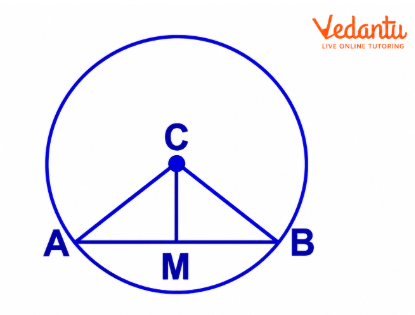
Therefore:
∠CMA = ∠CMB = 90°
To prove:
AM = BM
Proof:
Consider ∆CMA and ∆CMB.
CA = CB, as they are radii of the same circle.
CM = CM, as it is the common side.
∠CMA = ∠CMB = 90°, as given.
Therefore, by the RHS congruence criterion:
∆CMA ≅ ∆CMB
Hence, by corresponding parts of congruent triangles:
AM = BM
Therefore, the perpendicular drawn from the centre of a circle to a chord bisects the chord.
Question 2.
An isosceles triangle ABC is inscribed in a circle, with AB = AC. Show that the altitude from A to BC passes through the centre of the circle.
Solution:
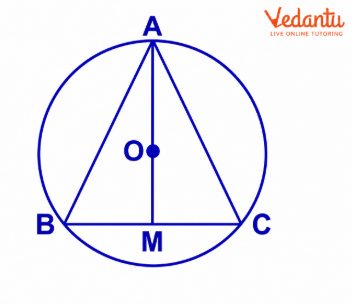
Given: ∆ABC is an isosceles triangle inscribed in a circle with centre O, where AB = AC. AM is the altitude drawn from A to BC.
To prove: AM passes through the centre O.
Proof:
Consider ∆AMB and ∆AMC.
AB = AC, as given.
AM = AM, as it is the common side.
∠AMB = ∠AMC = 90°, because AM is an altitude.
Therefore, by the RHS congruence criterion:
∆AMB ≅ ∆AMC
Hence:
BM = CM
Thus, M is the midpoint of chord BC.
The line joining the centre of a circle to the midpoint of a chord is perpendicular to the chord. Therefore:
OM ⊥ BC
We also know that:
AM ⊥ BC
Since only one perpendicular can be drawn from point M to line BC, AM and OM must lie on the same line.
Therefore, A, O, and M are collinear. Hence, the altitude from A to BC passes through the circle's centre, O.
Question 3.
Two parallel chords of lengths 6 cm and 8 cm are on opposite sides of the centre of a circle. If the radius of the circle is 5 cm, find the distance between the midpoints of the chords.
Solution:
Given:
Radius of the circle = 5 cm
Length of chord AB = 6 cm
Length of chord CD = 8 cm
Let N and M be the midpoints of chords AB and CD, respectively.
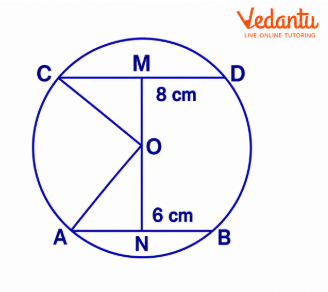
Since the line joining the centre of a circle to the midpoint of a chord is perpendicular to the chord:
AN = AB/2 = 6/2 = 3 cm
In right-angled ∆ANO:
OA² = ON² + AN²
5² = ON² + 3²
25 = ON² + 9
ON² = 16
ON = 4 cm
Similarly:
CM = CD/2 = 8/2 = 4 cm
In right-angled ∆CMO:
OC² = OM² + CM²
5² = OM² + 4²
25 = OM² + 16
OM² = 9
OM = 3 cm
Since the chords lie on opposite sides of the centre:
MN = ON + OM
= 4 + 3
= 7 cm
Therefore, the distance between the midpoints of the two chords is 7 cm.
Key Points to Remember for Class 9 Maths Exercise 5.3 Chapter 5 I’m Up and Down, and Round and Round
When revising Chapter 5 maths class 9 exercise 5.3, keep these important ideas in mind:
Identify the centre, chord, radius, midpoint, and perpendicular shown in the figure.
Use equal radii and RHS congruence to establish relationships between triangles.
Remember that a perpendicular from the centre bisects a chord.
Apply the Pythagorean theorem when finding distances involving chords and the radius.
For Maths Class 9, Chapter 5, Exercise 5.3, write proofs in a clear order: given information, reasoning, and conclusion.
Access Exercise Wise NCERT Solutions for Chapter 5 Maths Class 9
CBSE Class 9 Maths Chapter 5 Other Study Materials
Chapter-Specific NCERT Solutions for Class 9 Maths
Additional Study Materials for Class 9 Maths
FAQs on NCERT Solutions for Class 9 Maths Chapter 5 Exercise 5.3 2026-27
1. What is Class 9 Maths Chapter 5 Exercise 5.3 based on?
Exercise 5.3 deals mainly with the properties of chords, the centre of a circle, perpendiculars, congruent triangles, and related geometric results.
2. How do you prove that a perpendicular from the centre bisects a chord?
Join the centre to the endpoints of the chord and use the two right-angled triangles formed. They are congruent by RHS, so the two parts of the chord are equal.
3. What is the converse of the perpendicular-to-chord theorem?
If a line from the centre of a circle bisects a chord, then it is perpendicular to that chord.
4. How do you solve Question 2 of Class 9 Maths Chapter 5 Exercise 5.3?
Use the equal sides of the isosceles triangle to show the two right-angled triangles are congruent. This shows that the altitude bisects the chord and passes through the circle's centre.
5. How is RHS congruence used in Exercise 5.3?
RHS congruence is useful when two right-angled triangles have equal hypotenuses and one corresponding equal side.
6. How do you find the distance between two parallel chords in a circle?
Find the perpendicular distance from the centre to each chord. Since the chords are on opposite sides, add those two distances.
7. What is the answer to Question 3 in Exercise 5.3?
The distance between the midpoints of the two chords is 7 cm.
8. Why is half the chord used when solving the numerical question?
The perpendicular from the centre to a chord bisects the chord. Therefore, half of the chord forms one leg of the right-angled triangle used in the calculation.
9. Which theorem should I use for chord questions in Class 9 Maths Chapter 5?
The appropriate theorem depends on the information given, but the properties connecting the centre, perpendiculars, and chords are especially useful in Exercise 5.3.
10. How can I understand the proofs in Class 9 Maths Exercise 5.3?
Start by marking the equal radii and right angles in the figure. Then identify the two triangles and determine which congruence criterion applies.
11. What should I know before studying Exercise 5.3?
It helps to be comfortable with basic circle terminology, triangle congruence, right-angled triangles, and the Pythagorean theorem.
12. Are the Class 9 Maths Chapter 5 Exercise 5.3 solutions useful for proof questions?
Yes. They show how to convert the given information into logical steps and how the final result follows from the relevant theorem or congruence criterion.
13. What is the easiest way to approach Exercise 5.3?
Read the figure carefully, write the given information, identify the required result, and then choose the circle property or triangle theorem that connects the two.
14. Does Exercise 5.3 include numerical questions?
Yes. Along with geometry proofs, the exercise includes a question that requires finding the distances from the centre of a circle to two parallel chords.
15. Where can I find Class 9 Maths Exercise 5.3 solutions?
This page has complete step-by-step solutions for the exercise, covering both the proof-based questions and the numerical problems.