


 Watch Video




Getting Started with Class 9 Maths Chapter 6 Exercise 6.1
Measuring Space: Perimeter and Area are concepts you can spot in everyday things, from the boundary of a playground to the space a floor covers. Class 9 Maths Chapter 6 Exercise 6.1 solutions help you work through these ideas by connecting formulas with the figures and measurements given in each question.
 Table of Content
If you are using NCERT Solutions for Class 9 Maths Chapter 6 Exercise 6.1, first try setting up the problem yourself and then check the solution to verify your method. You can also explore NCERT Solutions Class 9 Maths for chapter-wise learning support. A PDF download can be useful when you want to keep the exercise solutions together while practising.


Class 9 Maths Chapter 6 Measuring Space: Perimeter and Area Exercise 6.1 Solutions 2026-27


 ShareShare
Unless stated otherwise, use the approximation 22/7 for π.
Question 1: The perimeter of a circle is 44 cm. What is its radius?
Solution:
Given:
Circumference of the circle, C = 44 cm
We know that:
C = 2πr
Therefore:
44 = 2 × 22/7 × r
r = 44 × 7/(2 × 22)
r = 7 cm
Hence, the radius of the circle is 7 cm.
Question 2: Calculate, correct to 3 significant figures, the circumference of a circle with:
(i) radius 7 cm
(ii) radius 10 cm
(iii) radius 12 cm.
Solution:
The circumference of a circle is:
C = 2πr
(i) When r = 7 cm
C = 2 × 22/7 × 7
C = 44 cm
Correct to 3 significant figures, the circumference is 44.0 cm.
(ii) When r = 10 cm
C = 2 × 22/7 × 10
C = 440/7 cm
C = 62.857... cm
Correct to 3 significant figures, the circumference is 62.9 cm.
(iii) When r = 12 cm
C = 2 × 22/7 × 12
C = 528/7 cm
C = 75.428... cm
Correct to 3 significant figures, the circumference is 75.4 cm.
Question 3: Calculate the length of the arc of a circle if: (i) the radius is 3.5 cm and the angle at the centre is 60°, and (ii) the radius is 6.3 m and the angle at the centre is 120°.
Solution:
The length of an arc with radius r and central angle θ is:
Arc length = θ/360° × 2πr
(i) When r = 3.5 cm and θ = 60°
Arc length = 60°/360° × 2 × 22/7 × 3.5
= 1/6 × 22
= 11/3 cm
= 3.666... cm
Therefore, the arc length is approximately 3.67 cm.
(ii) When r = 6.3 m and θ = 120°
Arc length = 120°/360° × 2 × 22/7 × 6.3
= 1/3 × 39.6
= 13.2 m
Therefore, the arc length is 13.2 m.
Question 4: Find the perimeter of a sector (i.e., the curved portion as well as the two straight portions) of a circle of radius 14 cm and sector angle 75°.
Solution:
The perimeter of a sector is the sum of its arc length and two radii.
Perimeter of sector = θ/360° × 2πr + 2r
Here:
r = 14 cm
θ = 75°
Therefore:
P = 75°/360° × 2 × 22/7 × 14 + 2 × 14
= 75/360 × 88 + 28
= 55/3 + 28
= 55/3 + 84/3
= 139/3 cm
= 46 1/3 cm
Hence, the sector's perimeter is 46 1/3 cm.
Question 5: Find the perimeters of the following shapes (taking the arcs to be quarter or half or three-quarters of a circle, as appropriate) (Fig. 6.14i to 6.14ix):
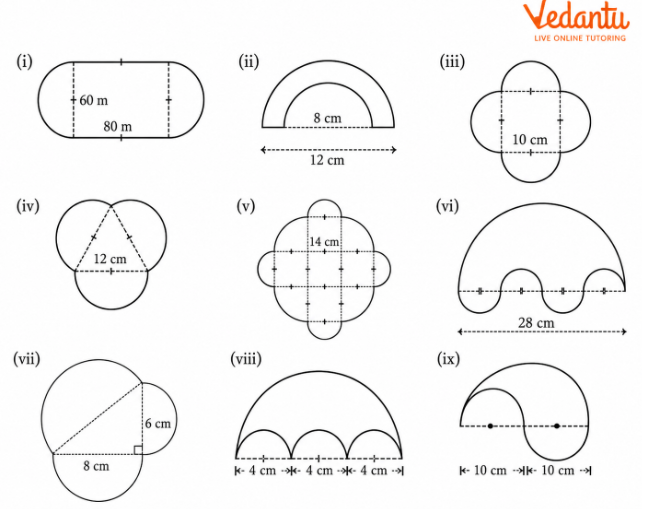
(i)
The boundary consists of two semicircular arcs of equal radius and two straight sides of the rectangular portion.
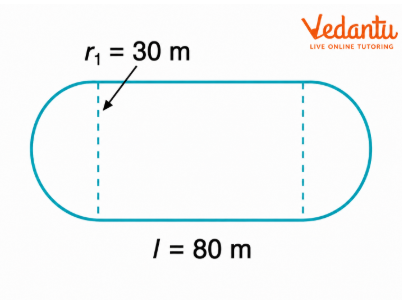
The two semicircular arcs together form one complete circle with a radius of 30 m.
Perimeter = 2πr + 2l
= 2 × 22/7 × 30 + 2 × 80
= 1320/7 + 160
= 1320/7 + 1120/7
= 2440/7 m
= 348 4/7 m
(ii)
The boundary consists of two semicircular arcs with radii 4 cm and 6 cm, along with two straight portions of 2 cm each.
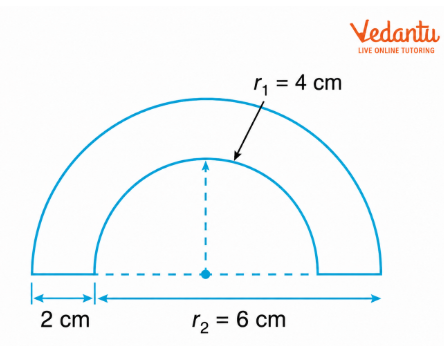
Perimeter = πr₁ + πr₂ + 2w
= 22/7 × 4 + 22/7 × 6 + 2 × 2
= 22/7 × 10 + 4
= 220/7 + 28/7
= 248/7 cm
= 35 3/7 cm
(iii)
The boundary consists of four semicircles, each having a radius of 5 cm.
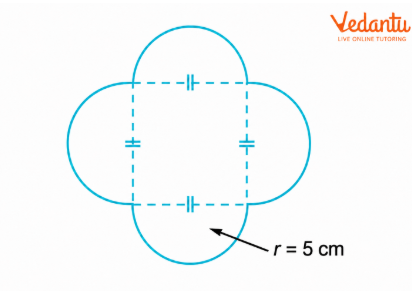
Perimeter = 4 × πr
= 4 × 22/7 × 5
= 440/7 cm
= 62 6/7 cm
(iv)
The boundary consists of three semicircular arcs, each with a radius of 6 cm.
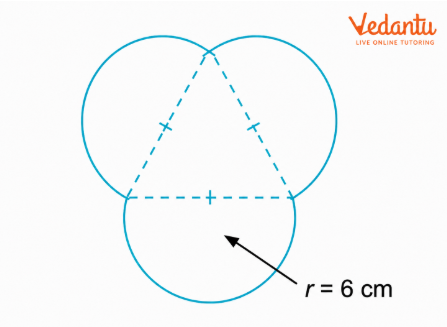
Perimeter = 3 × πr
= 3 × 22/7 × 6
= 396/7 cm
= 56 4/7 cm
(v)
The boundary consists of four quadrants of radius 14 cm and four semicircles of radius 7 cm.
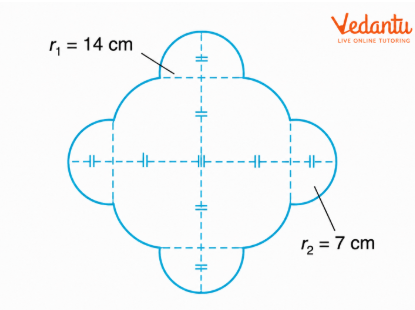
Perimeter of four quadrants:
= 4 × 1/4 × 2π × 14
= 28π
Perimeter of four semicircles:
= 4 × 1/2 × 2π × 7
= 28π
Total perimeter = 28π + 28π
= 56π
= 56 × 22/7
= 176 cm
(vi)
The boundary consists of one large semicircle with a diameter of 28 cm and four smaller semicircles, each with a diameter of 7 cm.
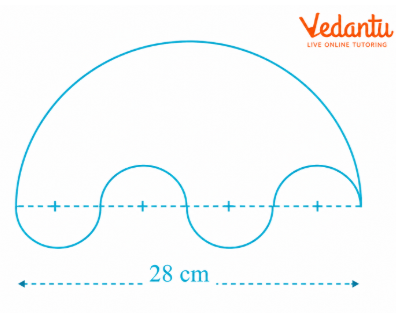
Radius of the large semicircle = 14 cm
Radius of each small semicircle = 7/2 cm
Perimeter = π × 14 + 4 × π × 7/2
= 14π + 14π
= 28π
= 28 × 22/7
= 88 cm
(vii)
The boundary consists of three semicircles whose diameters are the sides of a right-angled triangle with perpendicular sides 6 cm and 8 cm.
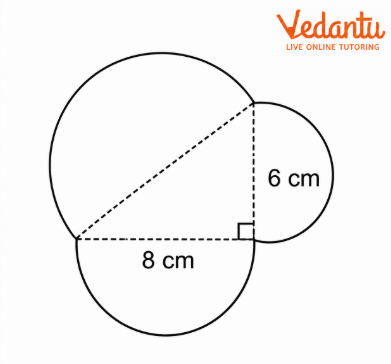
Using the Baudhayana-Pythagoras theorem:
Hypotenuse = √(6² + 8²)
= √(36 + 64)
= √100
= 10 cm
Therefore, the radii of the three semicircles are 3 cm, 4 cm and 5 cm.
Perimeter = πr₁ + πr₂ + πr₃
= π(r₁ + r₂ + r₃)
= 22/7 × (3 + 4 + 5)
= 22/7 × 12
= 264/7 cm
= 37 5/7 cm
(viii)
The boundary consists of one large semicircle with a diameter of 12 cm and three smaller semicircles, each with a diameter of 4 cm.
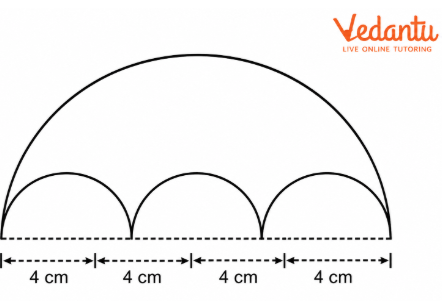
Radius of the large semicircle = 6 cm
Radius of each small semicircle = 2 cm
Perimeter = πr₁ + 3πr₂
= 22/7 × 6 + 3 × 22/7 × 2
= 132/7 + 132/7
= 264/7 cm
= 37 5/7 cm
(ix)
The boundary consists of one large semicircle with a radius of 10 cm and two smaller semicircles, each with a diameter of 10 cm.
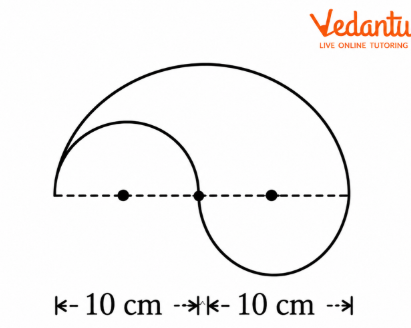
Radius of each small semicircle = 5 cm
Perimeter = πr₁ + 2πr₂
= 22/7 × 10 + 2 × 22/7 × 5
= 220/7 + 220/7
= 440/7 cm
= 62 6/7 cm
Question 6: If the diameter of a car tyre is 56 cm, then:
(i) How far does the car need to travel for the tyre to complete one revolution?
(ii) How many revolutions does the tyre make if the car travels 10 km?
Solution:
(i)
The distance the tyre travels in one complete revolution equals its circumference.
Circumference = πd
Given:
d = 56 cm
Therefore:
C = 22/7 × 56
= 176 cm
Since 100 cm = 1 m:
176 cm = 1.76 m
Hence, the car travels 1.76 m when the tyre completes one revolution.
(ii)
Distance travelled by the car = 10 km
Converting kilometres into metres:
10 km = 10,000 m
Number of revolutions = Total distance travelled ÷ Distance covered in one revolution
= 10,000 ÷ 1.76
= 5681.8 approximately
Therefore, the tyre makes approximately 5,682 revolutions while travelling 10 km.
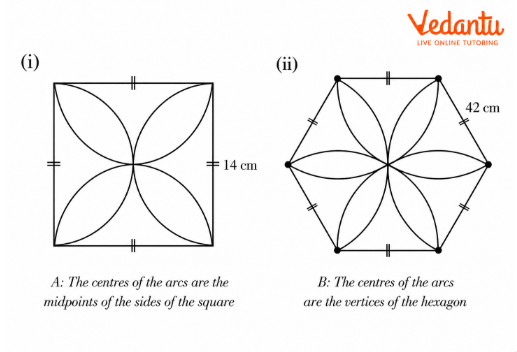
Question 7: Find the total perimeter of all the petals in each of the given flowers.
Solution:
(i)
The four petals are formed by four semicircular arcs, each with a diameter of 14 cm.
Radius of each semicircle = 7 cm
Total perimeter = 4πr
= 4 × 22/7 × 7
= 88 cm
(ii)
Six equal arcs form the six petals. Each arc belongs to a circle of radius 42 cm and subtends an angle of 120° at the centre.
Total perimeter:
= 6 × 120°/360° × 2πr
= 6 × 1/3 × 2 × 22/7 × 42
= 2 × 264
= 528 cm
Question 8: The ratio of the perimeters of two circles is 5: 4. What is the ratio of their radii?
Solution:
Let the radii of the two circles be r₁ and r₂.
Their circumferences are:
C₁ = 2πr₁
C₂ = 2πr₂
Given:
C₁ : C₂ = 5 : 4
Therefore:
2πr₁ : 2πr₂ = 5 : 4
Cancelling the common factor 2π:
r₁ : r₂ = 5 : 4
Hence, the ratio of their radii is 5:4.
Think and Reflect
In my school, the playground is too small for a 400 m track, so the school built a 200 m track instead. Does this mean that we need a smaller stagger for the race tracks in my school (i.e., smaller than the stagger used in the Olympics) for the same 4 × 100 m relay race?
Answer:
Yes. A 200 m track has smaller curved sections than a 400 m track. Because the difference in distance covered in the inner and outer lanes depends on the length of the curved sections, the difference in lane distances is smaller on a 200 m track.
Think and Reflect
How does this question relate to the one about the 400 m athletics track?
Answer:
Both questions involve finding the difference in lane distances on an athletics track. This difference determines the stagger in a relay race.
For a 400 m track, the runners cover longer curved sections, so the difference between lane distances is greater. For a 200 m track, the curved sections are shorter, so the difference is smaller. Thus, the track size directly affects the stagger needed for the same relay race.
Think and Reflect
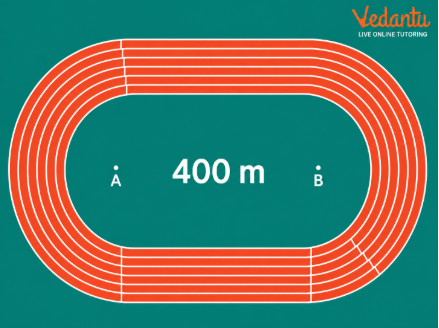
Question 1: What is the difference in radius between the first and second lanes? Use Fig. 6.11 to find the stagger needed by the runner in the second lane. Will the third and second lanes need an equal stagger?
Solution:
Each lane is 1.22 m wide. Therefore, the difference between the radii of the first and second lanes is:
Difference in radius = 1.22 m
The additional distance covered in the second lane occurs along the track's curved portions. The two semicircular curves together form one complete circle.
The extra distance covered in Lane 2 is:
Extra distance = 2π × difference in radius
= 2 × 22/7 × 1.22
= 7.67 m approximately
Therefore, the runner in the second lane needs a stagger of approximately 7.67 m.
Yes, the second and third lanes require an equal stagger because each lane is the same width. Hence, the difference between the radii of Lane 2 and Lane 3 is also 1.22 m.
What You Learn from Class 9 Maths NCERT Solutions Chapter 6 Exercise 6.1
Exercise 6.1 connects circle formulas with practical situations such as tracks, tyres, arcs, sectors, and curved shapes. It helps students:
Apply circumference, arc-length, and sector-perimeter formulas to different figures.
Break complex boundaries into simpler arcs and straight lines.
Convert measurements correctly while solving real-life problems.
Understand how radius and diameter affect circular distances.
Strengthen calculation skills through figure-based questions.
Use the Class 9 Maths Chapter 6 solutions PDF and PDF download option to check answers while practising.
For additional explanations and chapter-wise study material, students can visit Vedantu and explore NCERT Solutions Class 9 Maths.
Access Exercise-wise NCERT Solutions for Chapter 6 Maths Class 9
CBSE Class 9 Maths Chapter 6 Measuring Space: Perimeter and Area Study Materials
Chapter-Specific NCERT Solutions for Class 9 Maths
Additional Study Materials for Class 9 Maths


FAQs on Class 9 Maths Chapter 6 Measuring Space: Perimeter and Area Exercise 6.1 Solutions 2026-27
1. What is Class 9 Maths Chapter 6 Exercise 6.1 about?
Class 9 Maths Chapter 6 Exercise 6.1 mainly covers the perimeter and circumference of circles, arc lengths, sectors, and perimeters of shapes made with circular arcs.
2. How do you find the circumference of a circle in Exercise 6.1?
Use the formula C = 2πr when the radius is given or C = πd when the diameter is given. Substitute the given measurement and simplify.
3. What formula is used to find the length of an arc?
The arc-length formula is:
Arc length = (θ/360°) × 2πr
Here, θ is the angle at the centre, and r is the circle's radius.
4. How do you calculate the perimeter of a sector in Class 9 Maths Chapter 6 Exercise 6.1?
Add the length of the curved arc to the lengths of the two radii:
Perimeter of sector = Arc length + 2r
5. How is the perimeter of a circular shape found when it has both straight and curved sides?
Calculate the length of each curved and straight part that forms the outer boundary, then add them together. Include only the portions that form the perimeter.
6. How many revolutions will a tyre make over a given distance?
First, find the tyre's circumference. Then divide the total distance travelled by the distance covered in one revolution:
Number of revolutions = Total distance ÷ Circumference
7. What is the answer to Question 6 of Maths Class 9 Chapter 6 Exercise 6.1?
For a tyre with a diameter of 56 cm, one revolution covers 176 cm (1.76 m). For a distance of 10 km, the tyre makes approximately 5,682 revolutions.
8. Why is π taken as 22/7 in Class 9 Maths Chapter 6 Exercise 6.1?
The exercise specifies using 22/7 as the approximation for π, unless stated otherwise. Therefore, follow this value in your calculations.
9. How do you solve the flower-petal perimeter questions in Exercise 6.1?
Identify the number and type of arcs forming the petals, find the length of one arc, and multiply it by the required number of arcs. The given radius and central angle determine the arc length.
10. What is the answer to Question 8 in Class 9 Maths Chapter 6 Exercise 6.1?
The ratio of the perimeters of two circles is 5:4. Since a circle's circumference is directly proportional to its radius, the ratio of their radii is also 5:4.
11. Where can I find NCERT Class 9 Maths Chapter 6 Exercise 6.1 solutions?
You can find NCERT Class 9 Maths Chapter 6 Exercise 6.1 solutions on this page with step-by-step explanations for questions based on circumference, arcs, sectors, and perimeters.
12. How can Class 9 Maths NCERT Chapter 6 Exercise 6.1 solutions help me?
Class 9 Maths NCERT Chapter 6 Exercise 6.1 solutions help you understand the method behind each problem and check your calculations while practising the exercise.
13. What topics are covered in Maths Class 9 Chapter 6 Exercise 6.1 solutions?
The Maths Class 9 Chapter 6 Exercise 6.1 solutions cover circumference, arc length, sector perimeter, circular shapes, tyre revolutions, flower-petal figures, and ratios of circle perimeters.
14. Where can I check Maths Class 9 NCERT solutions Chapter 6 Exercise 6.1?
You can use the Maths Class 9 NCERT solutions Chapter 6 Exercise 6.1 on this Vedantu page to compare your answers and understand the steps used in each question. You can also download a PDF to keep the solutions handy for practice.
15. Where can I get more Class 9 Maths Chapter 6 study material?
For more chapter-wise explanations, NCERT solutions, notes, and other learning resources, you can visit Vedantu and explore its NCERT Solutions Class 9 Maths section.