


 Watch Video




NCERT Solutions for Class 9 Maths Chapter 6 Exercise 6.2


Class 9 Maths Chapter 6 Measuring Space: Perimeter and Area Exercise 6.2 Solutions 2026-27


 ShareShare
Think and Reflect
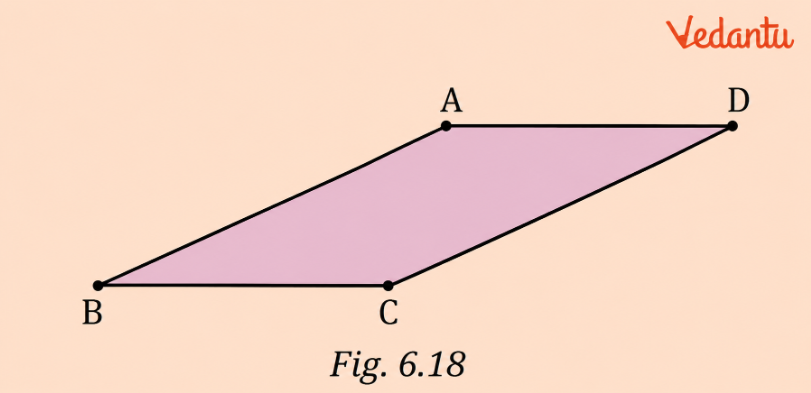
What happens if the parallelogram is ‘thin’ (Fig. 6.18) and the foot of the perpendicular from C to AD does not lie on side AD? The construction then does not seem to work. How do we fix this ‘gap’?
Answer:
If the parallelogram is very thin, the perpendicular from C may meet the line AD extended instead of falling on side AD.
To fix this, extend AD beyond the parallelogram until the perpendicular from C meets it. The perpendicular distance is still the height of the parallelogram because AD and BC are parallel.
Therefore,
Area of parallelogram = Base × Height
So, even if the foot of the perpendicular lies outside side AD, extending the base allows us to use the same construction and area formula.
Think and Reflect
We can find the area of a rectangle when we know the lengths of its sides. Is the same true for a parallelogram? That is, can we find the area of a parallelogram when we know the lengths of its sides? Why or why not?
Answer:
No. Knowing only a parallelogram's side lengths is not enough to determine its area.
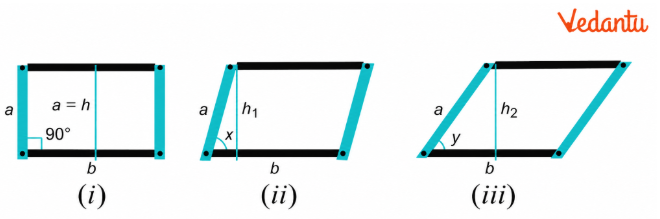
Consider four sticks, two of length a and two of length b, joined at their ends. When these sticks form a rectangle, all the angles are fixed at 90°. Therefore, one side also gives the perpendicular height.
If the base is b and the height is h, then:
Area = b × h
However, you can tilt the same four sticks to form different parallelograms without changing their side lengths. As the parallelogram tilts, its perpendicular height decreases.
If the corresponding heights are h, h₁ and h₂, where:
h > h₁ > h₂
then:
bh > bh₁ > bh₂
Thus, parallelograms with the same side lengths can have different areas. Hence, we also need the corresponding height, or other information that determines the height, to calculate the area of a parallelogram.
Think and Reflect
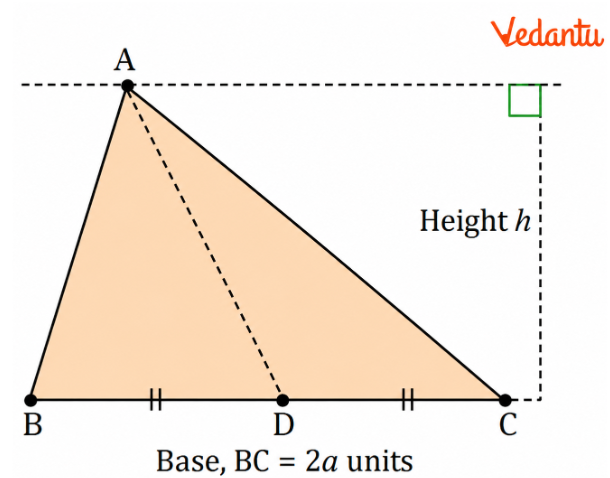
Since ΔABD and ΔACD have equal area, you may wonder — Can we divide ΔABD using straight cuts into two or more pieces that we can then rearrange to cover ΔACD exactly? What do you think? Is it possible?
Answer:
Yes, it is possible.
Since ΔABD and ΔACD have equal areas, we can divide ΔABD into a finite number of pieces with straight cuts and rearrange them to cover ΔACD exactly.
For example, make a cut along DE such that:
DE ∥ AC
This divides ΔABD into two pieces. After rearranging, ΔAED can cover the corresponding region ΔDE′A, while ΔBED can cover the remaining region ΔDE′C.
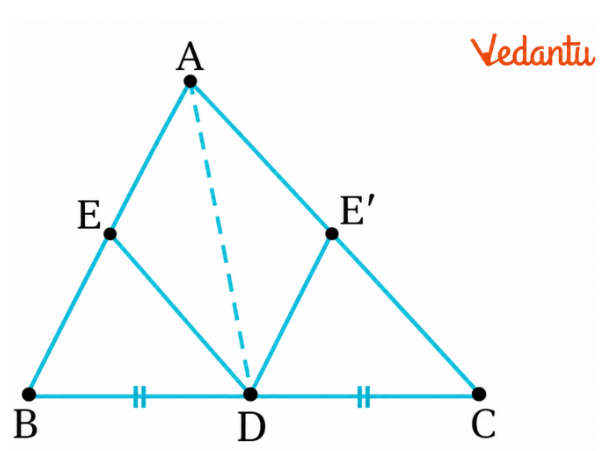
Thus, we can cut ΔABD into suitable pieces and rearrange them to cover ΔACD exactly.
Think and Reflect
Suppose we are given two polygons P and Q with equal area. Is it always possible to divide one of them with straight cuts into two or more pieces and then rearrange the pieces to cover the other polygon exactly? Try this out for familiar shapes, e.g.,
1. A square and a non-square rectangle with equal area,
2. Two triangles with different shapes but equal area,
3. A triangle and a square with equal area. Formulate a conjecture of your own about this.
Think of various rectangles with perimeter 40 units (the sides do not have to be integers).
1. How many such rectangles are there?
2. Among them, is there one whose area is the largest? What are its dimensions?
3. Among all these rectangles, is there one whose area is the smallest? What are its dimensions? Do either of these answers come as a surprise to you?
Answer:
Part 1: Polygons with Equal Areas
1. A square and non-square rectangle with equal area
Consider a square of dimensions 4 × 4 units.
Area of square:
= 4 × 4
= 16 square units
Now consider a rectangle of dimensions 2 × 8 units.
Area of rectangle:
= 2 × 8
= 16 square units
Since their areas are equal, you can divide the square with suitable straight cuts and rearrange its pieces to form the rectangle.
2. Two triangles with different shapes but equal area
Two triangles may have very different shapes and still have equal areas.
Each triangle can be divided and rearranged to form an equivalent rectangle. If both triangles can be transformed into the same equal-area rectangle, you can also rearrange the pieces to transform one triangle into the other.
3. A triangle and a square with equal area
This is also possible, although it may require more steps.
A convenient sequence is:
Triangle → Rectangle → Square
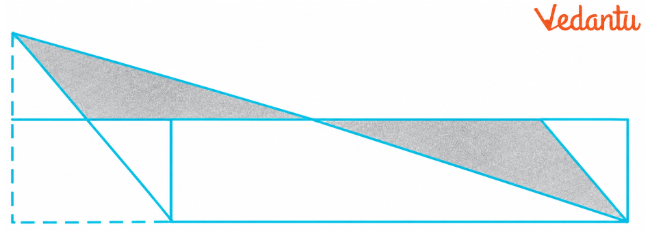
First, transform the triangle into a rectangle of equal area. Then, the rectangle is transformed into a square with the same area.
Conjecture: Two simple polygons having the same area can be divided into a finite number of polygonal pieces that can be rearranged to form one another.
Rectangles with Perimeter 40 Units
Let the sides of a rectangle be x and y units.
Given:
2(x + y) = 40
Therefore,
x + y = 20
So,
y = 20 − x
Area of the rectangle:
A = xy
A = x(20 − x)
1. How many such rectangles are there?
Since x can take any positive real value between 0 and 20, there are infinitely many such rectangles.
For example:
10 × 10
15 × 5
19 × 1
19.5 × 0.5
All these rectangles have a perimeter of 40 units.
2. Among them, is there one whose area is the largest? What are its dimensions?
Yes. The area is largest when the two sides are equal.
Therefore,
x = y = 10 units
Area:
= 10 × 10
= 100 square units
Hence, the rectangle with the largest area is a 10-unit × 10-unit square, and its area is 100 square units.
3. Among all these rectangles, is there one whose area is the smallest? What are its dimensions? Do either of these answers come as a surprise to you?
There is no rectangle with a smallest positive area.
As one side approaches 0, the other side approaches 20, and the area becomes closer and closer to 0.
For example, if:
x = 0.0001
then:
y = 19.9999
Its area is very close to 0.
However, x cannot actually be 0 because the figure would then become a line segment rather than a rectangle.
Therefore, the area can approach 0, but no valid rectangle has a minimum area.
Interestingly, the square gives the maximum area for a fixed perimeter, while no rectangle has the smallest positive area.
Think and Reflect
What procedure would you use to square a given triangle? Here, the task is to construct a square with the same area as the given triangle. Think carefully. How would you proceed?
Answer:
To square a triangle means to construct a square with the same area as the given triangle.
A useful procedure is:
Triangle → Rectangle → Square
Step 1: Convert the Triangle into an Equal-Area Rectangle
Consider ΔABC with base BC = b and corresponding height AD = h.
Area of ΔABC:
= ½ × b × h
= ½bh
Now construct a rectangle with length b and breadth ½h.
Area of rectangle:
= b × ½h
= ½bh
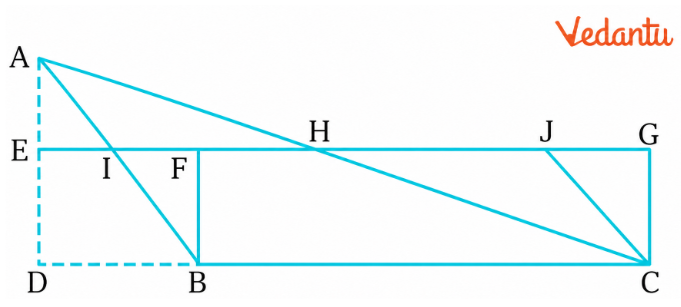
Therefore, the rectangle and ΔABC have equal areas.
Step 2: Convert the Rectangle into an Equal-Area Square
Now construct a square having the same area as this rectangle.
If s is the side of the required square:
s² = ½bh
Therefore,
s = √(bh/2)
Hence, a square with side √(bh/2) has the same area as the given triangle.
Exercise Set 6.2
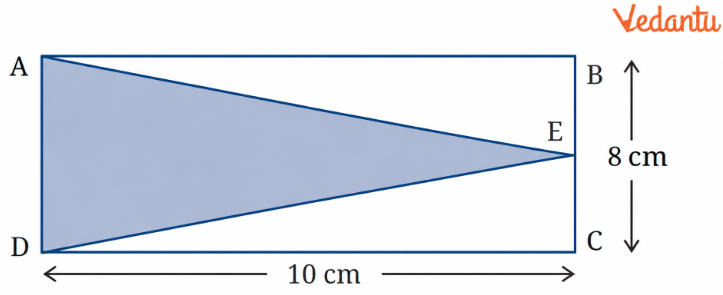
1. Find the area of triangle ADE in Fig. 6.31.
Solution:
From Fig. 6.31:
AD = BC = 8 cm
The corresponding height DC = 10 cm.
Area of a triangle:
= ½ × Base × Height
Therefore,
Area of ΔADE
= ½ × 8 × 10
= 40 cm²
Hence, the area of ΔADE is 40 cm².
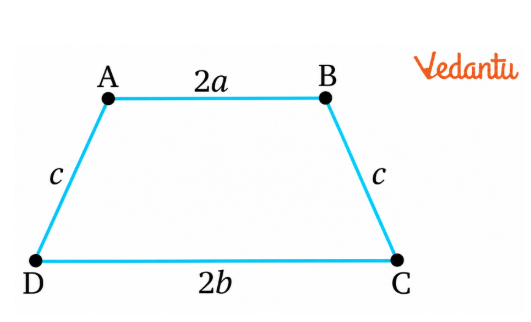
2. The parallel sides of a trapezium are 40 cm and 20 cm. If the non-parallel sides are equal, each 26 cm, find the area of the trapezium.
Solution:
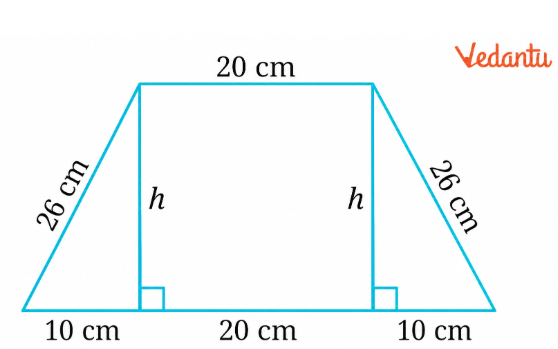
The parallel sides are 40 cm and 20 cm, while each non-parallel side is 26 cm.
To calculate the area, first find the trapezium's height.
Difference between the parallel sides:
= 40 − 20
= 20 cm
Since the non-parallel sides are equal, divide this difference equally at both ends.
Therefore,
20 ÷ 2 = 10 cm
Let the height be h cm.
Using the Baudhayana-Pythagoras theorem:
10² + h² = 26²
100 + h² = 676
h² = 576
h = 24 cm
Now,
Area of trapezium
= ½ × (Sum of parallel sides) × Height
= ½ × (40 + 20) × 24
= ½ × 60 × 24
= 720 cm²
Hence, the area of the trapezium is 720 cm².
3. Find the area of a triangle, given that its sides are 8 cm and 11 cm long, and its perimeter is 32 cm.
Solution:
Let the third side of the triangle be c cm.
Given:
8 + 11 + c = 32
19 + c = 32
c = 13 cm
Therefore, the three sides are:
8 cm, 11 cm and 13 cm
Semi-perimeter:
s = (8 + 11 + 13)/2
= 32/2
= 16 cm
Using Heron’s formula:
Area = √[s(s − a)(s − b)(s − c)]
= √[16(16 − 8)(16 − 11)(16 − 13)]
= √(16 × 8 × 5 × 3)
= √1920
= 8√30 cm²
Hence, the area of the triangle is 8√30 cm².
4. The sides of a triangular plot are in the ratio 3: 5: 7; its perimeter is 300 m. Find its area.
Solution:
Let the sides be:
3x, 5x and 7x
Given:
3x + 5x + 7x = 300
15x = 300
x = 20
Therefore, the sides are:
3 × 20 = 60 m
5 × 20 = 100 m
7 × 20 = 140 m
Semi-perimeter:
s = 300/2
= 150 m
Using Heron’s formula:
Area = √[s(s − a)(s − b)(s − c)]
= √[150(150 − 60)(150 − 100)(150 − 140)]
= √(150 × 90 × 50 × 10)
= 1500√3 m²
≈ 2598.08 m²
Hence, the area of the triangular plot is 1500√3 m², or approximately 2598.08 m².
5. One diagonal of a rhombus is twice as long as the other diagonal. If the rhombus has area 128 cm², find the length of the shorter diagonal.
Solution:
Let the shorter diagonal be x cm.
Then the longer diagonal is:
2x cm
Area of a rhombus:
= ½ × d₁ × d₂
Therefore,
128 = ½ × x × 2x
128 = x²
x = √128
x = √(64 × 2)
x = 8√2 cm
Using √2 ≈ 1.414:
x ≈ 8 × 1.414
x ≈ 11.31 cm
Hence, the shorter diagonal is 8√2 cm, or approximately 11.31 cm.
6. ABCD is a parallelogram. P and Q are any two points on side AB. What can you say about the ratio area (ΔPCD): area (ΔQCD)?
Solution:
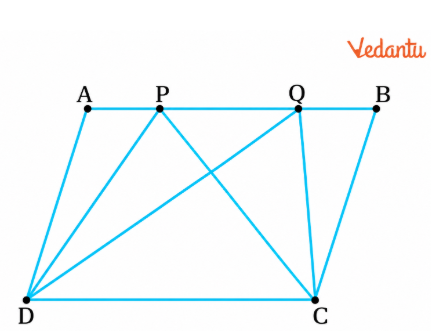
P and Q lie on side AB.
Both ΔPCD and ΔQCD have the same base CD.
Since ABCD is a parallelogram:
AB ∥ CD
Therefore, P and Q are equidistant from CD. Hence, both triangles have the same base and equal heights.
So,
Area (ΔPCD) = Area (ΔQCD)
Therefore,
Area (ΔPCD) : Area (ΔQCD) = 1 : 1
7. O is any point on the diagonal PR of a parallelogram PQRS. Prove that the areas of triangles PSO and PQO are equal.
Solution:
Draw diagonal QS and let it intersect PR at T.
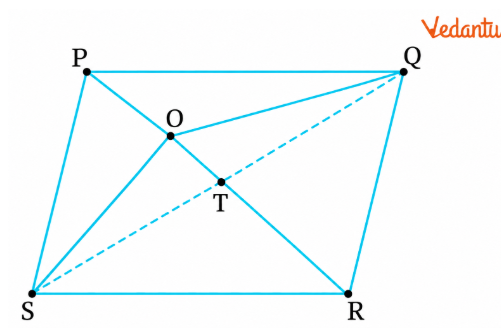
Since the diagonals of a parallelogram bisect each other, T is the midpoint of QS.
In ΔPSQ, PT is a median.
Therefore,
Area (ΔPST) = Area (ΔPQT) …(i)
Similarly, in ΔOSQ, OT is a median.
Therefore,
Area (ΔOST) = Area (ΔOQT) …(ii)
Subtracting equation (ii) from equation (i):
Area (ΔPST) − Area (ΔOST)
= Area (ΔPQT) − Area (ΔOQT)
Therefore,
Area (ΔPSO) = Area (ΔPQO)
Hence proved.
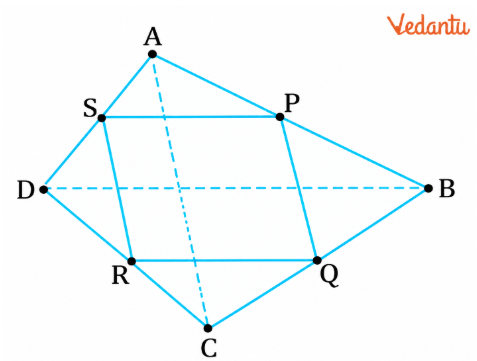
8. If the mid-points of the sides of a 4-gon (also known as a quadrilateral, but we prefer to call it a ‘4-gon’) are joined in order, prove that the area of the parallelogram thus formed will be half of the area of the given 4-gon. (You may wonder whether the 4-gon thus formed is always a parallelogram, and if so, why? These questions will be tackled and answered in the chapter on quadrilaterals.)
Solution:
Let ABCD be the given 4-gon, and let P, Q, R and S be the midpoints of AB, BC, CD and DA, respectively.
Join P, Q, R and S to form parallelogram PQRS.
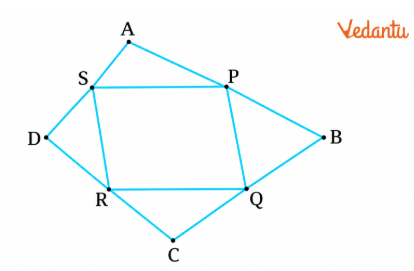
In ΔABC, P and Q are the midpoints of AB and BC.
Therefore,
PQ ∥ AC
and
PQ = ½AC
Hence,
Area (ΔPBQ) = ¼ Area (ΔABC) …(i)
Similarly,
Area (ΔSDR) = ¼ Area (ΔADC) …(ii)
Adding equations (i) and (ii):
Area (ΔPBQ) + Area (ΔSDR)
= ¼[Area (ΔABC) + Area (ΔADC)]
= ¼ Area (4-gon ABCD) …(iii)
Similarly,
Area (ΔPAS) + Area (ΔQCR)
= ¼ Area (4-gon ABCD) …(iv)
Adding equations (iii) and (iv):
Area of the four corner triangles
= ¼ Area (ABCD) + ¼ Area (ABCD)
= ½ Area (ABCD)
Therefore,
Area (PQRS)
= Area (ABCD) − ½ Area (ABCD)
= ½ Area (ABCD)
Hence,
Area (PQRS) = ½ Area (4-gon ABCD)
Hence proved.
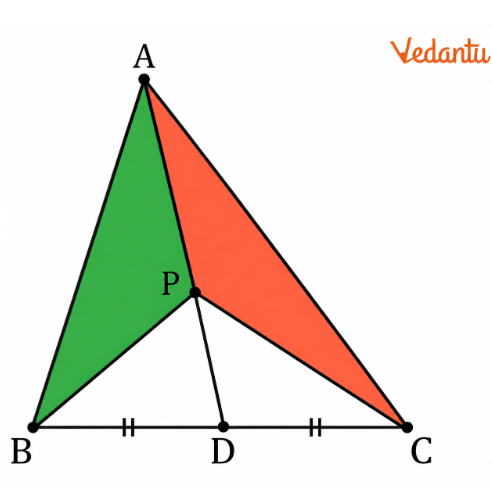
9. In ΔABC, the midpoint of BC is D (Fig. 6.32). Median AD is drawn. P is any point on AD. Show that area (ΔABP) = area (ΔACP).
Solution:
AD is a median of ΔABC.
Therefore, it divides ΔABC into two triangles of equal area.
So,
Area (ΔABD) = Area (ΔACD) …(i)
Also, D is the midpoint of BC. Therefore, PD is a median of ΔBPC.
Hence,
Area (ΔBPD) = Area (ΔCPD) …(ii)
Subtracting equation (ii) from equation (i):
Area (ΔABD) − Area (ΔBPD)
= Area (ΔACD) − Area (ΔCPD)
Therefore,
Area (ΔABP) = Area (ΔACP)
Hence proved.
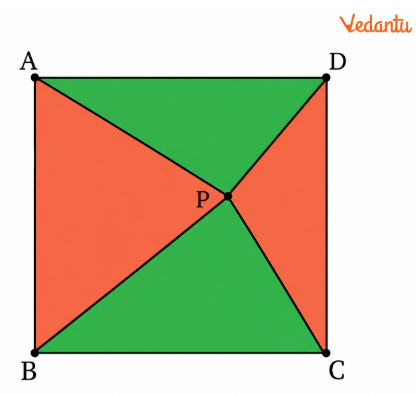
10. Given a square ABCD, let P be a point within it. Join PA, PB, PC, PD (Fig. 6.33). What is the ratio of the areas of the red region (ΔPAB and ΔPCD) and the green region (ΔPBC and ΔPDA)?
Solution:
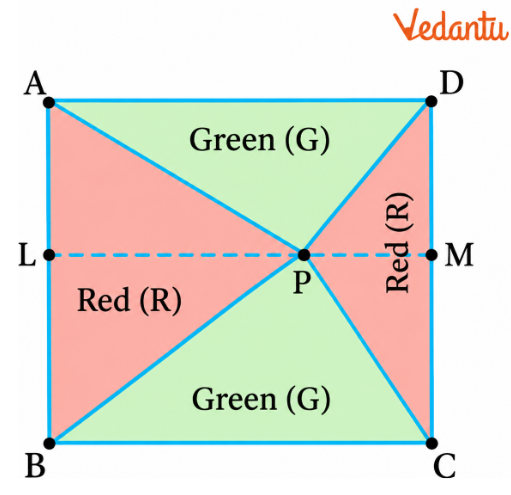
Through P, draw LM ∥ BC. This divides square ABCD into two rectangles.
ΔPBC and rectangle LMCB have the same base BC and lie between the same parallels.
Therefore,
Area (ΔPBC) = ½ Area (LMCB) …(i)
Similarly, ΔPDA and rectangle LMDA have the same base AD and lie between the same parallels.
Therefore,
Area (ΔPDA) = ½ Area (LMDA) …(ii)
Adding equations (i) and (ii):
Area (ΔPBC) + Area (ΔPDA)
= ½[Area (LMCB) + Area (LMDA)]
= ½ Area (square ABCD)
Therefore,
Area of green region = ½ Area (square ABCD)
Similarly, by drawing a line through P parallel to AB:
Area (ΔPAB) + Area (ΔPCD)
= ½ Area (square ABCD)
Therefore,
Area of red region = ½ Area (square ABCD)
Hence,
Area of red region: Area of green region = 1: 1
11. In ΔABC, D is the midpoint of AB. P is any point on BC, and Q is a point on AB such that CQ ∥ PD. PQ is joined (Fig. 6.34). Prove that Area (ΔBPQ) = ½ Area (ΔABC).
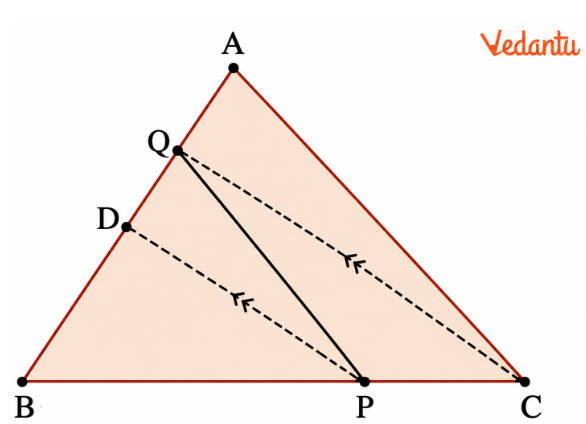
Solution:
Given:
D is the midpoint of AB
and
CQ ∥ PD
Join DC.
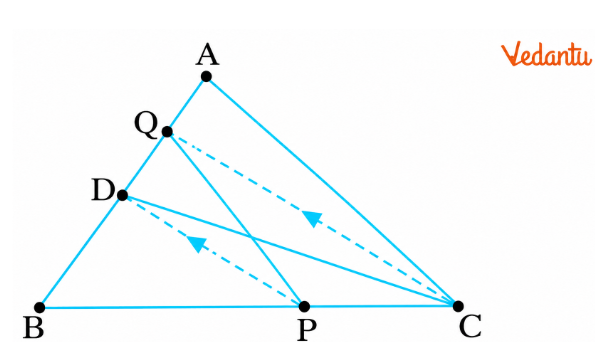
Since D is the midpoint of AB, CD is a median of ΔABC.
Therefore,
Area (ΔBDC) = ½ Area (ΔABC) …(i)
Now, ΔDPC and ΔDPQ have the same base DP and lie between the same parallels DP and CQ.
Therefore,
Area (ΔDPC) = Area (ΔDPQ) …(ii)
Also,
Area (ΔBDC)
= Area (ΔBPD) + Area (ΔDPC)
Using equation (ii):
Area (ΔBDC)
= Area (ΔBPD) + Area (ΔDPQ)
= Area (ΔBPQ) …(iii)
From equations (i) and (iii):
Area (ΔBPQ) = ½ Area (ΔABC)
Hence proved.
Understand Exercise 6.2 with Step-by-Step NCERT Solutions for Measuring Space: Perimeter and Area
The Maths Class 9 Chapter 6 Exercise 6.2 Solutions help students move from basic area calculations to questions that require geometric reasoning. This exercise covers the area of triangles and trapeziums, Heron’s formula, diagonals of a rhombus, equal-area triangles, medians, parallelograms and area-based proofs. While practising, students should identify the correct base and height, observe parallel lines and understand why a particular area property applies. After attempting the questions, using the NCERT Maths Solutions Class 9 Chapter 6 Exercise 6.2 can help students identify calculation mistakes, strengthen geometry concepts, and revise Chapter 6 more confidently for the 2026-27 academic year.
Students can also download the Class 9 Maths Chapter 6 Exercise 6.2 Solutions PDF for easy revision. Keep it handy to review the step-by-step solutions and practise the exercise whenever needed.
Access Exercise-wise NCERT Solutions for Chapter 6 Maths Class 9
CBSE Class 9 Maths Chapter 6 Measuring Space: Perimeter and Area Study Materials
Chapter-Specific NCERT Solutions for Class 9 Maths
Additional Study Materials for Class 9 Maths


FAQs on Class 9 Maths Chapter 6 Measuring Space: Perimeter and Area Exercise 6.2 Solutions 2026-27
1. What is Class 9 Maths Chapter 6 Exercise 6.2 about?
Class 9 Maths Chapter 6 Exercise 6.2 covers the areas of triangles, trapeziums, rhombuses, parallelograms, and other figures. It also includes Heron’s formula, medians, equal-area relationships and geometry-based proofs.
2. How many questions are there in Class 9 Maths Chapter 6 Exercise 6.2?
Exercise Set 6.2 contains 11 questions. They include numerical problems and questions that require students to prove relationships between the areas of geometric figures.
3. Which formulas are important for Class 9 Maths Exercise 6.2?
Important formulas include:
Area of triangle = ½ × Base × Height
Area of trapezium = ½ × (Sum of parallel sides) × Height
Heron’s formula = √[s(s − a)(s − b)(s − c)]
Area of rhombus = ½ × d₁ × d₂
4. What is Heron’s formula in Class 9 Maths Chapter 6?
For a triangle with sides a, b and c, first calculate the semi-perimeter:
s = (a + b + c)/2
Then:
Area = √[s(s − a)(s − b)(s − c)]
It is useful when you know all three sides of a triangle but not the height.
5. How do you find the area of a trapezium in Exercise 6.2?
The area of a trapezium is calculated using:
Area = ½ × (Sum of parallel sides) × Height
If the height is not given directly, it may first need to be calculated using the other dimensions provided in the question.
6. Does a median divide a triangle into two equal areas?
Yes. A median joins a vertex to the midpoint of the opposite side. The two triangles formed have equal bases and the same perpendicular height, so their areas are equal.
7. Are there proof-based questions in Class 9 Maths Chapter 6 Exercise 6.2?
Yes. Exercise 6.2 includes proof-based questions involving parallelograms, medians, midpoints, parallel lines and triangles with equal areas.
8. What is the area of the trapezium in Question 2 of Exercise 6.2?
The parallel sides are 40 cm and 20 cm, and the equal non-parallel sides are 26 cm. The perpendicular height is 24 cm, so the area is 720 cm².
9. What is the answer to Question 5 of Class 9 Maths Exercise 6.2?
The shorter diagonal of the rhombus is 8√2 cm, which is approximately 11.31 cm.
10. How can I prepare for Class 9 Maths Chapter 6 Exercise 6.2?
First, revise the area formulas and properties of triangles, trapeziums, rhombuses and parallelograms. Then attempt every question independently before checking the step-by-step NCERT solutions. Pay particular attention to diagrams, parallel lines, medians and the corresponding height used in area calculations.