



Draw a diagram of nephron and explain its structure.
Answer
 Verified
596.3k+ views
Hint: Nephron is the functional and structural unit of the kidneys that consists of glomerulus and its associated tubules to which the glomerular filtrate passes before it emerges in urine. There are about millions of nephrons present in the kidney.
Complete Answer:
1) Nephrons are the structural units that are composed of a renal corpuscle and renal tubule. It is a tube-like structure and 30-55mm long in length.
2) Renal tubule is a long, convoluted structure that emerges from glomerulus and further divided into 3 parts: proximal convoluted tubule (PCT); Henle’s loop; distal convoluted tubule.
3) PCT stays in the renal cortex due to its proximity to the glomerulus. The second part is Henle’s loop is also called a nephritic loop because it forms a loop that goes through renal medulla. Distal convoluted tubule which is the third part of renal tubule is also restricted to the renal cortex.
4) A cup-like structure called Bowman's capsule in which capillaries of glomerulus are enclosed. Then Bowman’s capsule extends to highly coiled tubules called proximal convoluted tubules (PCT).
5) PCT continues to form a Henle’s loop that ascends to DCT and which in turn opens into the collecting duct. Collecting duct is straight, long where potassium and hydrogen ions are secreted to maintain the electrolytic balance of blood.
6) Renal corpuscle consists of glomerulus that is surrounded by Bowman’s capsule. Glomerulus arises from afferent arteriole and empty in efferent arteriole.
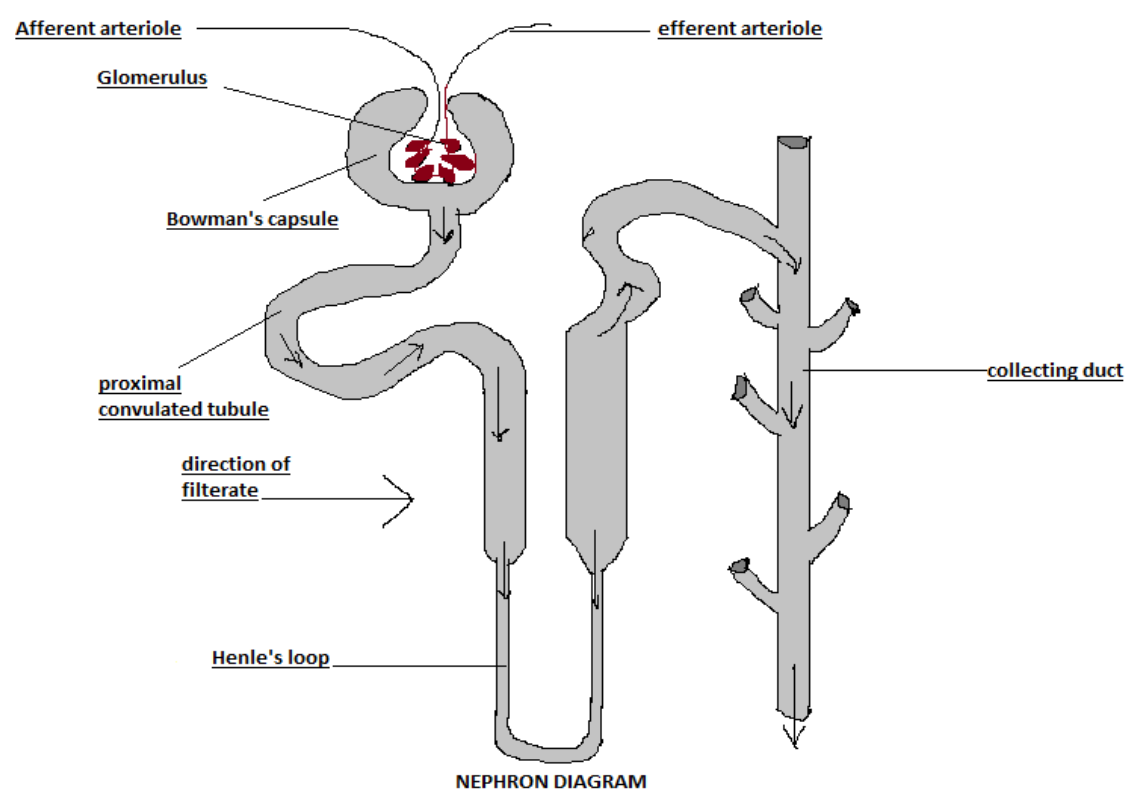
Note: In collecting duct, maximum reabsorption of water takes place which produces concentrated urine. Efferent arterioles have smaller diameters because it helps in maintaining the high blood pressure in glomerulus.
Complete Answer:
1) Nephrons are the structural units that are composed of a renal corpuscle and renal tubule. It is a tube-like structure and 30-55mm long in length.
2) Renal tubule is a long, convoluted structure that emerges from glomerulus and further divided into 3 parts: proximal convoluted tubule (PCT); Henle’s loop; distal convoluted tubule.
3) PCT stays in the renal cortex due to its proximity to the glomerulus. The second part is Henle’s loop is also called a nephritic loop because it forms a loop that goes through renal medulla. Distal convoluted tubule which is the third part of renal tubule is also restricted to the renal cortex.
4) A cup-like structure called Bowman's capsule in which capillaries of glomerulus are enclosed. Then Bowman’s capsule extends to highly coiled tubules called proximal convoluted tubules (PCT).
5) PCT continues to form a Henle’s loop that ascends to DCT and which in turn opens into the collecting duct. Collecting duct is straight, long where potassium and hydrogen ions are secreted to maintain the electrolytic balance of blood.
6) Renal corpuscle consists of glomerulus that is surrounded by Bowman’s capsule. Glomerulus arises from afferent arteriole and empty in efferent arteriole.
Note: In collecting duct, maximum reabsorption of water takes place which produces concentrated urine. Efferent arterioles have smaller diameters because it helps in maintaining the high blood pressure in glomerulus.
Recently Updated Pages
If x a + bt + ct2 where x is in meters and t is in class 11 physics CBSE

A car covers the first half distance between two places class 11 physics CBSE
The resultant of two vectors overrightarrow P and overrightarrow class 11 physics CBSE
Find the value of cos 135 class 11 maths CBSE
A mass M is held in place by an applied force F and class 11 physics CBSE
A solution of glucose in water is labelled as 10 dfracwv class 11 chemistry CBSE
Trending doubts
One Metric ton is equal to kg A 10000 B 1000 C 100 class 11 physics CBSE
Find the value of the expression given below sin 30circ class 11 maths CBSE
Draw a diagram of nephron and explain its structur class 11 biology CBSE
10 examples of friction in our daily life
Proton was discovered by A Thomson B Rutherford C Chadwick class 11 chemistry CBSE
Bond order ofO2 O2+ O2 and O22 is in order A O2 langle class 11 chemistry CBSE