




State and derive law of conservation of momentum.
Answer
 Verified
637.2k+ views
Hint: We need to understand the fundamental principles in the mechanics to understand the property of momentum and the laws which govern the linear momentum. The conservation law of linear momentum can be derived from Newton’s laws of motion.
Complete answer:
The linear momentum is defined as the combined effect of mass and velocity of an object experienced by another object which interacts with the former. The linear momentum is the product of the mass of a body and the velocity at which it travels. It is mathematically given as –
\[p=mv\]
A body which moves with a velocity ‘v’ can cause an impact on another object which collides with this body.
The conservation of linear momentum states that the linear momentum possessed by a system before and after collision will remain a constant, given that no external forces act in the system, i.e., there is no chance of acceleration.
Let us consider two particles moving against each other with forces \[{{F}_{1}}\text{ and }{{F}_{2}}\].
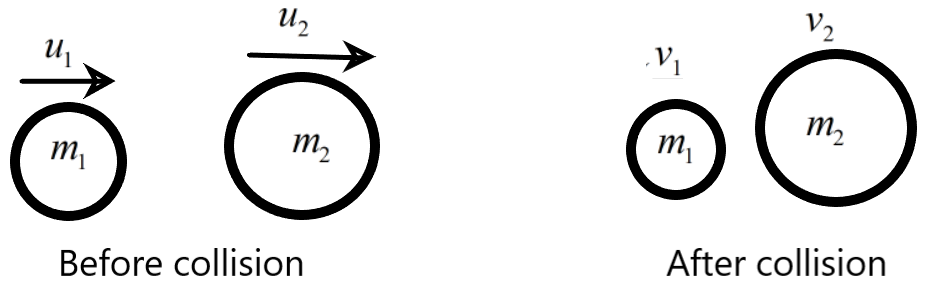
According to Newton's third law of motion, we know that every action has an equal and opposite reaction. So, once the two objects each of mass \[{{m}_{1}}\text{ and }{{m}_{2}}\] collide with each other, the forces acting will be equal and opposite. So, we can derive the momentum (let ‘v’ represent the final velocity of each mass after collision and ‘u’ represent the initial velocity before collision) as –
\[\begin{align}
& {{F}_{1}}={{m}_{1}}{{a}_{1}} \\
& \Rightarrow {{F}_{1}}={{m}_{1}}(\dfrac{{{v}_{1}}-{{u}_{1}}}{t}) \\
& \text{and,} \\
& {{F}_{2}}={{m}_{2}}{{a}_{2}} \\
& \Rightarrow {{F}_{2}}={{m}_{2}}(\dfrac{{{v}_{2}}-{{u}_{2}}}{t}) \\
\end{align}\]
\[\begin{align}
& \text{Now,} \\
& {{F}_{1}}=-{{F}_{2}} \\
& \Rightarrow {{m}_{1}}(\dfrac{{{v}_{1}}-{{u}_{1}}}{t})={{m}_{2}}(\dfrac{{{v}_{2}}-{{u}_{2}}}{t}) \\
& \Rightarrow {{m}_{1}}{{v}_{1}}-{{m}_{1}}{{u}_{1}}={{m}_{2}}{{v}_{2}}-{{m}_{2}}{{u}_{2}} \\
& \therefore {{m}_{1}}{{u}_{1}}+{{m}_{2}}{{u}_{2}}={{m}_{1}}{{v}_{1}}+{{m}_{2}}{{v}_{2}} \\
\end{align}\]
We understand that the sum of the initial momenta of the two bodies is equal to the sum of the final momenta. Thus, the law of conservation of momentum is proved.
This is the required solution.
Note:
The conservation of linear momentum is valid only when there is no external net force acting on the masses involved in the system. We can apply the law of conservation of energy in such cases where there is an external force in the system.
Complete answer:
The linear momentum is defined as the combined effect of mass and velocity of an object experienced by another object which interacts with the former. The linear momentum is the product of the mass of a body and the velocity at which it travels. It is mathematically given as –
\[p=mv\]
A body which moves with a velocity ‘v’ can cause an impact on another object which collides with this body.
The conservation of linear momentum states that the linear momentum possessed by a system before and after collision will remain a constant, given that no external forces act in the system, i.e., there is no chance of acceleration.
Let us consider two particles moving against each other with forces \[{{F}_{1}}\text{ and }{{F}_{2}}\].
According to Newton's third law of motion, we know that every action has an equal and opposite reaction. So, once the two objects each of mass \[{{m}_{1}}\text{ and }{{m}_{2}}\] collide with each other, the forces acting will be equal and opposite. So, we can derive the momentum (let ‘v’ represent the final velocity of each mass after collision and ‘u’ represent the initial velocity before collision) as –
\[\begin{align}
& {{F}_{1}}={{m}_{1}}{{a}_{1}} \\
& \Rightarrow {{F}_{1}}={{m}_{1}}(\dfrac{{{v}_{1}}-{{u}_{1}}}{t}) \\
& \text{and,} \\
& {{F}_{2}}={{m}_{2}}{{a}_{2}} \\
& \Rightarrow {{F}_{2}}={{m}_{2}}(\dfrac{{{v}_{2}}-{{u}_{2}}}{t}) \\
\end{align}\]
\[\begin{align}
& \text{Now,} \\
& {{F}_{1}}=-{{F}_{2}} \\
& \Rightarrow {{m}_{1}}(\dfrac{{{v}_{1}}-{{u}_{1}}}{t})={{m}_{2}}(\dfrac{{{v}_{2}}-{{u}_{2}}}{t}) \\
& \Rightarrow {{m}_{1}}{{v}_{1}}-{{m}_{1}}{{u}_{1}}={{m}_{2}}{{v}_{2}}-{{m}_{2}}{{u}_{2}} \\
& \therefore {{m}_{1}}{{u}_{1}}+{{m}_{2}}{{u}_{2}}={{m}_{1}}{{v}_{1}}+{{m}_{2}}{{v}_{2}} \\
\end{align}\]
We understand that the sum of the initial momenta of the two bodies is equal to the sum of the final momenta. Thus, the law of conservation of momentum is proved.
This is the required solution.
Note:
The conservation of linear momentum is valid only when there is no external net force acting on the masses involved in the system. We can apply the law of conservation of energy in such cases where there is an external force in the system.
Recently Updated Pages
If x a + bt + ct2 where x is in meters and t is in class 11 physics CBSE

A car covers the first half distance between two places class 11 physics CBSE
The resultant of two vectors overrightarrow P and overrightarrow class 11 physics CBSE
Find the value of cos 135 class 11 maths CBSE
A mass M is held in place by an applied force F and class 11 physics CBSE
A solution of glucose in water is labelled as 10 dfracwv class 11 chemistry CBSE
Trending doubts
Find the value of the expression given below sin 30circ class 11 maths CBSE
One Metric ton is equal to kg A 10000 B 1000 C 100 class 11 physics CBSE
Draw a diagram of nephron and explain its structur class 11 biology CBSE
10 examples of friction in our daily life
Proton was discovered by A Thomson B Rutherford C Chadwick class 11 chemistry CBSE
Bond order ofO2 O2+ O2 and O22 is in order A O2 langle class 11 chemistry CBSE